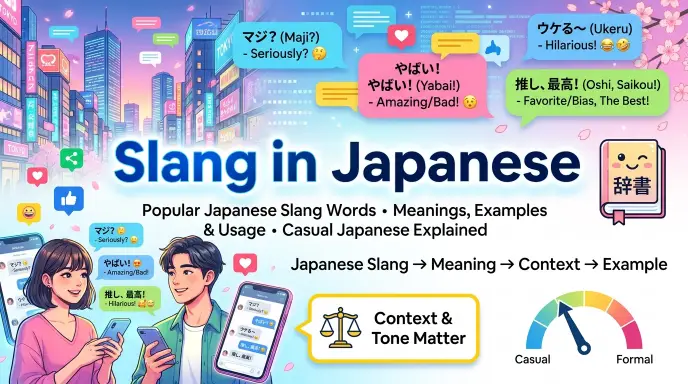
Slang in Japanese is called スラング (surangu), a Japanese loanword meaning “slang.” Japanese speakers also use many informal words and expressions that may sound very different from textbook Japanese.
These expressions appear in casual conversations, anime, gaming, texting, social media, and youth culture.
Japanese slang can be tricky for beginners because the meaning often depends on age, relationship, region, situation, and tone. A word that sounds friendly between close friends may sound rude when said to a stranger or older person.
This guide explains what slang means in Japanese, common Japanese slang words, how they are used online, and which expressions learners should avoid in formal situations
What Is Slang in Japanese?
Slang in Japanese is called スラング (surangu), and Japanese slang includes informal words and expressions used in casual speech, texting, social media, gaming, and popular culture.
Common examples include ヤバい (yabai), マジ (maji), ウケる (ukeru), めっちゃ (meccha), and ウザい (uzai). Their meaning can change with context and tone.
Quick Answer Table
| Japanese Slang | Romaji | General Meaning |
| スラング | surangu | Slang |
| ヤバい | yabai | Crazy, awesome, bad, dangerous |
| マジ | maji | Seriously, really |
| めっちゃ | meccha | Very, extremely |
| ウケる | ukeru | Funny, hilarious |
| ウザい | uzai | Annoying |
| キモい | kimoi | Gross, creepy |
| ダサい | dasai | Uncool, lame |
| ググる | guguru | To Google/search online |
| 神 | kami | Amazing, god-tier |
| 推し | oshi | Favorite person/character |
| w | warai | Internet laughter |
| www | warai | Laughter, similar to “LOL” |
| 乙 | otsu | Good work / thanks for your effort |
| 了解 | ryōkai | Got it / understood |
What Does Slang Mean in Japanese?
The Japanese word for slang is スラング (surangu).
Japanese slang includes words and phrases that are more casual than standard Japanese. Some come from shortened words, while others develop through pop culture, youth communities, gaming, or the internet.
For example:
マジ? (Maji?)
can mean:
“Seriously?”
And:
めっちゃいい! (Meccha ii!)
means:
“It’s really good!”
These expressions are more casual than the formal Japanese vocabulary a beginner may first learn in a classroom.
Common Japanese Slang Words
ヤバい (Yabai)
Yabai is one of the most useful and confusing Japanese slang words.
Depending on context, it can mean:
- Dangerous
- Bad
- Awful
- Amazing
- Incredible
- Intense
- Unbelievable
For example:
ヤバい!
Yabai!
Depending on the situation, this could mean:
“Oh no!”
or:
“That’s amazing!”
Context and tone determine the meaning.
マジ (Maji)
Maji means “seriously,” “really,” or “for real.”
Example:
マジ?
Maji?
Meaning:
“Seriously?”
You may also hear:
マジで?
Meaning:
“Seriously?” or “Really?”
It is very common in casual speech.
めっちゃ (Meccha)
Meccha means “very” or “extremely.”
Example:
めっちゃおいしい!
Meaning:
“It’s really delicious!”
It is informal and common in casual conversation.
ウケる (Ukeru)
Ukeru can mean “funny,” “hilarious,” or “that’s funny.”**
Example:
それウケる!
Meaning:
“That’s hilarious!”
It is often used when reacting to something amusing.
ウザい (Uzai)
Uzai means “annoying” or “irritating.”
It comes from うざったい (uzattai).
Example:
あの人、ウザい。
Meaning:
“That person is annoying.”
This can sound rude, so beginners should be careful with it.
キモい (Kimoi)
Kimoi is a casual shortened form associated with 気持ち悪い (kimochi warui).
It can mean:
- Gross
- Creepy
- Disgusting
- Weird
Example:
それキモい。
Meaning:
“That’s gross.”
It can be insulting when directed at a person.
ダサい (Dasai)
Dasai means “uncool,” “lame,” or “tacky.”
Example:
その服ダサい。
Meaning:
“Those clothes are uncool.”
Because it can criticize someone’s appearance or style, it may sound harsh.
Japanese Internet Slang
Japanese internet culture has its own slang and abbreviations.
W
The letter w is commonly used online to represent laughter.
It comes from 笑い (warai), meaning laughter.
For example:
それ面白すぎるw
This is similar to:
“That’s so funny lol.”
Multiple w’s can also appear:
www
The more w’s someone uses, the stronger the expression of laughter can appear.
乙 (Otsu)
乙 is commonly used online as a shortened or stylized way of saying お疲れ様 (otsukaresama).
It can express:
“Good work.”
or:
“Thanks for your effort.”
It is particularly associated with informal online communication.
ググる (Guguru)
ググる means “to Google” or “search online.”
It comes from Google plus a Japanese verb-forming pattern.
Example:
ググってみて。
Meaning:
“Try Googling it.”
This is an example of how Japanese speakers can turn a brand name into a casual verb.
Japanese Slang for Friends
Japanese has several casual ways to address or describe friends, although they do not all translate directly to “friend.”
友達 (Tomodachi)
Tomodachi means friend and is standard Japanese rather than slang.
Example:
彼は友達です。
Meaning:
“He is my friend.”
友 (Tomo)
Tomo can be a shorter, more casual form related to “friend” in some contexts.
It may appear in usernames, online communities, or stylized language.
仲間 (Nakama)
Nakama means something like companion, comrade, teammate, or member of the same group.
It is especially common in pop culture.
For example, a group of people working toward the same goal may refer to each other as nakama.
Japanese Slang for “Cool”
Japanese speakers have several casual expressions for something cool or impressive.
かっこいい (Kakkoii)
Kakkoii means cool, attractive, stylish, or impressive.
It is not necessarily slang, but it is very common in casual speech.
神 (Kami)
Literally meaning “god,” kami can be used online or casually to describe something as amazing, exceptional, or god-tier.
For example:
神プレイ!
can describe an incredibly impressive gaming performance.
Japanese Slang for “Cute”
かわいい (Kawaii)
Kawaii means cute and is one of the best-known Japanese words worldwide.
Although it is standard Japanese, it is extremely common in casual speech and online culture.
People may also exaggerate it in informal writing:
かわいすぎる!
Meaning:
“Too cute!”
Japanese Slang for “Awesome”
Depending on the situation, Japanese speakers might use:
- ヤバい (yabai) amazing/incredible
- すごい (sugoi) amazing
- 神 (kami) god-tier
- 最高 (saikō) the best
For example:
最高!
means:
“The best!”
Japanese Slang on Social Media
Japanese social media has developed many informal expressions.
| Expression | Meaning | Typical Context |
| w | LOL | Online comments |
| www | LOL / laughing | Forums and social media |
| 推し | Favorite idol, character, creator, etc. | Fandom |
| 神 | Amazing / god-tier | Gaming, entertainment |
| 乙 | Good work | Online communities |
| ググる | Search online | Casual internet use |
| バズる | Go viral | Social media |
| リア充 | Person with a fulfilling social/romantic life | Internet slang |
What Does 推し (Oshi) Mean?
Oshi is a very important term in modern Japanese fandom culture.
It refers to a favorite person, character, idol, celebrity, creator, or other figure that someone strongly supports.
For example:
私の推しはこのアイドルです。
This means roughly:
“This idol is my favorite.”
The word is closely connected with the verb 推す (osu), meaning to support or recommend.
You may see 推し frequently in discussions about anime, manga, idols, gaming, music, and online creators.
What Does バズる (Bazuru) Mean?
Bazuru means to go viral or suddenly receive a lot of attention online.
It is related to the English word “buzz.”
For example:
この動画、バズった。
Meaning:
“This video went viral.”
It is especially useful when discussing social media.
What Does リア充 (Riajuu) Mean?
リア充 (riajū) is internet slang for someone whose real-life social or romantic life is considered fulfilling.
The term combines ideas related to:
- Real life
- Being fulfilled
It is often used jokingly online.
The tone can range from playful to mildly sarcastic.
Japanese Slang in Anime and Manga
Anime and manga can introduce learners to many informal expressions. However, there is an important warning:
Anime dialogue does not always represent normal everyday Japanese.
Characters may speak in exaggerated, dramatic, old-fashioned, regional, or highly stylized ways.
For example, a fictional character may use unusual pronouns or sentence endings to show personality.
Therefore, learners should not copy every expression they hear from anime.
Japanese Slang in Gaming
Japanese gamers also use informal abbreviations and expressions.
You may encounter:
- 神プレイ incredible play
- 乙 good work
- w / www laughter
- ネタ joke or comedic material
- バグ bug/glitch
- チート cheat/cheating
- ガチ serious/for real
ガチ (Gachi)
Gachi means serious, genuinely, or for real.
For example:
ガチで強い。
Meaning:
“They’re seriously strong.”
It can also describe someone who is genuinely committed to something.
Is Japanese Slang Rude?
Some Japanese slang is harmless, while other expressions can sound rude or insulting.
For example:
| Expression | General Tone |
| めっちゃ | Casual |
| マジ | Casual |
| ヤバい | Context-dependent |
| ウケる | Casual |
| ウザい | Can be rude |
| キモい | Can be insulting |
| ダサい | Can be insulting |
| www | Informal |
| 乙 | Informal |
The relationship between speakers matters.
Japanese places strong importance on politeness and social relationships. The same basic idea can sound friendly among close friends but disrespectful when used toward a stranger, teacher, customer, or senior colleague.
When Should You Avoid Japanese Slang?
Avoid slang when speaking to people in formal situations, especially if you are still learning Japanese.
Be cautious with slang around:
- Teachers
- Employers
- Customers
- Business partners
- Government officials
- Older people you do not know
- Formal audiences
Instead, use standard polite Japanese.
For example, casual:
マジ?
Formal:
本当ですか?
Both can communicate surprise or disbelief, but the second is more polite.
Japanese Slang vs Standard Japanese
| Casual Slang | More Standard/Polite Alternative |
| マジ? | 本当ですか? |
| めっちゃ | とても |
| ウザい | 迷惑です / annoying |
| キモい | 気持ち悪い |
| ヤバい | すごい / 大変 |
| ググる | 検索する |
| ウケる | 面白い |
This does not mean slang is “bad Japanese.” It simply serves a different social purpose.
Common Mistakes When Learning Japanese Slang
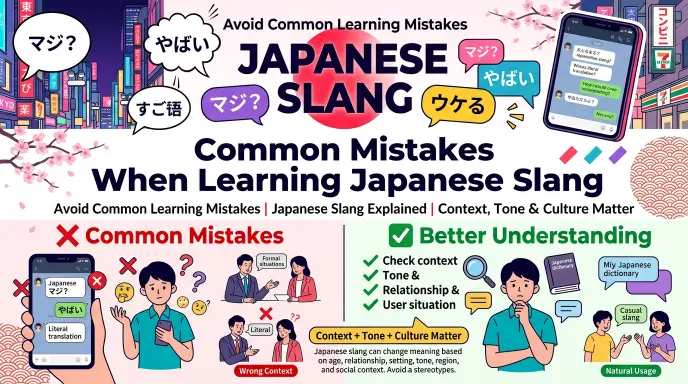
Assuming One Slang Word Has One Meaning
Yabai is a good example. Depending on context, it can express danger, trouble, surprise, or admiration.
Copying Anime Characters
Anime often uses exaggerated speech. Real conversations may sound very different.
Using Slang With Everyone
Japanese speakers adjust their language based on social relationships.
Ignoring Tone
The same word can sound playful, sarcastic, or insulting depending on how it is said.
Translating Slang Word-for-Word
A literal translation may miss the actual feeling of an expression.
Assuming Online Japanese Equals Spoken Japanese
Internet slang can be specific to online communities and may sound strange when spoken aloud.
Why Is Japanese Slang So Context-Dependent?
Japanese communication relies heavily on social context.
Speakers consider factors such as:
- Age
- Social status
- Familiarity
- Situation
- Group identity
- Formality
- Tone
Therefore, learning the dictionary definition of a slang word is only the first step. Understanding when and with whom to use it is equally important.
Real-Life Examples
Example: Friends
A: マジ?
B: マジ!
Meaning:
A: “Seriously?”
B: “Seriously!”
This is casual and natural between friends.
Example: Social Media
この動画バズったw
Meaning:
“This video went viral lol.”
Example: Gaming
神プレイ!
Meaning:
“That play was incredible!”
Example: Complaining
あの人ウザい。
Meaning:
“That person is annoying.”
This can sound rude, so it should not be used carelessly.
Example: Food
これめっちゃおいしい!
Meaning:
“This is really delicious!”
Is Japanese Slang Still Used Today?
Yes. Japanese slang continues to change through social media, gaming, entertainment, youth culture, and online communities.
Some expressions become mainstream. Others disappear after a short period.
This means that slang dictionaries can become outdated quickly. A term that was popular several years ago may now sound old-fashioned, exaggerated, or “cringe” to younger speakers.
That is why modern Japanese slang should always be considered in its time and community context.
Key Takeaways
- Slang in Japanese is called スラング (surangu).
- Japanese has many informal expressions used in everyday life and online.
- Yabai can mean either something bad or something amazing, depending on context.
- Maji means “seriously” or “really.”
- Meccha means “very” or “extremely.”
- Ukeru can mean “funny” or “hilarious.”
- Oshi refers to a favorite person or character someone supports.
- W and www represent laughter online.
- Some slang can sound rude or insulting.
- Anime slang should not automatically be treated as everyday Japanese.
- Formal situations call for polite Japanese rather than slang.
Frequently Asked Questions
What is the Japanese term for slang?
The Japanese term for slang is スラング (surangu). Another common term is 俗語 (zokugo), which means informal or colloquial language.
Japanese speakers may also use 若者言葉 (wakamono kotoba) for “youth language,” especially when talking about slang used by younger people.
Why do Japanese say “oi oi oi”?
“Oi oi oi” (おいおいおい) is an informal expression used to get someone’s attention or react to something surprising, unbelievable, or concerning.
Depending on tone, it can mean something like “Hey, hey, hey!”, “Whoa, hold on!”, or “Come on!” It is casual and strongly depends on the situation.
What does “suki” mean in Japanese?
Suki (好き) means “like” or “to like” in Japanese. In romantic situations, suki can also mean “I like you” or express romantic affection.
For example, 好きだよ (suki da yo) can mean “I like you” or “I love you,” depending on the relationship and context.
Is yabai a swear word?
Yabai (やばい) is not technically a swear word. It is a highly informal Japanese expression that can mean “dangerous,” “bad,” “wild,” “awful,” or, in modern casual speech, “amazing” or “awesome.” Its meaning changes greatly with context, tone, and situation.
Japanese Slang Insults
Japanese has many informal insults, but their strength depends heavily on context, tone, and the relationship between speakers.
Words such as バカ (baka), meaning “idiot” or “foolish,” and アホ (aho), meaning “fool” or “idiot,” can be insulting but may also sound playful among friends. Stronger expressions should be used with caution.
Slang in Japanese Translate
The word “slang” is commonly translated into Japanese as スラング (surangu). Another useful term is 俗語 (zokugo), meaning informal or colloquial language. For example, “Japanese slang” can be written as 日本語のスラング (nihongo no surangu).
Slang in Japanese Words
Japanese slang includes informal words, shortened expressions, internet terms, youth language, and casual phrases.
Examples include やばい (yabai) for something “wild,” “bad,” or “amazing,” ウケる (ukeru) for “that’s funny,” and マジ (maji) for “seriously” or “really.” The meaning can change depending on context.
Slang in Japanese to English
Japanese slang does not always translate into one exact English word. For example, やばい (yabai) can mean “dangerous,” “bad,” “wild,” or “awesome,” depending on how it is used.
Likewise, マジ (maji) can mean “seriously” or “for real.” Context is important when translating Japanese slang into English.
Conclusion
Slang in Japanese, or スラング (surangu), includes a wide range of casual expressions used in conversations, online communities, gaming, anime fandom, social media, and youth culture.
Words such as yabai, maji, meccha, ukeru, oshi, and gachi can make Japanese conversations feel more natural, but they also require an understanding of context.
The most important lesson is that Japanese slang does not work exactly like a simple vocabulary list. Some expressions are friendly, some are rude, and others can change meaning based on tone.
Yabai, for example, can describe something terrible or something amazing. Similarly, online expressions such as w may feel natural in a comment but would not fit a formal business conversation.
If you are learning Japanese, learn the standard polite forms first. Then add slang gradually. Pay attention to who uses each expression, where it appears, and how native speakers use it.
That approach will help you understand Japanese online culture without accidentally using an expression in the wrong situation.
Discover More Articles!
What Does POS Mean in Texting, TikTok, and Social Media?(2026)
What Does Snatched Mean? Slang Definition, Uses & Examples.
Trinidadian Slang Words and Phrases You Should Know.

Hi, I’m Sophia Bennett, a novelist passionate about creating heartfelt stories filled with romance, emotion, and unforgettable characters. Through my books, I hope to inspire readers and take them on journeys they’ll always remember.