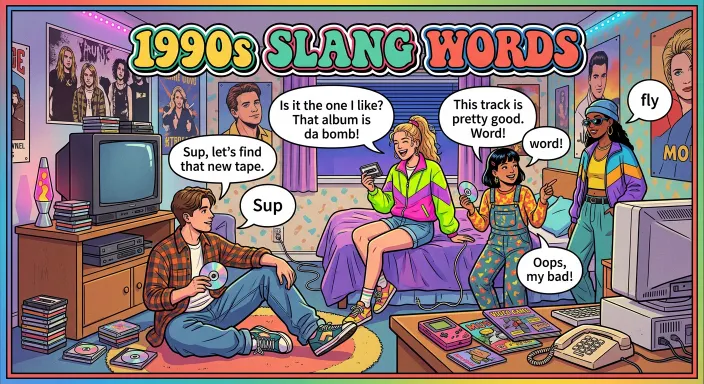
The 1990s slang words were a colorful mix of hip hop language, youth culture, television catchphrases, gaming terms, fashion talk, and expressions that spread through movies and music.
Words such as da bomb, fly, phat, my bad, buggin’, word, sup, and talk to the hand became strongly associated with the decade. Some were new in the 1990s, while others were older expressions that became much more popular during the decade.
The 1990s were also different from today because social media did not exist. Slang spread through schoolyards, telephone conversations, television, movies, radio, music, magazines, and early internet communities. Popular shows and films helped certain expressions reach millions of people.
For example, Clueless helped popularize several expressions, while Seinfeld, The Simpsons, and Wayne’s World also influenced everyday speech.
This guide covers popular 1990s slang words and phrases, what they meant, where they came from, examples, and which expressions still sound natural today.
What Are 1990s Slang Words?
1990s slang words are informal words and phrases that were popular among different groups during the 1990s. They appeared in everyday speech, music, television, movies, sports, fashion, and youth culture.
Some expressions became strongly linked with the decade, even when they were actually older. For example, phat dates back earlier than the 1990s, but it reached wider mainstream use during the decade. Likewise, chill pill began earlier but remained popular in the 1990s.
So, “1990s slang” does not always mean “a word invented in the 1990s.” It can also describe language that became especially popular during that period.
Quick Answer: Popular 1990s Slang Words
| 1990s Slang | Meaning |
| Da bomb | Excellent or very impressive |
| Fly | Stylish or attractive |
| Phat | Great, attractive, or excellent |
| My bad | My mistake |
| Word | I agree or I understand |
| Sup | What’s up? |
| Buggin’ | Overreacting or freaking out |
| Kickin’ it | Relaxing or hanging out |
| Talk to the hand | I don’t want to listen |
| Booyah | An excited celebration |
| Psych! | Just kidding; you were fooled |
| All that | Very impressive or overly confident |
| Duh | Obviously |
| Don’t go there | Don’t bring up that subject |
| Jiggy | Fun, energetic, stylish, or sexually suggestive |
| Whatever | I don’t care or I disagree |
| Wicked | Very good or excellent |
| Bling | Flashy jewelry |
| Yada, yada, yada | And so on |
| Not! | A joke that reverses the previous statement |
Popular 1990s Slang Words and Their Meanings
Da Bomb
Da bomb meant something was excellent, impressive, or extremely cool.
For example:
“That new game is da bomb.”
The phrase became strongly associated with 1990s popular culture. Dictionary.com notes that a 1993 Kris Kross song helped popularize the expression.
Today, da bomb sounds distinctly retro.
Fly
Fly meant stylish, fashionable, attractive, or sophisticated.
For example:
“Those shoes are fly.”
The word has roots in African American Vernacular English (AAVE) and had widespread use in the 1990s. It should not be treated as a word invented by 1990s pop culture.
Phat
Phat meant excellent, attractive, or impressive.
For example:
“That’s a phat jacket.”
Although the slang has older roots, it became mainstream during the 1990s, particularly through hip hop culture. The popular claim that “PHAT” stood for “pretty hot and tempting” is not a reliable origin story.
My Bad
My bad means “my mistake” or “my fault.”
For example:
“My bad, I forgot to call you.”
The expression was useful for admitting a small mistake in a casual way. It remains understandable today, although its strongest 1990s association has faded.
Word
In 1990s slang, word could mean “I agree,” “I understand,” or “that’s true.”
Example:
“That movie was amazing.”
“Word.”
Dictionary.com notes that this meaning peaked in usage during the 1990s.
Sup
Sup is a shortened form of “What’s up?”
Example:
“Sup, dude?”
It was a relaxed way to greet someone and remains understandable today.
Buggin’
Buggin’ meant overreacting, freaking out, acting irrationally, or sometimes being wrong.
Example:
“You’re buggin’. It’s not that serious.”
The expression became strongly associated with hip hop culture and 1990s movies, including Clueless.
Kickin’ It
Kickin’ it meant relaxing, hanging out, or spending time with friends.
Example:
“We’re just kickin’ it at Mike’s house.”
It was a casual expression for having a relaxed time with friends.
Talk to the Hand
Talk to the hand was a dismissive way to tell someone that you did not want to listen.
It was often accompanied by holding up an open palm toward the other person. The phrase became a major 1990s pop culture expression and appeared in television shows, movies, and songs.
Example:
“You never listen to me.”
“Talk to the hand.”
Today, it usually sounds deliberately retro or humorous.
Booyah
Booyah was an excited exclamation used to celebrate success or victory.
Sports broadcaster Stuart Scott helped make the expression widely recognizable during the 1990s.
Example:
“We won the championship. Booyah!”
Psych!
Psych! meant “Just kidding” or “I fooled you.”
Someone might make a false statement and then immediately say “Psych!”
Example:
“The test is canceled tomorrow. Psych!”
The expression was strongly associated with 1990s youth culture and prank style humor.
All That
If someone said they were all that, they thought they were extremely impressive, attractive, or important.
The phrase could also be sarcastic.
Example:
“He thinks he’s all that.”
The expression became especially recognizable during the 1990s, helped by the Nickelodeon show All That, which premiered in 1994.
Duh
Duh was used to point out that something was obvious.
Example:
“The sun is hot.”
“Duh!”
The word existed before the 1990s, but it gained significant attention during the decade. The American Dialect Society selected “duh” as one of its Most Useful Words in 1997.
Don’t Go There
Don’t go there means something like “Don’t bring up that subject” or “Don’t even suggest that.”
Example:
“Maybe we should talk about your old relationship.”
“Don’t go there.”
The phrase could be playful or serious depending on the situation.
Jiggy
Jiggy became strongly associated with dancing, having fun, and energetic behavior during the 1990s. Will Smith’s 1997 hit “Gettin’ Jiggy Wit It” helped popularize this sense.
Example:
“Everybody was getting jiggy on the dance floor.”
The word now sounds very retro.
Whatever
Whatever was often used to show indifference, disagreement, or dismissal.
Example:
“You’re wrong.”
“Whatever.”
The phrase became especially associated with Clueless and 1990s teen culture.
Wicked
In some 1990s usage, wicked meant extremely good, impressive, or excellent.
Example:
“That was a wicked concert.”
The positive use of wicked is older than the 1990s, but it had a noticeable presence in popular culture during the decade.
Bling
Bling refers to flashy or conspicuous jewelry.
The word reached mainstream attention in 1999 through hip hop culture, particularly after B.G.’s “Bling Bling.”
Example:
“He showed off his new bling.”
Unlike many 1990s expressions, bling survived well beyond the decade.
Yada, Yada, Yada
Yada, yada, yada means “and so on” or skips over details in a story.
A 1997 Seinfeld episode helped make the expression especially popular.
Example:
“We went shopping, had dinner, yada, yada, yada.”
Not!
Not! was used after a statement to suddenly reverse or negate what had just been said.
Example:
“I’m the smartest person here. Not!”
The expression became popular through Wayne’s World and was named the American Dialect Society’s Word of the Year in 1992.
1990s Slang by Category
Different groups used slang for different purposes. This table makes the differences easier to see.
| Category | Examples |
| Cool or impressive | Da bomb, fly, phat, wicked |
| Friendship | Kickin’ it, sup |
| Agreement | Word |
| Humor | Psych!, not!, duh |
| Dismissal | Whatever, talk to the hand |
| Excitement | Booyah, jiggy |
| Mistakes | My bad |
| Fashion | Fly, phat, bling |
| Social criticism | Judgy, harsh |
| Conversation fillers | Yada, yada, yada |
1990s Slang in Movies and Television
Movies and television played a major role in spreading slang during the 1990s.
Clueless
Clueless became one of the best known sources of 1990s teen language. Expressions such as whatever, as if, and buggin’ became strongly connected with its characters and style. Dictionary.com notes that the movie itself helped popularize several expressions.
Seinfeld
Seinfeld helped popularize yada, yada, yada after a 1997 episode.
Wayne’s World
Wayne’s World helped spread the use of not! as a humorous way to reverse a statement.
The Simpsons
The expression d’oh became one of the decade’s most recognizable catchphrases through Homer Simpson. Merriam Webster describes it as an expression used when someone realizes a foolish mistake or an ironic situation.
1990s Slang and Hip Hop Culture
Hip hop had a major influence on American slang during the 1990s. Several terms that became mainstream during the decade were connected to African American speech, hip hop, music, and entertainment.
For example, fly had roots in AAVE, while phat became strongly associated with hip hop culture. Bling also entered mainstream culture through hip hop near the end of the decade.
It is important not to claim that all 1990s slang came from hip hop. The decade had many different language sources, including regional speech, television, movies, sports, gaming, youth culture, and early internet communities.
1990s Slang vs Modern Slang
The biggest difference is how slang spreads.
During the 1990s, expressions often spread through:
- Television
- Movies
- Music
- Radio
- School
- Magazines
- Friends and family
- Early internet communities
Today, slang can spread globally within hours through TikTok, Instagram, YouTube, Discord, Reddit, and other online platforms.
Dictionary.com notes that modern digital communication allows slang and cultural language to spread much faster than it did during the dial up era.
Are 1990s Slang Words Still Used Today?
Some are.
Words such as my bad, sup, fly, bling, and yada, yada, yada can still be understood and used today.
Others, such as talk to the hand, da bomb, psych!, and not!, usually sound intentionally nostalgic or humorous.
The difference is important. A word can remain understandable without remaining fashionable.
| 1990s Slang | How It Sounds Today |
| My bad | Still natural |
| Sup | Casual and dated for some speakers |
| Bling | Still recognizable |
| Fly | Still used in some contexts |
| Whatever | Still common |
| Duh | Still common |
| Yada, yada, yada | Still recognizable |
| Da bomb | Retro |
| Talk to the hand | Very retro |
| Psych! | Dated |
| Not! | Mostly humorous or nostalgic |
Common Mistakes When Using 1990s Slang

Assuming Every Word Was Invented in the 1990s
This is one of the biggest mistakes. Some terms were much older but became popular during the decade.
For example, chill pill originated before the 1990s, while phat also has earlier roots.
Treating Pop Culture as the Whole Story
Movies and television influenced slang, but they did not create every expression.
Using Fake Grunge Slang as Real History
The 1990s had a famous grunge slang hoax. A Sub Pop receptionist named Megan Jasper invented phrases such as wack slacks, lamestain, and cob nobbler when a reporter asked about Seattle grunge vocabulary. The terms were later published as if they were real.
Therefore, these should not be presented as genuine common 1990s slang.
Assuming Every 1990s Expression Sounds Natural Today
Some expressions have survived, while others now sound dated.
When to Avoid Using 1990s Slang
1990s slang is generally harmless, but it is informal. Avoid relying on it in:
- Academic papers
- Business reports
- Job applications
- Legal documents
- Formal presentations
- Professional emails
It can work well in creative writing, nostalgic content, casual conversations, and themed events.
Also, be careful with expressions that originated in specific cultural communities. Using slang without understanding its cultural background can make the wording feel forced or disrespectful.
Is 1990s Slang Offensive?
Most popular 1990s slang is not inherently offensive. However, some terms had meanings or cultural associations that require context.
For example, fly has roots in AAVE, and hip hop culture influenced the mainstream popularity of several expressions. It is better to describe these origins accurately than to label every 1990s slang term as generic “teen slang.”
Key Takeaways
- 1990s slang words included expressions such as da bomb, fly, phat, my bad, word, sup, and buggin’.
- Movies, television, music, sports, and youth culture helped spread slang.
- Some 1990s slang was actually older language that became popular during the decade.
- Clueless, Seinfeld, Wayne’s World, and The Simpsons helped popularize memorable expressions.
- Some terms, such as bling and my bad, remain recognizable today.
- Others, such as talk to the hand and psych!, now sound strongly retro.
- Not every word reported as 1990s slang was genuine; the grunge slang hoax is an important example.
- Context and cultural origin matter when explaining historical slang.
Frequently Asked Questions
What slang words were popular in the 1990s?
Popular examples include da bomb, fly, phat, my bad, word, sup, buggin’, kickin’ it, talk to the hand, booyah, psych!, whatever, duh, and bling. Some were older expressions that became especially popular during the decade.
What was 1990s slang for cool?
Several expressions could mean cool or excellent. Da bomb, fly, phat, and wicked were used to describe something impressive, stylish, or excellent.
What did “da bomb” mean in the 1990s?
Da bomb meant something was excellent, impressive, or very cool. The phrase became strongly associated with 1990s pop culture and was helped by a 1993 Kris Kross song.
What did “word” mean in 1990s slang?
Word could mean “I agree,” “I understand,” or “that’s true.” Dictionary.com notes that this meaning peaked during the 1990s.
What did “talk to the hand” mean?
Talk to the hand was a dismissive phrase meaning that someone did not want to hear what another person was saying. It was often accompanied by an open palm gesture.
What did “my bad” mean?
My bad meant “my mistake” or “my fault.” It was commonly used to accept responsibility for a small mistake in a casual way.
What 1990s slang is still used today?
My bad, whatever, duh, bling, sup, fly, and yada, yada, yada remain recognizable. However, their popularity and tone can vary by age group and context.
Was “wack slacks” real 1990s slang?
No. Wack slacks was part of a famous 1990s grunge slang hoax. Megan Jasper invented several supposed Seattle grunge terms that were mistakenly reported as genuine slang.
Conclusion
1990s slang words reflect a decade shaped by hip hop, television, movies, music, sports, fashion, and early internet culture. Expressions such as da bomb, fly, phat, my bad, word, sup, buggin’, and talk to the hand became memorable because people heard them repeatedly in popular culture and everyday conversations.
However, not every “1990s slang” term was created during the decade. Some expressions were older, while others became popular because of a particular movie, television show, song, or cultural movement. That distinction matters when researching the history of slang.
Some expressions have survived, while others now sound deliberately retro. Still, these words offer a useful look at how people communicated before social media transformed the way slang spreads.
Understanding their history makes 1990s language more than a collection of nostalgic phrases it shows how culture and communication shaped each other.
Discover More Articles!
1950s Slang Words: Popular Words and Phrases From the 1950s
SYD Meaning in Text, Snapchat, TikTok, and Social Media
PC Meaning Slang: What Does PC Mean in Text?

Hi, I’m Sophia Bennett, a novelist passionate about creating heartfelt stories filled with romance, emotion, and unforgettable characters. Through my books, I hope to inspire readers and take them on journeys they’ll always remember.