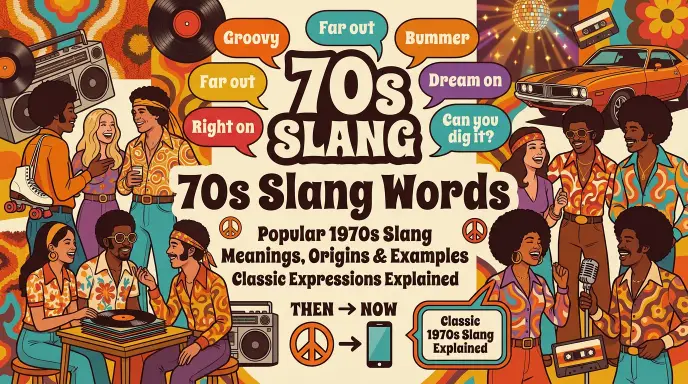
70s slang words were informal expressions used during the 1970s, especially by young people, music fans, and different counterculture communities.
Words such as groovy, far out, dude, funky, bummer, bread, and psyched became strongly associated with the decade. Some came from earlier decades, while others gained wider popularity during the 1970s.
The slang of the 1970s reflected major changes in American and British pop culture. Disco, rock, funk, television, movies, surfing culture, and youth movements all helped spread new expressions. Some terms are still familiar today, while others now sound distinctly old fashioned.
Understanding 70s slang words can help you read older books, understand classic movies and songs, and recognize references to 1970s culture.
What Are Some 70s Slang Words?
Popular 70s slang words include groovy, far out, bummer, dude, bread, funky, boogie, psyche, can you dig it, and right on.
These expressions were used to describe something cool, surprising, disappointing, stylish, or exciting.
Some originated before the 1970s but became especially popular during the decade through music, television, movies, and youth culture.
Quick Answer Table
| 70s Slang Word | Meaning |
| Groovy | Cool, enjoyable, excellent |
| Far out | Amazing, unusual, impressive |
| Right on | I agree / excellent |
| Bummer | Disappointment or bad situation |
| Dude | Guy, person, or friend |
| Bread | Money |
| Funky | Stylish, distinctive, often related to music |
| Boogie | Dance |
| Psyche! | Just kidding / fooled you |
| Can you dig it? | Do you understand or like it? |
| Dream on | That is unrealistic |
| Rip off | Something overpriced or unfair |
| Fox | Attractive person |
| Chill out | Relax |
| Heavy | Serious, intense, or profound |
| Keep on truckin’ | Keep going |
| The fuzz | Police |
| Square | Uncool or conventional person |
| Jive | Foolish talk or style associated with a cultural context |
| Baked | Intoxicated, often from marijuana |
What Made 70s Slang Unique?
The 1970s had a mix of slang from several different cultural movements.
Rock music brought expressions associated with concerts and counterculture. Funk and disco added their own vocabulary. Meanwhile,
Black American speech, Chicano culture, surfing culture, and television all influenced the language people heard during the decade.
Because of this mix, there was no single type of 1970s slang.
A teenager in Los Angeles might use different expressions from someone in New York. Likewise, music fans, surfers, hippies, and disco fans could have different vocabulary.
Groovy
Groovy is probably one of the most recognizable expressions associated with the 1960s and 1970s.
It means:
- Cool
- Excellent
- Enjoyable
- Pleasant
- Stylish
Example:
“That new record is groovy.”
Meaning:
“That new record is really good.”
Although groovy became popular before the 1970s, people continued using it during the decade.
Today, it usually sounds deliberately retro.
Far Out
Far out was used to express surprise, excitement, or admiration.
Example:
“You met the band backstage? Far out!”
Meaning:
“That’s amazing!”
The expression became strongly connected with counterculture and psychedelic culture.
In modern speech, far out often sounds nostalgic or humorous rather than completely natural.
Right On
Right on expressed agreement, approval, or encouragement.
For example:
“I finally got the job.”
“Right on!”
It could mean:
- Great!
- Exactly!
- I agree!
- Good for you!
The phrase has deeper roots in Black American speech and activism, and it became widely used across popular culture.
Bummer
A bummer is a disappointing, unpleasant, or unfortunate situation.
Example:
“The concert was canceled.”
“What a bummer.”
It means:
“That’s really disappointing.”
Unlike some 70s expressions, bummer has remained understandable in modern English, although its popularity varies by age and region.
Dude
Dude can mean a guy, person, or friend.
Example:
“Dude, check this out!”
The word existed long before the 1970s. However, its association with casual youth speech continued to grow through surfing, movies, and popular culture.
Today, dude remains common in informal American English.
Bread
In 1970s slang, bread could mean money.
Example:
“I need some bread before we go out.”
Meaning:
“I need some money before we go out.”
This use was not invented in the 1970s. It had earlier roots in American slang and continued through the decade.
Similar money slang included bucks and dough.
Funky
Funky had several meanings.
It could describe something:
- Stylish
- Unusual
- Distinctive
- Related to funk music
The word has a complex history in African American English and music culture. Its meaning has changed over time.
In a 1970s music context, funky could be strongly positive.
For example:
“That band has a funky sound.”
Today, the word remains common, although its meaning depends heavily on context.
Boogie
Boogie means to dance or, in some contexts, refers to dancing itself.
Example:
“Let’s boogie!”
Meaning:
“Let’s dance!”
The expression became strongly associated with 1970s disco and dance culture.
It could also appear in music related expressions such as boogie woogie.
Psyche!
Psyche! was used after tricking or fooling someone.
Example:
“I bought you a new car. Psyche!”
Meaning:
“Just kidding! I fooled you.”
It became popular in informal American speech, especially among young people.
The spelling can vary, including psych! or sike!
Modern spellings often appear online.
Can You Dig It?
“Can you dig it?” means something like:
“Do you understand?”
or:
“Do you like or appreciate it?”
Example:
“This is the new sound we’re going for. Can you dig it?”
The phrase has roots that predate the 1970s, particularly in African American slang and counterculture. Movies and popular culture helped spread it more widely.
Dream On
Dream on can be a dismissive way to tell someone that what they want is unrealistic.
Example:
“I’m going to become a millionaire tomorrow.”
“Dream on.”
The phrase can sound playful or sarcastic depending on tone.
It is still understood today.
Rip Off
A rip off is something unfairly expensive, dishonest, or not worth the price.
Example:
“Ten dollars for that? What a rip off!”
This expression became well established in American informal English and remains common today.
Fox
In older slang, fox could refer to an attractive woman.
For example:
“She’s a fox.”
The expression was used in popular culture during the 1970s.
However, it can sound dated today. It is generally better to use modern, respectful language when complimenting someone’s appearance.
Chill Out
Chill out means relax or calm down.
Example:
“Chill out. Everything is fine.”
The phrase has roots in earlier slang and became widely familiar through American informal speech.
It remains common today.
Heavy
In 1970s counterculture, heavy could describe something intense, serious, meaningful, or emotionally powerful.
Example:
“That movie was heavy.”
Depending on context, this could mean:
“That movie was intense.”
or:
“That movie made me think deeply.”
The expression was particularly useful for describing serious music, conversations, or experiences.
Keep on Truckin’
“Keep on truckin’” means keep going, stay positive, or continue moving forward.
The phrase became famous through a 1960s underground comics image by Robert Crumb and continued into 1970s popular culture.
Example:
“Things are difficult, but keep on truckin’.”
Today, it strongly evokes the counterculture era.
The Fuzz
The fuzz was slang for the police.
Example:
“Watch out—the fuzz is coming.”
This was informal and often associated with counterculture or anti establishment speech.
It is now largely dated.
Square
A square was an uncool, conventional, or old fashioned person.
Example:
“Don’t be such a square.”
The word was not unique to the 1970s. It had already been used in earlier jazz and beatnik culture.
However, it remained part of the vocabulary of youth and counterculture.
Jive
Jive has a complicated history and should be used carefully.
It can refer to:
- Deceptive or foolish talk
- A style of speech
- A dance or musical style
The word has strong historical connections to African American English and Black music culture.
For example:
“Don’t give me that jive.”
could mean:
“Don’t give me that nonsense.”
Because the term has a complex cultural history, it should not be used as a generic imitation of African American speech.
Baked
Baked was informal slang for being intoxicated, particularly from marijuana.
Example:
“He was completely baked.”
This meaning was common in counterculture contexts.
The word can have other meanings, too, so context matters.
70s Slang for Money
Money had several informal names during the era.
| Slang | Meaning |
| Bread | Money |
| Dough | Money |
| Bucks | Dollars |
| Green | Money |
| Paper | Money |
Some of these expressions existed well before the 1970s and continued afterward.
70s Slang for Something Cool
If you wanted to describe something as impressive, you could hear expressions such as:
- Groovy
- Far out
- Right on
- Heavy
- Funky
- Outta sight
Outta Sight
Outta sight could mean excellent, impressive, or amazing.
Example:
“That guitar solo was outta sight!”
Meaning:
“That guitar solo was incredible!”
The expression is strongly associated with older American slang.
70s Slang for Having Fun
People could use expressions such as:
- Boogie
- Hang out
- Have a blast
- Get down
- Party
Get down could refer to dancing or having a good time, particularly in music and dance contexts.
Example:
“Let’s get down!”
Meaning:
“Let’s dance or have fun!”
70s Slang in Music Culture
Music played a major role in spreading slang.
Rock, funk, soul, disco, and punk each contributed to the language of the era.
Words such as funky, boogie, groove, get down, and heavy often appeared around music.
However, these expressions did not all come from the same community. Some have roots in Black American culture, while others developed through broader American counterculture or music scenes.
70s Slang in Movies and Television
Movies and television helped spread slang far beyond local communities.
A phrase used by a popular character could quickly become recognizable across the country.
This is one reason some 70s expressions remain familiar today, even among people who were born decades later.
However, movies can exaggerate slang for comedy or characterization. A fictional character should not always be treated as evidence of how everyone actually spoke.
Real Life Examples of 70s Slang
Talking About Music
“This band’s new album is groovy.”
Meaning: The album is excellent or enjoyable.
Reacting to Good News
“I got tickets to the show!”
“Right on!”
Meaning: Great news!
Talking About Money
“Do you have enough bread for dinner?”
Meaning: Do you have enough money?
Talking About a Disappointment
“The game got canceled.”
“That’s a bummer.”
Meaning: That’s disappointing.
Inviting Someone to Dance
“Come on, let’s boogie!”
Meaning: Let’s dance.
Describing Something Amazing
“You actually met the singer? Far out!”
Meaning: That’s amazing!
Telling Someone to Relax
“Chill out. We still have plenty of time.”
Meaning: Relax.
Are 70s Slang Words Still Used?
Some are.
Dude, chill out, rip off, bread, bucks, and bummer can still be understood or used today.
Other expressions, such as groovy, far out, outta sight, and the fuzz, now sound much more retro.
The popularity of slang changes over time. A word may survive because it remains useful, while another survives mainly through movies, music, memes, or nostalgia.
Is 70s Slang Different From 60s Slang?
There is significant overlap.
Many expressions associated with the 1970s were already popular during the 1960s. Groovy, far out, square, and right on are good examples.
The 1970s added stronger influences from:
- Disco
- Funk
- Punk
- Television
- Blaxploitation cinema
- Surf culture
- New youth movements
So it is often more accurate to say that the 1970s continued and reshaped earlier slang rather than completely inventing a new vocabulary.
Common Mistakes When Using 70s Slang
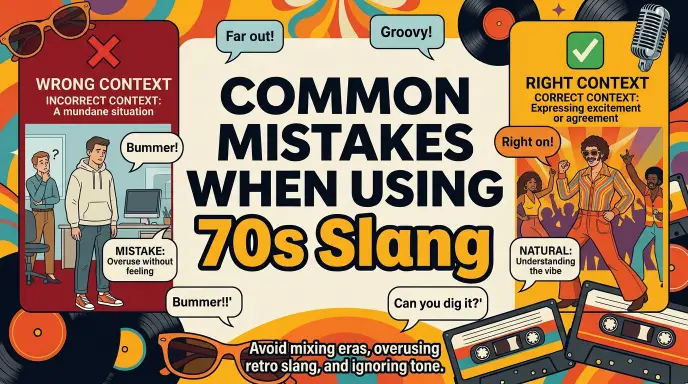
Assuming Every Expression Started in the 1970s
Many famous 70s slang terms have older roots.
Treating Movie Dialogue as Typical Speech
Hollywood sometimes exaggerates slang to create a specific character.
Using Cultural Slang Without Understanding Its History
Some expressions came from specific communities and cultural movements. Understanding that background matters.
Using Every 70s Expression Seriously Today
Words such as groovy may sound intentionally retro in modern conversation.
Confusing Slang With Standard English
Some expressions moved from slang into common everyday language. Others remained informal.
When to Avoid 70s Slang
Most 70s slang is harmless, but it is still informal.
Avoid using strongly dated expressions in:
- Job applications
- Academic papers
- Formal reports
- Business emails
- Professional presentations
Some terms also have cultural histories that require care. Jive, for example, should not be used to imitate a racial or cultural speech style.
For casual writing, themed parties, creative projects, or historical discussions, however, 70s slang can be useful and fun.
Key Takeaways
- 70s slang words reflect the music, youth culture, counterculture, and media of the 1970s.
- Groovy means cool or enjoyable.
- Far out expresses surprise or admiration.
- Right on shows agreement or approval.
- Bummer means a disappointment.
- Bread means money.
- Boogie means dance.
- Psyche! means “just kidding.”
- Dude means a guy, person, or friend.
- The fuzz was slang for the police.
- Many famous 70s expressions actually originated earlier.
- Some terms remain common, while others now sound dated or intentionally retro.
- Cultural context matters when using slang connected to specific communities.
Frequently Asked Questions
What are some hippie slang words?
Some well-known hippie era slang words include groovy, far out, flower power, peace, mellow, bread, chick, freak, psychedelic, and bummer. These terms were especially associated with the counterculture of the 1960s and early 1970s.
What are the top 10 slang words?
There is no single official list of the “top 10” slang words because slang changes by time, place, and community. Some widely recognized examples include cool, awesome, dude, lit, vibe, chill, fire, GOAT, sus, and slay.
Is “groovy” 70s slang?
Yes, “groovy” was popular slang in the 1960s and 1970s. It meant something was cool, enjoyable, fashionable, or pleasing.
Although strongly linked with hippie and counterculture speech, the word actually became popular before the 1970s.
What was a cool word in 1970s slang for “awesome”?
“Far out” was a popular 1970s-era expression for something impressive, exciting, unusual, or amazing. “Groovy” was another common choice. For example, someone might say, “That concert was far out!” to express strong approval.
70s Slang Words for Girl
Common 1970s era slang terms for a girl or young woman included chick, fox, chickie, doll, and honey.
Some were friendly or affectionate, while others could sound dated or objectifying today. Context and the relationship between speakers matter.
70s Slang Words for Cool
Popular 1970s expressions for something cool included groovy, far out, hip, happening, and outta sight. These terms could describe something fashionable, exciting, impressive, or enjoyable.
Catchy 70s Phrases
Some memorable 1970s style phrases include “Keep on truckin’,” “Right on,” “Far out,” “Groovy,” “Can you dig it?” and “What’s your bag?” Their meanings ranged from showing agreement to expressing excitement or asking about someone’s interests.
70s Slang Insults Funny
Some playful or dated 1970s insults included square (an uncool or conventional person), nerd (a socially awkward or overly studious person), dork (a foolish or awkward person), bozo (a silly person), and turkey (a foolish or inept person). These were generally informal and could be teasing rather than seriously offensive.
Conclusion
70s slang words offer a useful look at the culture of the 1970s. Expressions such as groovy, far out, right on, bummer, bread, dude, funky, and boogie appeared across conversations, music, movies, television, and youth culture.
They did not all come from the same place, either. Many had roots in earlier decades or in specific cultural communities.
Some of these expressions still feel natural today. Dude, chill out, rip off, bucks, and bummer remain recognizable, while groovy, far out, and the fuzz often create a more deliberately retro feeling.
It is also important to remember that slang does not follow exact decade boundaries. A phrase can become popular in the 1960s, remain common in the 1970s, and continue into later decades.
Therefore, the best way to understand 70s slang is to view it as part of a larger history of American informal language, shaped by music, regional speech, youth culture, and changing social trends.
Discover More Articles!
What Does POS Mean in Texting, TikTok, and Social Media?(2026)
Slang in Japanese: 30+ Japanese Slang Words and Meanings.
Ion Meaning Slang: What Does “Ion” Mean in Texting and Slang?(2026)

Hi, I’m Sophia Bennett, a novelist passionate about creating heartfelt stories filled with romance, emotion, and unforgettable characters. Through my books, I hope to inspire readers and take them on journeys they’ll always remember.