Irish slang insults are casual words and phrases that Irish people use to tease, mock, or call someone foolish, annoying, or unpleasant. Many sound harsh, but some are used in a friendly and funny way.
Irish English has a rich slang vocabulary. Some insults come from everyday Irish speech, while others are linked to older Irish expressions. Their meaning can also change with tone and context.
For example, calling someone a “gobshite” is clearly rude. However, close friends may use it jokingly. In the same way, words such as “eejit” can sound insulting but may also have a playful tone.
So, if you hear an Irish person use one of these expressions, do not judge the meaning from the word alone. The relationship between the speakers and the tone of voice matter a lot.
Quick Answer: What Are Common Irish Slang Insults?
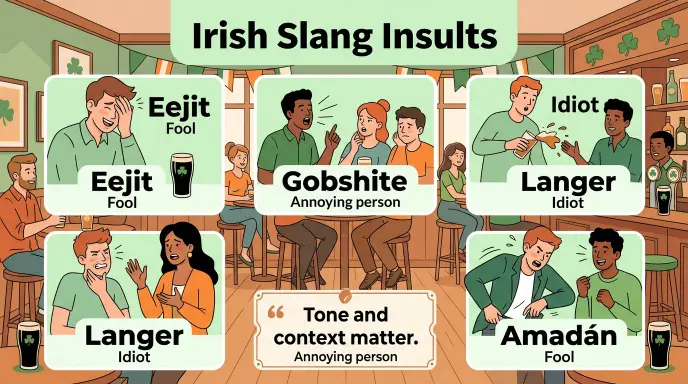
Common Irish slang insults include gobshite, eejit, langer, gowl, amadán, tool, dose, and bollocks.
Some are mild and playful. Others are much stronger.
Here are a few examples:
| Irish slang | General meaning | Tone |
| Eejit | Fool or idiot | Mild/playful |
| Gobshite | Foolish or annoying person | Rude |
| Langer | Idiot or unpleasant person | Rude |
| Gowl | Fool or annoying person | Rude |
| Amadán | Fool | Mild to rude |
| Dose | Annoying person | Mild/rude |
| Tool | Fool or idiot | Rude |
| Bollocks | Nonsense or foolish person | Strong/casual |
The exact meaning can vary by region and situation.
What Makes Irish Slang Insults Different?
Irish insults often have a playful quality. Instead of using a simple word such as “idiot,” a speaker may choose a colorful expression.
This makes Irish banter sound very different from standard English.
For example, two close friends might insult each other without being angry. They may laugh while saying it. In that case, the insult can show familiarity rather than real hostility.
However, this does not mean every Irish insult is friendly.
Some expressions are vulgar or offensive. You should understand the tone before using them yourself.
Eejit
Eejit is one of the best known Irish slang insults. It means “idiot” or “fool.”
The word often sounds softer and more playful than “idiot.”
For example:
“You left your phone at home again, you eejit!”
The speaker may be annoyed, but the phrase can also be affectionate between friends or family members.
Because of this, eejit can range from a mild insult to playful teasing.
Is Eejit Offensive?
It can be, but it is often less harsh than stronger insults.
Tone matters. Saying it with a laugh to a friend is very different from saying it angrily to a stranger.
Gobshite
Gobshite is a much stronger Irish slang insult.
It can describe someone who is inconsiderate, foolish, irritating, or someone who talks too much nonsense.
The word comes from “gob,” an informal word for mouth, combined with “shite.”
For example:
“Don’t be such a gobshite.”
This is clearly rude.
Friends may sometimes use it as banter. However, learners should be careful because it contains vulgar language.
Langer
Langer is a well known Irish insult, especially associated with Irish slang from Cork and surrounding areas.
It can describe a inconsiderate, ignorant, or unpleasant person.
For example:
“That langer nearly caused an accident.”
The word can be strong, and its exact use can vary by speaker and region.
If you are learning Irish slang, it is useful to recognize langer, but it is better not to use it casually with people you do not know.
Gowl
Gowl is another Irish insult used for a foolish, annoying, or unpleasant person.
For example:
“Stop acting like a gowl.”
It is informal and can sound quite rude.
Like many Irish insults, the strength depends on the situation. Among friends, it may be playful. During an argument, it can become much more offensive.
Amadán
Amadán is an Irish language word meaning “fool.”
It can appear in Irish speech and Irish influenced slang.
For example:
“You’re some amadán.”
This can mean:
“You’re such a fool.”
It has a strong connection to the Irish language, so it is a good example of how Irish and English can mix in everyday speech.
Dose
In Irish slang, dose can describe an annoying or difficult person.
For example:
“He’s some dose.”
This can mean that someone is irritating or unpleasant.
The word can also have other meanings in English, so context is important.
A person who is unfamiliar with Irish English might misunderstand it if they only know the standard meaning of “dose.”
Tool
Tool is an informal insult used for someone who behaves like a fool or idiot.
For example:
“Don’t be a tool.”
This expression is not unique to Ireland. English speakers in other countries also use it.
Still, you may hear it in Irish conversations, especially when someone is describing foolish behavior.
Bollocks
Bollocks is a common vulgar word in Irish and British English.
It can refer to nonsense, rubbish, or foolish talk.
For example:
“That’s a load of bollocks.”
This means:
“That’s a load of nonsense.”
It can also appear in insults:
“He’s talking bollocks.”
This means the person is talking nonsense.
Because the word is vulgar, it is best avoided in formal situations.
Gob
Gob is an informal word for mouth in Irish and British English.
It is not always an insult by itself. However, it appears in several expressions that can be insulting.
For example:
“Shut your gob.”
This means:
“Be quiet” or “shut your mouth.”
It is rude, so you should not use it in polite conversation.
Feck
Feck is a famous Irish expression that is often used as a milder substitute for a stronger swear word.
For example:
“Feck off!”
This can mean “go away” in a rude or annoyed way.
You may hear the word in Irish comedy and television. It is often associated with Irish speech, although it is not a direct equivalent of every use of the stronger swear word it resembles.
The tone can range from humorous to angry.
Fecker
Fecker comes from the same family of informal language as “feck.”
It can describe an annoying or troublesome person.
For example:
“That fecker took my seat.”
Depending on the speaker and situation, this may sound humorous, annoyed, or insulting.
It is still informal and somewhat vulgar.
Gobdaw
Gobdaw is an Irish slang term for a fool or inconsiderate person.
It combines the idea of “gob” with a term used to describe foolishness.
For example:
“Don’t be a gobdaw.”
The expression is informal and is often used in humorous speech.
Thick
In Irish and British English, thick can describe someone who is inconsiderateor slow to understand something.
For example:
“Don’t be thick.”
This means:
“Don’t be inconsiderate.”
The word can sound insulting, but it is not necessarily a very strong swear word.
Eejit vs. Idiot
Eejit and idiot have almost the same basic meaning, but they do not always sound the same.
Idiot is a standard English insult.
Eejit has a more Irish and playful flavor.
For example:
“You idiot!”
sounds direct.
“You eejit!”
can sound more humorous, especially when said between friends.
Still, neither word should be used carelessly with strangers.
Irish Insults Used as Banter
One important part of Irish slang is banter.
Banter means playful teasing between people who know each other.
For example:
“You absolute eejit!”
A person may say this after a friend makes a silly mistake.
Everyone may laugh, and there may be no real anger behind the words.
This is why translating Irish insults word for word can sometimes lead to the wrong conclusion.
The same word can be friendly in one situation and offensive in another.
Funny Irish Insults
Some Irish insults sound funny because they are colorful or exaggerated.
Examples include:
- Eejit
- Gobshite
- Gobdaw
- Amadán
- Gowl
- Langer
- Dose
- Fecker
- Tool
The humor often comes from the sound of the word and the way the speaker delivers it.
However, funny does not always mean harmless. Some of these expressions contain vulgar language.
Irish Insults for Friends
If close friends are joking with each other, mild insults may become part of their normal banter.
For example:
“You absolute eejit!”
or:
“What a gobshite!”
A friend may laugh instead of feeling offended.
Still, this depends on the people involved. If you are new to Irish slang, it is safer to understand these expressions before trying them.
Irish Insults for Someone Being inconsiderate
If the main idea is that someone has done something foolish, these words may be used:
- Eejit — fool or idiot
- Amadán — fool
- Gobdaw — fool
- Gowl — foolish or annoying person
- Tool — foolish person
For example:
“You left the door open all night, you eejit.”
The insult focuses on the person’s action rather than their identity.
Irish Insults for Someone Who Talks Nonsense
Irish English also has colorful ways to describe someone who talks rubbish.
Gobshite is one example.
Another common expression is:
“He’s talking bollocks.”
This means:
“He’s talking nonsense.”
Here, the insult may focus more on what the person says than on the person themselves.
Are Irish Slang Insults Offensive?
Some are mild, while others are definitely offensive.
The safest way to understand them is to consider three things:
The word: Some words are naturally stronger than others.
The relationship: Friends may use insults that strangers should not use.
The tone: A laughing voice can make an insult playful, while an angry voice can make the same word aggressive.
Because of this, there is no single level of offensiveness for every Irish slang insult.
Irish Slang Insults vs. American Insults
Irish and American English share many insults, but Irish English has its own expressions.
For example, “eejit” has a strong Irish association, while “tool” is used across different English speaking communities.
Irish speech also has a strong tradition of playful banter. As a result, an insult may sound much stronger when translated into another variety of English than it does in the original conversation.
Context remains the key.
Common Mistakes When Using Irish Slang Insults
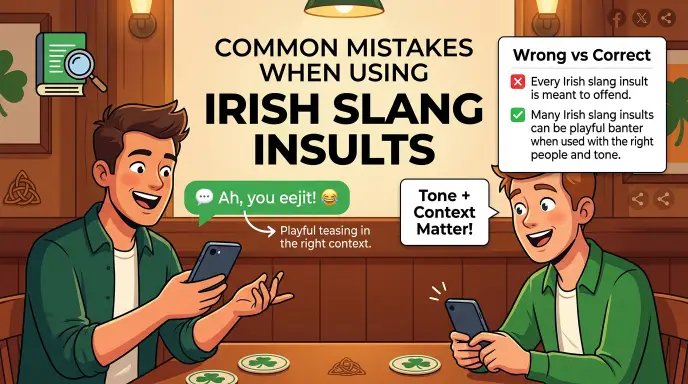
Using an Insult With a Stranger
A word that works between friends may offend someone you do not know.
Start with mild language when you are unsure.
Thinking Every Irish Insult Is Funny
Some expressions are humorous, but others are genuinely rude.
Do not assume that an Irish accent makes an insult harmless.
Ignoring Tone
Tone can change the meaning.
A playful “eejit” can be very different from an angry insult.
Using Vulgar Words in Formal Situations
Words such as gobshite, bollocks, and fecker are informal and may be inappropriate at work, school, or other formal settings.
Assuming Every Irish Person Uses the Same Slang
Irish slang can vary by region, age, and social group.
A word common in one part of Ireland may be less common somewhere else.
How to Understand Irish Insults in Conversation
If you hear an unfamiliar Irish insult, first look at the situation.
Ask yourself:
- Is everyone laughing?
- Are the speakers friends?
- Is the speaker angry?
- Is the word aimed at a person’s behavior?
- Does the phrase contain profanity?
- Does the local context change the meaning?
These clues can help you understand if the expression is playful or serious.
Irish Slang Insults in Movies and TV
Irish slang insults often appear in movies, TV shows, comedy, and online videos.
Writers use them because they can show personality, humor, anger, or friendship.
However, entertainment does not always represent everyday speech perfectly. A character may use stronger slang because it makes the scene funnier or more dramatic.
So, hearing an insult in a show does not mean everyone in Ireland uses it every day.
Why Do Irish People Use So Much Playful Insulting?
Irish banter has a strong role in many social situations.
Friends may tease each other as a way of showing familiarity. A playful insult can sometimes reduce tension and make a conversation more humorous.
For example, a friend who makes a silly mistake might hear:
“You’re some eejit!”
The speaker may not actually be angry.
This type of humor depends heavily on trust and shared understanding.
Key Takeaways
- Irish slang insults are informal expressions used to tease, criticize, or mock someone.
- Eejit means fool or idiot and can be playful.
- Gobshite is a stronger and vulgar insult.
- Langer is strongly associated with Cork and can mean an idiot or unpleasant person.
- Gowl can describe a foolish or annoying person.
- Amadán means fool and comes from Irish.
- Dose can describe an annoying person.
- Bollocks can mean nonsense and is vulgar.
- Some Irish insults are used as friendly banter.
- Tone and context can completely change how an insult sounds.
- Regional differences matter.
- Many insults are inappropriate in formal situations.
FAQs About Irish Slang Insults
What is a common Irish slang insult?
Eejit is one of the best known Irish slang insults. It means “idiot” or “fool” and can sound playful depending on the context.
What does eejit mean in Irish slang?
Eejit means “idiot” or “fool.” It is often used in a playful way, especially between friends.
What are swear words in Irish?
Common Irish swear words and insults include amadán (fool/idiot), gobshite (ignorant or inconsiderate person), bollocks (vulgar term for testicles, also used to express annoyance), and feck (a milder substitute for a stronger English swear word). Usage and strength depend on context.
What is disrespectful in Irish culture?
In Irish culture, disrespect can include insulting someone’s family, acting rudely toward older people, being overly arrogant, mocking someone’s accent or background, or behaving badly in someone’s home or community.
Social manners, friendliness, and humor are generally valued, although attitudes vary among individuals.
What are some Irish slangs?
Some common Irish slang terms include craic (fun or enjoyable conversation), grand (fine or okay), yer man (that man/guy), yer one (that woman/girl), banjaxed (broken or exhausted), gobshite (foolish person), and eejit (idiot).
What do Irish say instead of “I love you”?
Irish people may simply say “I love you” in English, but in the Irish language, “Tá grá agam duit” means “I love you.”
Irish speakers may also use affectionate terms such as a stór (“my treasure”) when speaking warmly to someone.
How do I say shut up in Irish?
In Irish, a direct way to say “shut up” is “Dún do bhéal,” which literally means “Close your mouth.”
It can sound rude or forceful, so it is better suited to informal or joking situations rather than polite conversation.
What is the #1 cuss word?
There is no universally agreed-upon #1 cuss word. In English, “fuck” is often considered one of the strongest and most widely used swear words, but its offensiveness depends on the country, situation, speaker, and audience.
Conclusion
Irish slang insults are a colorful part of informal Irish English. Words such as eejit, gobshite, langer, gowl, amadán, dose, and gobdaw can describe someone as foolish, annoying, or unpleasant.
However, the meaning is not only in the word. Tone, friendship, location, and context all matter.
An expression that sounds rude may be friendly banter between close friends, while the same expression can cause offense when used with a stranger.
If you are learning Irish slang, focus on understanding these words before using them. That will help you recognize the difference between friendly teasing and a genuine insult.
Discover More Articles!
FS Meaning Slang: What Does FS Mean in Text?
ASL Slang Meaning: What Does ASL Mean in Text?(2026)
Spanish Slang for Gossip: Chisme, Chismear & More.

Hi, I’m Sophia Bennett, a novelist passionate about creating heartfelt stories filled with romance, emotion, and unforgettable characters. Through my books, I hope to inspire readers and take them on journeys they’ll always remember.