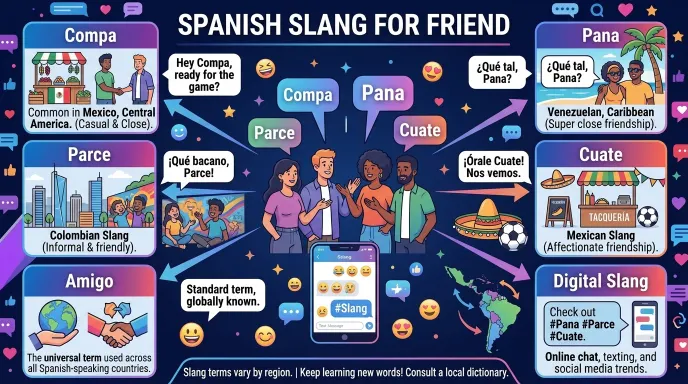
Spanish slang for friend includes casual words such as amigo, amiga, compa, pana, parcero, parce, cuate, and bro. The best choice depends on the Spanish speaking country and the relationship between the people.
For example, compa is common in Mexico, pana is widely used in parts of Latin America, while parce is strongly associated with Colombia.
Spanish does not have one slang word for “friend” that works everywhere. Regional culture plays a big role. Some words sound natural among close friends but may sound unusual in another country.
This guide explains the most useful options, their meanings, regional differences, examples, and when to use them.
What Is Spanish Slang for Friend?
Common Spanish slang for friend includes compa, pana, parcero, parce, cuate, colega, and amigo.
The meaning is usually “friend,” “buddy,” “pal,” or “mate.” However, usage changes by country. Compa is common in Mexico, parce is Colombian, and pana is popular in several Latin American countries.
Quick Answer Table
| Spanish Slang | Meaning | Common Region |
| Amigo / Amiga | Friend | Most Spanish speaking regions |
| Compa | Buddy / friend | Mexico, Central America |
| Pana | Friend / buddy | Venezuela, Colombia, Caribbean, other regions |
| Parce | Friend / bro | Colombia |
| Parcero / Parcera | Friend / buddy | Colombia |
| Cuate | Buddy / close friend | Mexico |
| Carnal | Close friend / brother like friend | Mexico |
| Colega | Mate / friend | Spain |
| Tío / Tía | Bro / mate | Spain |
| Chamo / Chama | Young person / friend | Venezuela |
| Bro | Bro | Widely used |
What Does Amigo Mean in Spanish Slang?
Amigo simply means friend. Although it is not really slang, Spanish speakers often use it in casual conversation.
For example:
“Hola, amigo. ¿Cómo estás?”
This means:
“Hi, friend. How are you?”
For a woman, amiga is used.
“Ella es mi amiga.”
Meaning:
“She is my friend.”
Because amigo is standard Spanish, it is one of the safest choices for learners.
What Does Compa Mean?
Compa is a casual word for friend, buddy, or companion. It is especially common in Mexico and can also appear in other parts of Latin America.
It comes from compadre in informal usage.
Example:
“¿Qué onda, compa?”
Meaning:
“What’s up, buddy?”
You will often hear compa between people who are comfortable with each other.
What Does Pana Mean?
Pana is a popular slang word for friend, buddy, or close companion.
It is strongly associated with countries such as Venezuela and is also used in Colombia, Puerto Rico, and other parts of Latin America.
Example:
“Él es mi pana.”
Meaning:
“He’s my friend.”
Another example:
“Gracias, pana.”
Meaning:
“Thanks, buddy.”
The exact popularity of pana varies by country.
What Does Parce Mean?
Parce is Colombian slang for friend, buddy, or bro.
It is one of the most recognizable informal terms in Colombian Spanish.
Example:
“¿Qué más, parce?”
This can mean:
“What’s up, bro?”
You may also see parcero.
What Does Parcero Mean?
Parcero means friend, buddy, or mate in Colombian Spanish.
For a woman, parcera can be used.
Example:
“Él es mi parcero.”
Meaning:
“He’s my buddy.”
The shorter form parce is also extremely common.
What Does Cuate Mean?
Cuate is Mexican slang for friend, buddy, or close companion.
Example:
“Es mi cuate.”
Meaning:
“He’s my buddy.”
It is casual and friendly. However, it is much more strongly associated with Mexico than with Spanish speaking countries in general.
What Does Carnal Mean?
In Mexican slang, carnal can mean a close friend or brother like friend.
Literally, the word relates to flesh or blood, but slang gives it a warmer social meaning.
Example:
“Gracias, carnal.”
Meaning:
“Thanks, bro.”
It usually suggests familiarity and closeness.
What Does Colega Mean?
Colega means colleague in standard Spanish, but in Spain it can also mean friend, mate, or buddy in casual speech.
Example:
“Es un buen colega.”
Meaning:
“He’s a good mate.”
This word is particularly useful if you are learning Spanish from Spain.
What Does Tío Mean in Spanish Slang?
In Spain, tío literally means “uncle,” but casual Spanish speakers often use it to mean guy, dude, or mate.
For example:
“Oye, tío, mira esto.”
Meaning roughly:
“Hey, dude, look at this.”
For a woman, tía can be used.
This meaning is strongly associated with Spain, so it should not automatically be treated as universal Latin American slang.
Spanish Slang for Friend by Country
Regional differences matter when choosing the right word.
| Country/Region | Common Casual Terms |
| Mexico | Compa, cuate, carnal |
| Colombia | Parce, parcero, pana |
| Venezuela | Pana, chamo |
| Spain | Colega, tío |
| Argentina | Amigo, che |
| Chile | Amigo, compa |
| Puerto Rico | Pana, amigo |
| Central America | Compa, amigo |
| General Spanish | Amigo, amiga |
These are broad patterns, not strict rules. A person may understand several of these terms even if they do not normally use them.
Spanish Slang for Best Friend
If you want to say best friend, there are several natural options.
Mi mejor amigo
This means:
“My best friend.”
It is standard and widely understood.
Mi mejor amiga
For a female best friend:
“My best friend.”
Mi compa
This means something closer to:
“My buddy.”
Mi pana
This means:
“My close friend / buddy.”
Mi parcero
In Colombia:
“My buddy.”
The relationship and country determine which option sounds most natural.
Spanish Slang for Male Friend
For a male friend, you can use:
- Amigo
- Compa
- Pana
- Parce
- Parcero
- Cuate
- Carnal
- Colega
- Tío
However, the regional choice matters.
For example:
“¿Qué onda, compa?” — Mexico
“¿Qué más, parce?” — Colombia
ué pasa, tío?” — Spain
These all create a casual, friendly tone.
Spanish Slang for Female Friend
For a female friend, common choices include:
- Amiga
- Compa
- Pana
- Parcera
- Colega
- Tía
Some slang words do not change based on gender, while others do.
For example:
amigo → amiga
parcero → parcera
tío → tía
Is Spanish Slang for Friend Rude?
Most of these words are casual rather than rude.
However, tone matters.
| Word | General Tone |
| Amigo | Neutral/friendly |
| Compa | Casual/friendly |
| Pana | Friendly |
| Parce | Very casual |
| Parcero | Casual |
| Cuate | Casual |
| Carnal | Very casual |
| Colega | Casual |
| Tío | Very casual |
A friendly word can still sound inappropriate if you use it with someone who expects formal language.
When to Avoid Spanish Friend Slang
Use caution with slang when speaking to:
- Teachers
- Employers
- Customers
- Government officials
- Older people you do not know well
- People in formal situations
For these settings, amigo is safer than highly regional slang, although even “amigo” may not be appropriate in every formal context.
When you are unsure, use the person’s name or a polite form of address instead.
Real Life Examples
Mexico
Carlos: ¿Qué onda, compa?
Luis: Todo bien. ¿Y tú?
Meaning:
“What’s up, buddy?”
Colombia
Juan: ¿Qué más, parce?
Mateo: Todo bien.
Meaning:
“What’s up, bro?”
Venezuela
Diego: Gracias, pana.
Luis: No hay problema.
Meaning:
“Thanks, buddy.”
Spain
Álvaro: Oye, tío, ¿vamos?
Pablo: Sí, vamos.
Meaning:
“Hey, mate, shall we go?”
General Spanish
“Ella es mi amiga.”
Meaning:
“She is my friend.”
Friend vs Buddy vs Bro in Spanish
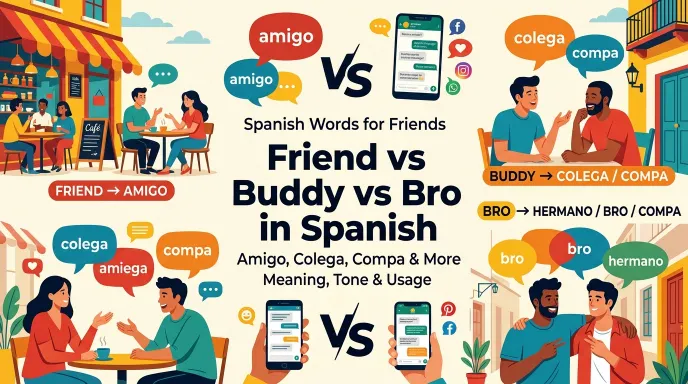
There is no perfect one to one translation for English friendship slang.
| English | Possible Spanish Equivalent |
| Friend | Amigo / amiga |
| Buddy | Compa / pana |
| Bro | Carnal / parce / bro |
| Pal | Colega / amigo |
| Mate | Colega / tío |
| Best friend | Mejor amigo / mejor amiga |
The best translation depends on the country and tone.
Common Mistakes
Using Every Slang Word Everywhere
Spanish slang is highly regional. A word that sounds natural in Colombia may sound unusual in Mexico.
Calling Everyone “Carnal”
Carnal has a distinctly Mexican flavor. It is not the universal Spanish word for friend.
Assuming Pana Is Universal
Pana is widely understood in parts of Latin America, but its popularity differs across countries.
Confusing Tío With “Uncle”
In Spain, tío can mean “dude” or “mate” in casual speech. Context tells you which meaning is intended.
Using Slang in Formal Situations
Regional slang can sound too casual in professional settings.
Why Does Spanish Have So Many Words for Friend?
Spanish is spoken across many countries and regions. Each community has developed its own informal vocabulary.
That is why you can hear:
- Compa in Mexico
- Parce in Colombia
- Pana in Venezuela and other regions
- Tío in Spain
These differences are similar to English differences such as mate, buddy, pal, and bro.
Are These Terms Still Used Today?
Yes. Many remain active in everyday speech and online conversations.
You may see them in:
- TikTok comments
- Instagram captions
- WhatsApp messages
- YouTube comments
- Gaming chats
- Music
- TV shows
- Everyday conversations
However, usage varies by country, age, and social group.
Key Takeaways
- Spanish slang for friend varies by country.
- Amigo/amiga is the safest general term.
- Compa is strongly associated with Mexico.
- Parce/parcero is strongly associated with Colombia.
- Pana is common in Venezuela and several other Latin American communities.
- Cuate and carnal are common Mexican choices.
- Colega and tío/tía are useful casual terms in Spain.
- Slang is informal, so context matters.
Frequently Asked Questions
What Do You Call a Friend in Spanish Slang?
Answer: Common Spanish slang words for a friend include amigo/amiga, compa, cuate, pana, parcero/parce, and bro.
The best choice depends on the country. For example, compa is common in Mexico, while parce is strongly associated with Colombia.
What Is Mexican Slang for Homie?
Answer: In Mexican Spanish, compa is one of the most common casual words for homie, buddy, or close friend.
Cuate is another friendly Mexican term for a friend or pal. For example, “¿Qué onda, compa?” means “What’s up, homie?”
How Do You Say “Buddy” in Spanish Slang?
Answer: There is no single Spanish slang word for buddy because slang changes by country. Compa works well in Mexico, pana is common in several Caribbean and Latin American countries, and parce is widely used in Colombia. Amigo is the general Spanish word for friend.
What Is Spanish for Bestie?
Answer: Spanish speakers can say mejor amigo for a male best friend or mejor amiga for a female best friend.
In casual speech, bestie is also used by some younger Spanish speaking social media users, especially in online conversations influenced by English.
What Is Spanish Slang for a Girl Friend?
Answer: For a female friend, amiga is the standard word, while amiga mía can sound warm and familiar.
Depending on the country and relationship, terms such as pana or compa may also be used casually, although some slang terms are more common for mixed or male friend groups.
What Is Spanish Slang for a Female Friend?
Answer: Amiga is the safest and most natural Spanish word for a female friend. In casual Latin American speech, regional terms can also be used. For example, pana can mean friend in several countries, while parce is commonly used in Colombia.
What Is Spanish Slang for Friend in English?
Answer: Spanish slang words for friend can translate into English as buddy, pal, homie, bro, mate, or bestie, depending on the expression.
Common examples include compa = buddy/homie, pana = pal/buddy, and parce = buddy/mate.
What Are Some Funny Spanish Slang Words for a Friend?
Answer: Friends often use playful terms such as compa, cuate, pana, parce, bro, and carnal. Their tone can be funny or affectionate when used between close friends.
However, slang varies by country, so a word that sounds playful in one Spanish-speaking region may sound unusual in another.
What Is the Difference Between Amigo, Compa, Pana, and Parce?
Answer: Amigo is the general Spanish word for friend. Compa is especially common in Mexico and means something like buddy or homie.
Pana is used in several Latin American and Caribbean countries for a close friend. Parce is strongly associated with Colombia and means friend, buddy, or mate.
What Is Spanish Slang for a Guy Friend?
Answer: For a male friend, Spanish speakers may use amigo, compa, cuate, pana, parce, or bro, depending on the country and social group.
In Mexico, compa and cuate are especially useful casual terms, while parce is strongly linked with Colombian Spanish.
What Is Spanish Slang for a Girl?
Answer: Chica is a common casual Spanish word for girl, while muchacha can also mean girl or young woman.
Slang varies by region, so words such as chava in Mexico or pelaa/pelada in some South American varieties may have more local meanings.
Conclusion
There are many ways to say friend in Spanish slang, but the right choice depends heavily on the region.
Compa sounds natural in Mexico, parce and parcero are strongly linked with Colombia, pana is common in Venezuela and other parts of Latin America, and colega or tío can sound natural in casual Spanish from Spain.
If you are learning Spanish, start with amigo or amiga because these words work across most Spanish speaking communities. Then learn regional slang as you become familiar with a particular country.
Most importantly, pay attention to context, because slang can change meaning, tone, and popularity from one place to another.
Discover More Articles!
Slang for Clothes: What People Actually Call Their Outfits
What Does Tuff Mean in Slang? Meaning, Uses, Examples & Origin
YMMV Meaning Slang: What Does YMMV Mean in Text?

Hi, I’m Sophia Bennett, a novelist passionate about creating heartfelt stories filled with romance, emotion, and unforgettable characters. Through my books, I hope to inspire readers and take them on journeys they’ll always remember.