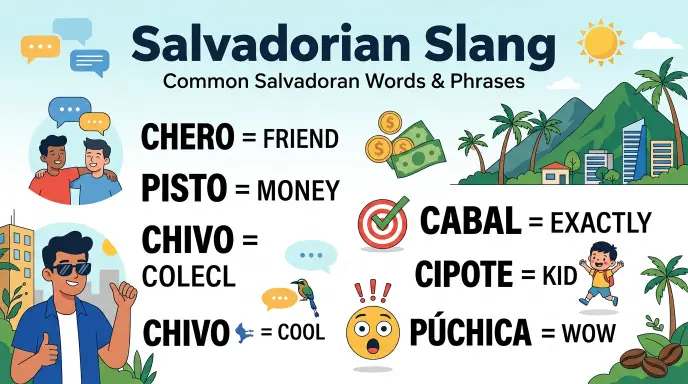
Salvadorian slang, more commonly called Salvadoran slang, refers to the informal Spanish words and expressions used in El Salvador. These words can make everyday conversations sound more local, friendly, and natural.
If you are learning Spanish, you may notice that Salvadoran Spanish has many words that differ from the Spanish used in Mexico, Spain, or other Latin American countries.
Words such as chero, maje, bicho, cipote, pisto, chivo, cabal, and púchica are common examples.
Salvadoran slang is sometimes called caliche, although that term can refer more broadly to local slang or informal speech.
Some Salvadoran words also have roots in Indigenous languages, while others are shared with neighboring Central American countries.
The meaning of a slang word can also change with tone and context. So, learning the word alone is not enough. You also need to know how Salvadorans use it in real conversations.
What Is Salvadoran Slang?
Salvadoran Slang Is Informal Spanish Used in El Salvador
Salvadoran slang is the collection of informal words, expressions, and phrases commonly heard in everyday life in El Salvador.
Some words are used mainly with friends, while others are common in general conversation. For example, cabal can mean “exactly” or “that’s right,” while chero means “friend” or “pal.” Pisto is commonly used for “money,” and cipote can mean “kid” or “young person.”
These terms are part of the local vocabulary and can help distinguish Salvadoran Spanish from other varieties of Spanish.
Common Salvadoran Slang Words
Here are some of the most useful Salvadoran slang words and expressions.
| Salvadoran Slang | English Meaning | Common Use |
| Chero / chera | Friend, pal | Talking to or about a friend |
| Maje | Dude, guy, buddy | Casual conversation |
| Bicho / bicha | Kid, young person | Talking about young people |
| Cipote / cipota | Kid, young person | Talking about children or teens |
| Pisto | Money | Talking about cash |
| Chivo / chiva | Cool, great | Showing approval |
| Cabal | Exactly, that’s right | Agreeing with someone |
| Púchica | Wow, dang | Surprise or frustration |
| Buena onda | Good vibes, friendly | Describing a nice person or situation |
| Está yuca | It’s difficult | Describing something hard |
| De choto | For free | Talking about something free |
| Simón | Yes, of course | Informal agreement |
| Vaya pues | Okay, see you / alright then | Ending or accepting a conversation |
| Volado | Thing, object | Referring to an unspecified thing |
| Bayunco | Silly, foolish, uncouth | Criticizing someone’s behavior |
| Chafa | Cheap, fake, imitation | Describing poor-quality or fake items |
Several of these meanings are documented in Salvadoran-language references and educational glossaries.
Chero Meaning in Salvadoran Slang
Chero or chera means friend, buddy, or pal in Salvadoran Spanish.
For example:
“Mi chero vive cerca.”
This means:
“My friend lives nearby.”
You can also hear chero used when directly talking to a friend:
“¿Qué ondas, chero?”
That means something like:
“What’s up, buddy?”
The word is strongly associated with informal Salvadoran speech.
Maje Meaning in Salvadoran Slang
Maje can mean dude, guy, buddy, or man.
Its tone depends heavily on the conversation. Among friends, it can sound casual and friendly:
“¿Qué onda, maje?”
This is similar to:
“What’s up, dude?”
However, maje can also carry a negative meaning when used to call someone foolish or foolish. Because tone matters, it is better understood from the full sentence.
Bicho Meaning in El Salvador
One interesting Salvadoran slang word is bicho.
In standard Spanish, bicho can mean a bug or small creature. In El Salvador, however, bicho or bicha can refer to a kid or young person.
For example:
“Ese bicho es muy inteligente.”
This can mean:
“That kid is very intelligent.”
This is an important example of why Spanish slang should not always be translated word for word.
Cipote Meaning in Salvadoran Spanish
Cipote or cipota means kid, child, teenager, or young person.
For example:
“Cuando era cipote, jugaba fútbol.”
This means:
“When I was a kid, I played soccer.”
The word is also used in other parts of Central America, including Honduras and Nicaragua, but it is strongly associated with Salvadoran everyday speech.
Pisto Meaning in Salvadoran Slang
Pisto means money in Salvadoran slang.
For example:
“No tengo pisto.”
means:
“I don’t have any money.”
You may hear the word in conversations about shopping, transportation, food, bills, or going out with friends.
Because slang meanings can differ across Spanish-speaking countries, do not assume that pisto has exactly the same meaning everywhere.
Chivo Meaning in El Salvador
Chivo or chiva can mean cool, great, good, or excellent in Salvadoran Spanish.
For example:
“¡Qué chivo!”
can mean:
“How cool!”
You may also hear:
“Está bien chivo.”
This means that something is really good or enjoyable.
The word is commonly listed among Salvadoran expressions used to show approval.
Cabal Meaning in Salvadoran Slang
Cabal is one of the most useful Salvadoran expressions.
In casual conversation, it can mean:
- Exactly
- That’s right
- Correct
- Yes, that’s what I mean
For example:
“Nos vemos a las seis.”
“¡Cabal!”
The response confirms that the speaker agrees.
Although cabal has other meanings in standard Spanish, Salvadoran speakers commonly use it as an informal agreement or confirmation.
Púchica Meaning in Salvadoran Slang
¡Púchica! is an exclamation used to express feelings such as surprise, frustration, admiration, or shock.
For example:
“¡Púchica! Qué calor hace.”
This can be translated naturally as:
“Wow! It’s so hot.”
Or:
“¡Púchica! No puedo creerlo.”
The exact English translation depends on the situation. It can work like “wow,” “dang,” “oh man,” or a similar mild reaction.
Buena Onda Meaning in El Salvador
Buena onda literally relates to “good vibes,” but it is often used to describe someone who is friendly, pleasant, or likable.
For example:
“Ese maje es buena onda.”
This means:
“That guy is really nice.”
The expression is not exclusive to El Salvador and appears in other varieties of Spanish too. However, it is also used in Salvadoran casual speech.
Está Yuca Meaning in Salvadoran Slang
Está yuca means “it’s difficult,” “it’s hard,” or “that’s tough.”
For example:
“El examen está yuca.”
means:
“The exam is really difficult.”
This expression is useful when someone wants to complain about a difficult task or situation.
De Choto Meaning
De choto means for free.
For example:
“La entrada es de choto.”
This means:
“The entrance is free.”
It is an informal expression, so it fits casual conversations better than formal writing. Salvadoran references list de choto as an expression meaning something is free.
Simón Meaning in Salvadoran Slang
Simón is an informal way to say yes, sure, or of course.
For example:
“¿Vamos al cine?”
“¡Simón!”
This can mean:
“Are we going to the movies?”
“Yeah!”
It is casual and should not be confused with the formal Spanish word or name that happens to have the same spelling.
Vaya Pues Meaning
Vaya pues is a common conversational expression in El Salvador. Depending on the situation, it can communicate something like “okay then,” “alright,” “go ahead,” or a casual goodbye.
For example:
“Nos vemos mañana.”
“Vaya pues.”
The exact translation depends on the conversation and tone.
Volado Meaning in Salvadoran Spanish
Volado can mean thing, object, or something in informal Salvadoran speech.
For example:
“Pasame ese volado.”
can mean:
“Pass me that thing.”
It is useful when the speaker does not want to name an object directly or assumes the listener knows what they mean.
Some Salvadoran references describe volado as a common informal word for a thing or object.
Bayunco Meaning
Bayunco can describe someone who is silly, foolish, uncouth, rude, or lacking good manners, depending on context.
For example:
“No seas bayunco.”
This can mean:
“Don’t be silly.”
or, in another context:
“Don’t be rude.”
The word is generally negative, so it is best used carefully.
Chafa Meaning in Salvadoran Slang
Chafa can describe something that is cheap, fake, an imitation, or poor quality.
For example:
“Esos zapatos son chafa.”
This means:
“Those shoes are fake or low quality.”
The word can be useful when talking about imitation products or something that does not seem original.
How Salvadoran Slang Is Different From Standard Spanish
The biggest difference is vocabulary and everyday usage.
A Spanish learner may know:
amigo = friend
But in El Salvador, they may hear:
chero = friend
They may know:
dinero = money
But hear:
pisto = money
They may know:
niño = child
But hear:
bicho or cipote = kid
This does not mean Salvadoran Spanish is a completely different language. It is Spanish with its own regional vocabulary, pronunciation, expressions, and conversational habits.
Salvadoran Slang and Voseo
Another important part of Salvadoran Spanish is voseo, the use of vos instead of tú in many informal situations.
For example, instead of:
“¿Tú quieres?”
a Salvadoran speaker may say:
“¿Vos querés?”
The verb form changes with vos as well.
This is not slang by itself, but it is an important part of understanding informal Salvadoran conversation.
It also helps explain why Salvadoran dialogue may sound different to someone who learned Spanish mainly through textbooks based on tú.
Are Salvadoran Slang Words Used Everywhere in El Salvador?
Not necessarily.
Language can vary by:
- Age
- Region
- Social group
- Family
- Setting
- Generation
- Personal preference
Some expressions are widely recognized, while others may be more local or less common.
Online slang lists can also mix genuinely Salvadoran vocabulary with words shared across Central America.
Therefore, it is better to describe a word as common in Salvadoran Spanish rather than claiming that only Salvadorans use it.
Why Does Salvadoran Spanish Have Unique Slang?
El Salvador has its own linguistic history, and Salvadoran Spanish includes vocabulary influenced by local languages and regional contact.
Some sources connect parts of Salvadoran vocabulary to Náhuat, the Indigenous language historically spoken in the region.
Other expressions developed through Spanish-language change and contact with neighboring Central American varieties.
This history helps explain why some Salvadoran words may sound unfamiliar to Spanish speakers from other countries.
When to Use Salvadoran Slang
Salvadoran slang is most natural in casual settings.
You can encounter it when:
- Talking with friends
- Chatting online
- Watching Salvadoran videos
- Reading Salvadoran social media
- Visiting El Salvador
- Learning regional Spanish
- Talking about Salvadoran culture
If you are speaking with Salvadoran friends, using a few familiar expressions can make your Spanish sound more natural. However, you should learn the meaning and tone first.
When to Avoid Salvadoran Slang
Avoid slang when you need very formal or neutral Spanish.
Examples include:
- Academic papers
- Legal documents
- Formal business writing
- Official applications
- Professional reports
- Formal presentations
Instead, use standard Spanish when clarity is more important than regional style.
You should also avoid using slang terms to label someone if you do not understand the tone.
For example, maje can be friendly in one conversation and insulting in another.
Common Mistakes When Using Salvadoran Slang
Assuming Every Word Is Unique to El Salvador
Some Salvadoran expressions are also used in neighboring Central American countries.
For example, words such as púchica and buena onda are not exclusive to El Salvador.
Translating Every Word Literally
Literal translation can create confusion.
For example:
“Ese bicho…”
may sound like it refers to an insect to a learner of standard Spanish.
In Salvadoran Spanish, bicho can mean a kid or young person.
Using Maje With Strangers
Because maje can be friendly or insulting depending on tone, it is safer to learn the context before using it with someone you do not know well.
Treating Slang as Formal Spanish
Words such as chero, pisto, chivo, and simón belong mainly to informal speech.
Use standard vocabulary when the situation requires formal Spanish.
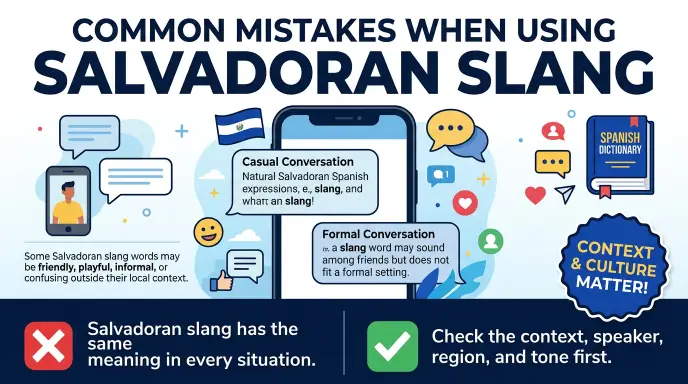
Assuming One Meaning Always Applies
Words can change meaning according to context.
Cabal, for example, can work as “exactly” or “that’s right,” while other terms may have additional meanings outside slang.
Is Salvadoran Slang Offensive?
Most Salvadoran slang is not offensive.
Words such as cabal, chero, chivo, pisto, and buena onda can be completely normal in casual conversations.
However, some expressions can sound rude, insulting, vulgar, or disrespectful depending on the word and situation.
Tone also matters. A word that sounds friendly between close friends may not be appropriate when speaking to a stranger, teacher, employer, or older person.
Is Salvadoran Slang the Same as Mexican Slang?
No.
Salvadoran Spanish and Mexican Spanish share many words, but each variety also has its own vocabulary and expressions.
For example, a Mexican Spanish speaker may commonly use güey for “dude,” while a Salvadoran speaker may use maje or chero in suitable contexts.
Likewise, pisto is a familiar Salvadoran term for money, while other countries have their own common words.
There is no single “Latin American slang.” Each country and community can develop its own vocabulary.
Key Takeaways About Salvadoran Slang
- Salvadorian slang is more commonly called Salvadoran slang.
- It refers to informal Spanish words and expressions used in El Salvador.
- Chero means friend or pal.
- Maje can mean dude, guy, or buddy, but tone matters.
- Bicho and cipote can mean kid or young person.
- Pisto means money.
- Chivo means cool, great, or excellent.
- Cabal can mean exactly or that’s right.
- Púchica expresses surprise, frustration, or admiration.
- Está yuca means something is difficult.
- De choto means for free.
- Simón is an informal way to say yes.
- Salvadoran slang is mainly useful in casual conversation.
- Some terms are shared with other Central American Spanish varieties.
- Context, tone, age, and community can change how a slang word sounds.
Frequently Asked Questions
What is a common insult in El Salvador?
A common Salvadoran insult is “cerote,” a vulgar word that can mean “asshole,” “jerk,” or “idiot,” depending on context and tone. Among close friends, it can sometimes be used jokingly.
How do you say “hi” in Salvadoran?
Salvadorans commonly say “¡Hola!” for “hi” or “hello.” In casual speech, “¿Qué ondas?” is also common and means something like “What’s up?” or “How’s it going?”
What does “bicho” mean in Salvadoran slang?
In Salvadoran slang, “bicho” commonly means “kid,” “boy,” or “young person.” It can be used casually for children or young people, depending on the context.
How do you say “cool” in Salvadoran slang?
A common Salvadoran way to say “cool” is “chivo.” For example, “Está chivo” can mean “It’s cool,” “It’s awesome,” or “That’s great.”
Salvadoran slang words
Common Salvadoran slang words include chivo (cool/great), bicho (kid/young person), cipote (kid/young person), maje (dude/friend), púchica (an expression of surprise), and pisto (money).
Funny Salvadoran slang words
Some Salvadoran expressions may sound funny to English speakers. “Púchica” is a common mild exclamation, while “chivo” means cool or great, and “bicho” can mean a kid or young person.
Salvadoran slang bad words Reddit
Salvadoran speakers may use vulgar words such as cerote, culero, and hijo de puta as insults. Their strength depends on the situation, relationship, and tone.
On Reddit, individual speakers may describe these terms differently, so they should not be treated as universal rules for all Salvadorans.
Salvadoran slang for girl
Common informal terms include “bicha” for a girl or young woman and “cipota” for a girl or young person. The exact choice can vary by age, region, and context.
El Salvador slang Urban Dictionary
Urban Dictionary contains user-submitted definitions for Salvadoran slang, but those entries are not an official dictionary of Salvadoran Spanish. Common Salvadoran terms include chivo (cool), maje (dude), bicho (kid), and pisto (money).
Salvadoran slang in English
Some common Salvadoran slang translations are chivo = cool, maje = dude/guy, bicho = kid, bicha = girl, pisto = money, and púchica = wow/darn. Meanings can change with context.
Conclusion
Salvadoran slang is a colorful part of everyday Spanish in El Salvador. Words such as chero, maje, bicho, cipote, pisto, chivo, cabal, and púchica can sound unfamiliar to Spanish learners, but they become easier to understand once you know their context.
The most important point is that Salvadoran slang is not one fixed list of words. Usage can change by region, age, social group, and situation.
Some terms are strongly associated with El Salvador, while others are shared with neighboring Central American countries.
If you are learning Salvadoran Spanish, start with common expressions such as chero, chivo, cabal, pisto, and púchica.
Then pay attention to how native speakers use them. That will help you understand both the meaning and the natural tone.
Discover More Articles!
ASF Slang Meaning: What Does ASF Mean in Text?(2026)
50s Slang: Common 1950s Slang Words and Their Meanings
Italian Slang: Common Italian Slang Words and Their Meanings

Hi, I’m Sophia Bennett, a novelist passionate about creating heartfelt stories filled with romance, emotion, and unforgettable characters. Through my books, I hope to inspire readers and take them on journeys they’ll always remember.