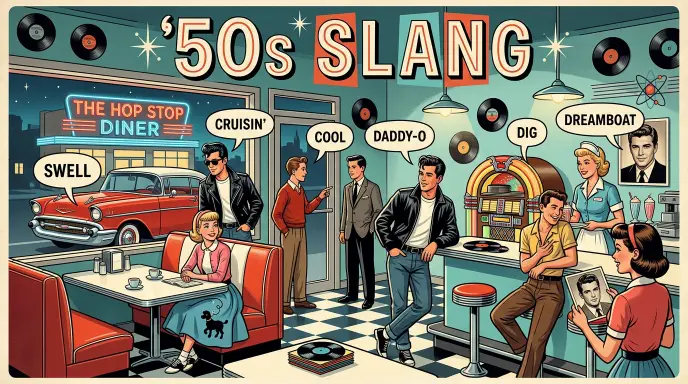
50s slang refers to the informal words and phrases popular in the 1950s, especially among young people in the United States.
Terms like cool, daddy o, hep, hip, swell, square, dig, dreamboat, cat, and cruisin’ became part of the era’s popular speech.
The 1950s brought major changes in American youth culture. Rock and roll, diners, drive in theaters, cars, jukeboxes, television, and new music styles helped create a strong cultural identity for young Americans.
Some 1950s slang came from earlier decades, while other terms became popular through music, movies, television, and youth culture.
Not every phrase was used by every person in the 1950s, so it is better to think of these words as popular examples of 1950s American slang, not as language used by everyone.
Today, many of these expressions sound retro or playful. You may still see them in movies, vintage themed posts, Halloween costumes, books, music, and social media.
What Was 50s Slang? Quick Answer
| 1950s slang | Meaning |
| Cool | Good, impressive, stylish |
| Daddy o | A friendly way to address a man |
| Hep | Knowledgeable or fashionable |
| Hip | Informed, fashionable, aware of trends |
| Square | Conventional or unfashionable person |
| Dig | Understand or like |
| Swell | Very good |
| Dreamboat | Very attractive person |
| Cat | A person, often a stylish or music loving man |
| Doll | Attractive or charming woman |
| Cruisin’ | Driving around for fun |
| Pad | Home or apartment |
| Bread | Money |
| Split | Leave |
| Buzz | Excitement or a strong feeling |
| Far out | Amazing, unusual, or impressive |
| Big Daddy | A powerful or important man |
| Greaser | A working class youth style associated with leather jackets and slicked back hair |
| Sock hop | A school or youth dance |
| Jive | Talk or behavior associated with a particular style of jazz and slang |
Cool
Cool is one of the most famous words linked with 1950s slang.
In the 1950s, cool could mean good, impressive, stylish, calm, or socially confident.
For example:
“That car is cool.”
This means:
“That car is impressive.”
The word existed long before the 1950s, especially in African American and jazz communities, but the decade helped make cool a major part of mainstream American youth culture.
Today, cool remains common. Its meaning has changed and expanded over time, but its connection with 1950s culture is still strong.
Daddy O
Daddy O was a casual way to address a man or friend.
For example:
“Hey, Daddy O!”
It had a friendly, playful, and slightly hip style.
The expression is strongly associated with mid century American slang, jazz culture, beat culture, and popular entertainment.
Today, Daddy O usually sounds deliberately retro rather than like normal everyday speech.
Hep
Hep meant being knowledgeable, aware, fashionable, or familiar with a particular cultural scene.
Someone who was hep knew what was happening and understood the latest trends.
For example:
“He’s hep to the new music.”
This suggests:
“He knows about the new music.”
The word is historically connected with jazz and earlier American slang.
Hip
Hip had a meaning similar to hep. It could describe someone who was informed, fashionable, or aware of current cultural trends.
For example:
“He’s hip to the scene.”
This means he understands or knows about what is happening.
The word became strongly associated with youth culture and music.
Today, hip still means fashionable or culturally aware, although modern usage may differ from its 1950s use.
Square
In 1950s slang, a square was a person seen as conventional, old fashioned, or out of touch with newer youth culture.
For example:
“Don’t be such a square.”
This means:
“Don’t be so conventional or old fashioned.”
The term was often used in contrast with hip.
A person who followed traditional ideas might be called a square, while someone who understood new music and youth culture might be considered hip.
Dig
Dig could mean understand, appreciate, or like something.
For example:
“Do you dig this music?”
This means:
“Do you like or understand this music?”
The expression has strong roots in African American speech and jazz culture and was later adopted more widely.
Today, “dig” can still be understood in this sense, although it may sound old fashioned or stylized.
Swell
Swell meant very good, excellent, or pleasant.
For example:
“That sounds swell.”
This means:
“That sounds great.”
The word was not created in the 1950s. It had been used in English long before that. However, it remained familiar in mid century American speech.
Today, swell often sounds vintage or humorous.
Dreamboat
Dreamboat was slang for a very attractive or desirable person, especially a romantic interest.
For example:
“He’s such a dreamboat.”
This means:
“He is very attractive.”
The word appeared in popular culture before the 1950s and remained familiar during the decade.
Today, dreamboat sounds playful and retro.
Cat
In mid century slang, cat could refer to a person, especially a man associated with jazz, music, or a stylish social scene.
For example:
“That cat can really play.”
Here, cat means something like:
“That guy is a talented musician.”
The word had deep roots in jazz culture and was not limited to the 1950s.
Doll
Doll was an informal term used for an attractive or charming woman.
For example:
“Hey, doll!”
The expression appeared in earlier decades and continued into the 1950s.
Today, calling someone “doll” can sound old fashioned or overly familiar, depending on the situation.
Cruisin’
Cruisin’ meant driving around, often for fun, socializing, or enjoying the music.
Cars played a major role in American youth culture during the 1950s. Young people often connected cars, music, diners, and social life.
For example:
“We’re going cruisin’ tonight.”
This means:
“We’re going to drive around tonight.”
The term became strongly associated with American car culture.
Pad
Pad was slang for a person’s home or apartment.
For example:
“Come over to my pad.”
This means:
“Come over to my place.”
The term became associated with informal youth and beat culture.
Pad can still be understood today, although it sounds more casual and sometimes retro.
Bread
Bread could mean money.
For example:
“I need some bread.”
This means:
“I need some money.”
The money meaning of bread has a longer history and did not begin in the 1950s. However, it was part of American slang and popular culture during the era.
Today, “bread” is still used as slang for money.
Split
Split could mean leave.
For example:
“Let’s split.”
This means:
“Let’s leave.”
The phrase was used before the 1950s and continued through the decade.
It is one of the older slang expressions that still appears in modern casual English.
Buzz
Buzz could describe excitement, a strong feeling, or the excitement surrounding something.
For example:
“There’s a big buzz about the new record.”
This means:
“There is a lot of excitement about the new record.”
The word has many meanings, so the exact interpretation depends on the sentence.
Far Out
Far out could express surprise, approval, or amazement.
For example:
“Far out! That’s incredible.”
It became strongly connected with American counterculture and youth language, especially in later decades.
Although people often associate it with the 1960s and 1970s, it has roots in earlier slang and music culture.
For a strict 1950s article, it is best to treat far out as an expression that was emerging rather than one that defined the entire decade.
Big Daddy
Big Daddy could refer to an important, powerful, respected, or influential man.
The exact meaning depended on the speaker and situation.
For example:
“He thinks he’s Big Daddy.”
This could suggest that the person acts powerful or important.
The phrase has a longer history and later became common in different forms of popular culture.
Greaser
Greaser became associated with a youth style involving leather jackets, slicked back hair, motorcycles, cars, and rock and roll culture.
The term was not simply a universal word for every teenager. It was tied to a particular youth subculture and was also used in ways that could carry class or ethnic stereotypes.
The image of the greaser became especially famous through 1950s and later popular culture.
Sock Hop
A sock hop was a youth dance, often connected with schools and popular music.
Students might dance in a school gym while listening to records or live music.
The term became strongly associated with 1950s teenage culture.
For example:
“Are you going to the sock hop?”
This means:
“Are you going to the school dance?”
The phrase remains one of the most recognizable terms from the decade.
Jive
Jive has several historical meanings.
In music and slang, it became connected with jazz culture, dance, and a style of speech.
Someone might also use jive to describe misleading or deceptive talk.
For example:
“Don’t give me that jive.”
This can mean:
“Don’t give me that nonsense.”
The word has complex roots in African American English and jazz culture, so its history should not be reduced to a simple “1950s word.”
50s Slang for Friends
People did not use only one word for friends in the 1950s. Terms such as pal, buddy, cat, chum, and Daddy O could appear in informal speech, depending on the social group.
For example:
“Hey, buddy!”
or:
“Hey, Daddy O!”
Some terms were more strongly associated with particular subcultures than others.
50s Slang for Money
Some money related slang included:
- Bread : money
- Dough : money
- Scratch : money
- Moolah : money
These words were not all created during the 1950s. Many had longer histories.
Still, they appeared in American informal speech and popular culture around the era.
50s Slang for Girls
Some terms used in mid century American culture included:
- Doll : attractive woman
- Dreamboat : attractive person
- Chick : young woman
- Babe : attractive young person, often a woman in some contexts
Some of these terms can sound outdated or disrespectful today.
Modern readers should understand them as historical slang rather than assume they are appropriate terms to use now.
50s Slang for Boys and Men
Common informal terms included:
- Guy : man or person
- Cat : man, especially in jazz related contexts
- Daddy O : informal address for a man
- Buddy : friend or man
- Pal : friend
Again, context mattered. Some expressions belonged to particular groups rather than the whole population.
50s Slang for Something Good
If someone wanted to describe something positively, expressions included:
- Cool : good or impressive
- Swell : very good
- Neat : nice or enjoyable
- Terrific : excellent
- Hip : fashionable or culturally aware
Some of these words were not exclusive to the 1950s. They simply fit the language and popular culture of the period.
50s Slang for Something Bad
Some informal words could describe something unpleasant, boring, or undesirable.
Square could describe someone viewed as old fashioned.
Drag could describe something boring or disappointing.
Dud could describe something that failed to impress.
For example:
“The party was a dud.”
This means:
“The party was disappointing.”
50s Teen Slang
Teenagers played an important role in popularizing mid century slang.
Words and phrases associated with teenage culture included:
- cool
- hip
- square
- daddy o
- dreamboat
- cruisin’
- sock hop
- greaser
- swell
- dig
Teen slang often reflected music, cars, dating, movies, and the growing importance of youth culture.
50s Slang in Music
Music had a major effect on 1950s language.
Rock and roll, rhythm and blues, jazz, and other music styles helped spread words between different communities.
Some slang was already used in African American communities and jazz culture before becoming popular with wider audiences.
This is important because many so called “1950s slang words” were not invented by white teenagers in the 1950s. Their histories often reach back much further.
50s Slang in Movies and TV
Movies and television helped create a lasting image of 1950s speech.
Characters in films and TV shows sometimes used words such as:
- Daddy O
- swell
- doll
- square
- cool
- dreamboat
- greaser
However, fictional dialogue is not always a perfect record of everyday speech.
Writers sometimes exaggerated slang to make characters sound young, rebellious, fashionable, or humorous.
Did Everyone Use 1950s Slang?
No.
This is an important point.
The United States was not linguistically uniform in the 1950s. People spoke differently based on:
- region
- age
- race
- social class
- occupation
- community
- music scene
- local culture
Some slang was strongly associated with jazz musicians or African American communities. Other words became common in teenage culture.
So, a list of “1950s slang” should not be treated as a list of words every American used.
How 50s Slang Differs From Modern Slang
1950s slang often reflected the culture of the time.
Cars, diners, records, jukeboxes, dancing, rock and roll, and teenage social life all shaped the vocabulary.
Modern slang is strongly influenced by:
- social media
- texting
- gaming
- memes
- TikTok
- streaming
- online communities
For example, LOL and DM belong to the digital age, while sock hop and cruisin’ reflect an earlier social world.
Common Mistakes When Using 50s Slang
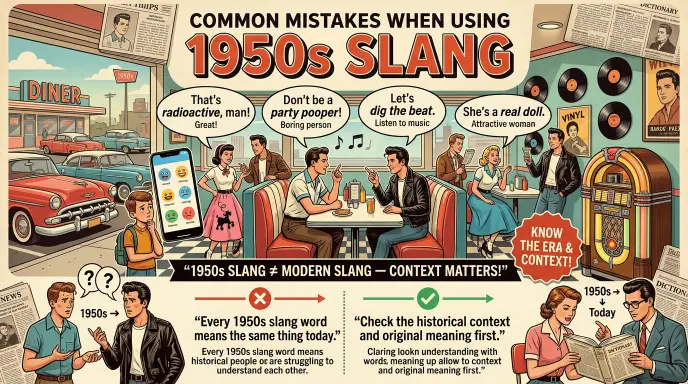
Assuming Every Word Was Invented in the 1950s
Many expressions existed before the decade.
The 1950s may have helped popularize them, but that does not mean the decade created them.
Treating Movies as Perfect Historical Evidence
Movies often exaggerate slang.
Real speech was more varied.
Using Every Term as Modern Slang
Words like Daddy O and swell can sound intentionally retro today.
Ignoring Cultural Origins
Some 1950s slang came from African American English, jazz culture, and other communities.
It is important to recognize those histories.
Assuming Everyone Used the Same Slang
Slang varied greatly by region, age, community, and social group.
Are 50s Slang Words Still Used Today?
Some are still common, while others sound old fashioned.
Words such as cool, bread, split, buddy, and hip still appear in modern English.
Expressions such as Daddy O, swell, and dreamboat are more likely to sound vintage.
Their modern use often appears in:
- retro parties
- movies
- books
- social media
- themed events
- comedy
- vintage fashion content
Why Is 50s Slang Still Popular?
1950s slang remains popular because the decade has a strong cultural image.
People still associate the era with:
- rock and roll
- classic cars
- diners
- jukeboxes
- leather jackets
- poodle skirts
- sock hops
- drive in theaters
- early television
Using 1950s slang can quickly create a retro mood.
That is why writers, filmmakers, marketers, and social media creators still use some of these expressions.
Key Takeaways About 50s slang
- 50s slang refers to informal language associated with the 1950s.
- Many popular terms came from earlier decades.
- Cool is one of the most recognizable expressions linked with the era.
- Daddy O was a casual way to address a man.
- Square described someone viewed as conventional or old fashioned.
- Dig could mean understand or like.
- Swell meant very good.
- Dreamboat referred to an attractive person.
- Cruisin’ described driving around for fun.
- Pad meant a person’s home or apartment.
- Bread and dough could mean money.
- Sock hop referred to a youth dance.
- 1950s slang varied by region, age, culture, and social group.
- Movies and TV sometimes exaggerate historical slang.
Frequently Asked Questions
What were popular 1950s slang terms?
Popular 1950s slang included cool cat (a stylish or impressive person), daddy-o (a man or guy), hep (fashionable or up to date), groovy (excellent or enjoyable), square (old fashioned or uncool), bread (money), chick (girl or young woman), and pad (home or apartment).
How do you say “cool” in the 50s?
In 1950s slang, “cool” itself was already a popular word for someone or something stylish, calm, or impressive. “Hep” and “cool cat” were also used to describe someone fashionable or in the know.
What is the slang word for 50?
There was no single widely used 1950s slang word that universally meant 50. In some contexts, “half a C” could refer to fifty because C represents 100, but this was not a standard everyday slang term.
What did they call girls in the 50s?
Common 1950s slang for girls included “chick,” “doll,” “broad,” and “gal.” These terms had different tones: “doll” could sound affectionate, while “broad” could sound dated or disrespectful.
What was 1950s slang for cool?
In the 1950s, “cool” was already popular slang for something stylish, impressive, or fashionable. Other expressions included “hep,” “cool cat,” and “groovy.”
What were popular 50s slang words?
Popular 1950s slang included cool, hep, cool cat, daddy-o, square, chick, doll, bread, pad, and groovy. Their meanings depended on the situation and the speaker.
What was 50s slang for girl?
Common 1950s slang for a girl included “chick,” “doll,” “gal,” and sometimes “broad.” “Chick” and “doll” could be casual or complimentary, while “broad” could sound disrespectful.
What was 1950s slang for a pretty girl?
A pretty or attractive girl could be called a “doll” or “chick” in 1950s slang. “Doll” was often used as a friendly or flattering term for an attractive young woman.
What were 1950s slang insults?
Some 1950s-era insults included “square” for someone considered dull or old-fashioned, “creep” for an unpleasant person, and “jerk” for someone acting foolishly or badly. Some terms had stronger meanings depending on context.
What was 1950s slang for boy?
Common terms for a boy or young man included “kid,” “cat,” “guy,” “fella,” and “hep cat.” “Cat” could especially refer to a fashionable or socially cool young man.
Conclusion
50s slang captures the informal language and changing youth culture of 1950s America. Words such as cool, Daddy O, hip, square, dig, swell, dreamboat, pad, and bread remain recognizable because movies, music, television, and later pop culture kept them alive.
However, these words did not all begin in the 1950s. Many have older histories, and some came from specific communities before becoming more widely known.
If you use 1950s slang today, the words may sound nostalgic or playful. Understanding their history and context makes it easier to use them accurately and avoid treating a fictional movie version of the 1950s as the complete picture.
Discover More Articles!
What Does Tweaking Mean in Slang? Meaning in Text, & Social Media
Mexico Slang: Common Mexican Slang Words & Meanings
ASF Slang Meaning: What Does ASF Mean in Text?(2026)

Hi, I’m Sophia Bennett, a novelist passionate about creating heartfelt stories filled with romance, emotion, and unforgettable characters. Through my books, I hope to inspire readers and take them on journeys they’ll always remember.