Italian slang is informal Italian used in everyday chats, among friends, on social media, and in casual conversations.
These words and phrases can sound more relaxed, funny, friendly, or expressive than standard Italian.
Italian has many regional varieties, so slang can change from one city or area to another. A phrase common in Rome may sound less common in Milan, Naples, or Sicily.
Younger speakers also create new slang through TikTok, Instagram, gaming, music, and online chats.
If you are learning Italian, slang can help you understand how people actually communicate. However, some expressions are very casual, rude, or vulgar. So, context matters.
What Does Italian Slang Mean? Quick Answer
Italian slang means informal words, expressions, and shortened phrases used in casual Italian speech and online communication.
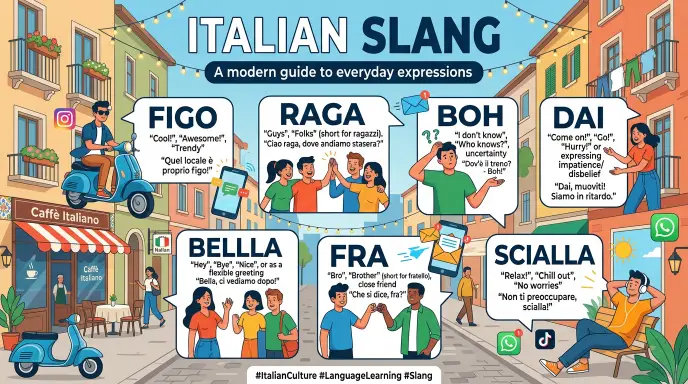
Common examples include figo for “cool,” tipo for “guy/person,” raga for “guys,” boh for “I don’t know,” dai for “come on,” and bella as a casual greeting.
Quick Italian Slang Table
| Italian slang | Meaning in English | Common use |
| Figo | Cool / awesome | Friends, social media |
| Raga | Guys / everyone | Group chats |
| Boh | I don’t know / who knows | Casual speech |
| Dai | Come on / go ahead | Everyday conversation |
| Bella | Hey / hi | Casual greeting |
| Tipo | Guy / person / like | Speech and texting |
| Mamma mia | Oh my gosh / wow | Surprise |
| Che figata! | How cool! / That’s awesome! | Excitement |
| Spacca | It’s great / it rocks | Casual praise |
| Scialla | Relax / chill | Informal speech |
| Bro | Bro / brother | Young speakers |
| Fra | Bro / mate | Friends and online chat |
| Cavolo | Darn / wow | Mild expression |
| Cazzo | Fuck / damn | Vulgar speech |
| Minchia | Damn / wow / fuck | Regional and vulgar |
| Rosicare | To be annoyed or jealous | Casual speech |
| Sfigato | Loser / unlucky person | Insult |
| Puzza | Stinks / smells bad | Informal speech |
| Sbatti | Hassle / effort | Casual conversation |
Common Italian Slang Words
Figo
Figo means “cool,” “awesome,” or “good-looking,” depending on the context.
You may hear:
Quel film è figo!
This means:
“That movie is cool!”
Figo is common in casual Italian. The feminine form figa can also appear, but its meaning and tone depend strongly on context. In some situations, it can sound vulgar or refer to an attractive woman.
Raga
Raga is a shortened form of ragazzi, which means “guys” or “boys.”
People often use raga when talking to a group of friends.
For example:
Raga, andiamo!
This means:
“Guys, let’s go!”
You may see raga in WhatsApp chats, Instagram comments, TikTok captions, and other casual online spaces.
Boh
Boh is one of the most useful informal Italian expressions.
It can mean:
- “I don’t know.”
- “Who knows?”
- “No idea.”
- “I’m not sure.”
Example:
Quando arriva?
Boh.
The natural English meaning is often simply “I don’t know.”
Dai
Dai literally comes from the verb dare, meaning “to give,” but in everyday speech it has many uses.
Depending on tone, dai can mean:
- Come on
- Go ahead
- Really?
- Stop it
- Let’s go
For example:
Dai, vieni con noi!
means:
“Come on, come with us!”
Because tone changes the meaning, beginners should listen to the full conversation before translating it.
Bella
Bella can mean “beautiful,” but in casual Italian it can also work as a greeting.
For example:
Bella, come stai?
can mean:
“Hey, how are you?”
The masculine form bello may also appear in casual speech.
However, bella has several meanings in Italian, so context is important.
Tipo
Tipo means “type” in standard Italian, but people also use it casually to mean “guy,” “person,” or “like.”
For example:
C’era un tipo alla festa.
This can mean:
“There was a guy at the party.”
It can also work as a filler similar to “like” in English.
Italian Slang for “Cool”
If you want to say something is cool in Italian, you have several informal choices.
Figo is one of the most common casual choices.
Che figata! means something like:
“How cool!”
or
“That’s awesome!”
Another informal expression is spacca, which can describe something that is really good or impressive.
For example:
Questa canzone spacca!
means:
“This song rocks!”
These expressions work best in casual conversations rather than formal writing.
Italian Slang for Friends
Italian speakers use several casual words when talking to friends.
Fra
Fra is short for fratello, meaning “brother.” In modern informal speech, it can mean “bro,” “brother,” or “mate.”
Example:
Fra, che fai?
Meaning:
“Bro, what are you doing?”
It is especially common among younger speakers and online.
Bro
The English word bro also appears in Italian online communication. Social media, gaming, music, and international internet culture have helped spread English slang among Italian speakers.
Raga
As mentioned above, raga comes from ragazzi and is often used when addressing several friends.
Italian Slang for “Chill” or “Relax”
Scialla
Scialla is informal Italian slang meaning “relax,” “take it easy,” or “don’t worry.”
For example:
Scialla, non è un problema.
This means:
“Relax, it’s not a problem.”
The expression is strongly associated with informal speech and youth culture. It is not a good choice for formal situations.
Funny Italian Slang and Expressions
Italian casual speech has many expressive phrases.
Mamma Mia
Mamma mia literally means “my mother,” but people use it as an emotional expression.
Depending on the situation, it can express:
- Surprise
- Shock
- Frustration
- Excitement
- Disbelief
For example:
Mamma mia, che caldo!
means:
“Oh my gosh, it’s so hot!”
Although the phrase is famous around the world, Italians use it in real speech too.
Che Figata!
Che figata! is a casual way to say “That’s awesome!” or “How cool!”
It comes from figo and has a distinctly informal tone.
Cavolo
Cavolo literally means “cabbage,” but it can work as a mild exclamation.
Depending on the context, it can be similar to:
- “Darn!”
- “Wow!”
- “Come on!”
It can also serve as a softer alternative to stronger vulgar expressions.
Italian Vulgar Slang
Italian has many swear words and vulgar expressions. They appear in movies, music, gaming, social media, and everyday speech, but that does not mean they are appropriate everywhere.
Cazzo
Cazzo is a very vulgar Italian word. Depending on the sentence, it can work like “fuck,” “damn,” or other strong English swear words.
For example, che cazzo? is a very rude way to express confusion, anger, or disbelief.
Avoid this word in formal conversations, professional settings, school assignments, and situations where you want to sound polite.
Minchia
Minchia is a vulgar expression strongly associated with Sicilian and southern Italian speech.
Depending on context and tone, it can express:
- Surprise
- Anger
- Frustration
- Amazement
It is not a neutral Italian word. Its meaning can also change across regions and situations.
Sfigato
Sfigato describes someone seen as unlucky, uncool, or a loser.
It can be insulting, although friends may sometimes use it jokingly.
Because of this, learners should be careful when using it with people they do not know well.
Italian Slang for Texting and Social Media
Italian slang has changed with online communication. People often shorten words or borrow expressions from English.
Common casual terms include:
- raga : guys
- fra : bro
- cmq : abbreviation of comunque, meaning “anyway”
- xché / xke : informal texting forms related to perché, meaning “why/because”
- nn : informal abbreviation for non
- qnd : informal abbreviation for quando, meaning “when”
- tvb : ti voglio bene, a common affectionate abbreviation
Texting abbreviations can vary by age and online community. Not every Italian speaker uses them, and some may look outdated or overly casual.
Italian Slang on TikTok and Instagram
Italian social media users mix traditional Italian slang with internet language.
You may see words such as raga, fra, bro, figo, and scialla in comments and captions. English internet slang also appears often, especially among younger users.
For example:
Raga, questo video spacca!
can be understood as:
“Guys, this video is awesome!”
Social platforms also spread regional expressions beyond their original areas. A word that once belonged mainly to one city or region can become familiar to users across Italy.
Italian Slang in Gaming
Italian gamers often mix Italian expressions with English gaming terms.
You may see:
- bro
- fra
- raga
- gg
- noob
- easy
- lag
- pushare : an Italianized form related to “push”
- nerfare : based on “nerf”
- droppare : based on “drop”
This mix shows how gaming communities create their own informal language.
For example:
Raga, pushiamo!
could mean:
“Guys, let’s push!”
These hybrid forms are especially common in online gaming and should not be treated as formal Italian vocabulary.
Italian Slang From Different Regions
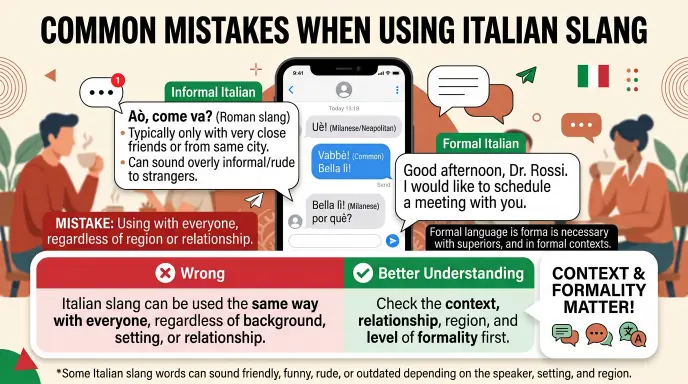
One important thing to remember is that Italian slang is not the same everywhere in Italy.
Italy has strong regional identities and many local varieties of speech. Roman slang can sound different from Neapolitan, Sicilian, Milanese, or other regional forms.
Some expressions may also change meaning depending on the city.
This is why a slang dictionary should give context instead of presenting every word as a universal Italian expression.
Regional slang can also reflect local history, dialect, music, food, and culture.
Italian Slang vs Standard Italian
The main difference is formality and context.
| Standard Italian | Informal/slang idea |
| Come stai? | Come va? |
| Ragazzi | Raga |
| Non lo so | Boh |
| È fantastico | È figo |
| Andiamo | Dai, andiamo |
| Rilassati | Scialla |
The informal versions can sound more natural among friends, but standard Italian remains important for school, business, official communication, and formal writing.
Common Mistakes When Using Italian Slang
Treating every slang word as universal
Some expressions are regional. Do not assume that every Italian speaker uses the same slang.
Using vulgar words with strangers
Strong words such as cazzo and minchia can offend people. Learn their tone before using them.
Translating word for word
Italian slang often does not translate literally.
For example, mamma mia does not normally mean that someone is literally talking about their mother.
Using slang in formal writing
A slang word that sounds natural in a WhatsApp chat may look inappropriate in an email, school essay, job application, or official document.
Assuming social media reflects all Italian speech
TikTok and Instagram show one part of Italian language use. Online slang can spread quickly, but it does not mean every Italian speaker uses it.
When Should You Avoid Italian Slang?
Use more formal Italian when speaking with:
- Teachers
- Employers
- Customers
- Officials
- People you have just met
- Professional contacts
Casual slang works better with close friends and in relaxed online conversations.
When in doubt, start with standard Italian. You can add informal expressions after you understand the social setting.
Is Italian Slang Different From Italian Dialects?
Yes.
Slang is informal vocabulary or expressions used by particular groups or in casual settings. A dialect or regional language variety can involve much broader differences in vocabulary, pronunciation, grammar, and structure.
Italy has many regional speech traditions. Some slang terms come from these local varieties, while others spread through national media, music, movies, television, and the internet.
So, Italian slang and Italian dialects can overlap, but they are not the same thing.
Key Takeaways About Italian Slang
- Italian slang is informal language used in casual speech and online communication.
- Figo can mean “cool” or “awesome.”
- Raga means “guys” and comes from ragazzi.
- Boh usually means “I don’t know” or “who knows.”
- Dai can mean “come on,” “go ahead,” or express disbelief.
- Bella can work as a casual greeting.
- Fra means “bro” or “mate” in informal speech.
- Scialla means “relax” or “take it easy.”
- Cazzo and minchia are vulgar and need extra care.
- Italian slang can change by region, age group, and online community.
- Formal Italian is safer for professional and official situations.
Frequently Asked Questions
How do Italians say “I’m sorry”?
The most common way to say “I’m sorry” in Italian is “Mi dispiace.” In casual situations, “Scusa” means “sorry” when speaking to one person informally.
What does “ugatz” mean in Italian?
“Ugatz” is not a standard Italian word. It is an Italian-American slang term, especially associated with Italian-American speech and The Sopranos, and is often used to mean “nothing” or “not a thing.”
What is Italian slang for “cool”?
Common Italian slang for “cool” includes “figo” or “forte.” For example, “È figo!” can mean “It’s cool!” or “That’s awesome!”
What is Italian slang for a hot girl?
In informal Italian, “una bella ragazza” means “a beautiful girl,” while “una ragazza sexy” means “a sexy girl.” “Figa” is also used in vulgar slang for an attractive woman, but it is crude and should be avoided in polite conversation.
Italian slang words
Common Italian slang words include figo (cool), raga (guys/everyone), bella (hi/hey), boh (I don’t know), tipo (guy/dude), casino (mess/chaos), sfigato (loser), and spacca (it rocks/is awesome). Meanings can change with region and context.
Italian slang Sopranos
The Sopranos uses many Italian American expressions rather than standard modern Italian. Examples include gabagool (capicola), goombah (an Italian American associate or friend), paisan (fellow Italian/Italian American), madone (Madonna, used as an exclamation), and ugatz (nothing/not a thing). Some spellings are stylized pronunciations rather than standard Italian.
Italian slang words insults
Common Italian insults include stupido (foolish), idiota (idiot), cretino (fool/idiot), stronzo (jerk/asshole), and coglione (idiot/asshole, vulgar). The stronger terms can be offensive, so tone and relationship matter.
Funny Italian slang words
Some Italian slang can sound funny to English speakers because of its unusual sound or literal meaning.
Examples include boh (I don’t know), casino (mess/chaos), pasticcio (mess-up), sbroccare (to lose it), and mollare (to ditch or leave someone/something).
Italian slang dictionary
An Italian slang dictionary explains informal words and expressions that may not appear in basic Italian lessons. Useful entries include figo (cool), bella (hey/hi), raga (guys), boh (I don’t know), tipo (guy), and casino (mess/chaos).
Italian slang words in English
Some Italian slang and Italian American expressions are familiar in English, especially through food, movies, television, and Italian American culture.
Examples include paisan/paisano (fellow Italian or Italian American), goombah (friend or associate), gabagool (a stylized Italian-American pronunciation of capocollo), and ugatz (nothing).
Conclusion
Italian slang makes casual communication more expressive and natural. Words such as figo, raga, boh, dai, bella, fra, and scialla can help learners understand conversations that standard Italian lessons may not cover.
However, Italian slang depends heavily on context, region, age, and relationship. Some words are friendly, while others are rude or vulgar.
Therefore, learning the meaning is only the first step. You should also learn when a word is appropriate.
For beginners, a good approach is to understand common casual expressions first and use stronger slang only after hearing how native speakers use it.
Discover More Articles!
Mexico Slang: Common Mexican Slang Words & Meanings
ASF Slang Meaning: What Does ASF Mean in Text?(2026)
50s Slang: Common 1950s Slang Words and Their Meanings

Hi, I’m Sophia Bennett, a novelist passionate about creating heartfelt stories filled with romance, emotion, and unforgettable characters. Through my books, I hope to inspire readers and take them on journeys they’ll always remember.