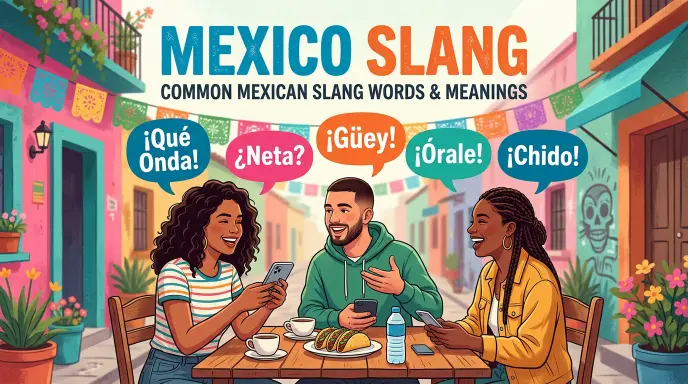
Mexico slang refers to the informal words, phrases, and expressions commonly used in everyday Mexican Spanish, especially in casual conversations, texting, social media, and among friends.
Mexican Spanish has many slang words that may sound confusing if you only know standard Spanish.
Words such as güey, chido, padre, neta, órale, lana, chamba, chela, and no manches can have meanings that are very different from their literal translations.
Mexico slang is also called Mexican Spanish slang or Mexican Spanish colloquial language. Some expressions are friendly and playful, while others can be rude, vulgar, or inappropriate in formal situations.
Learning these expressions can help you understand Mexican movies, music, TikTok videos, memes, text messages, and everyday conversations.
However, context matters because the same word can change meaning depending on tone, region, and the relationship between speakers.
What Is Mexico Slang? Quick Answer
Mexico slang is informal Mexican Spanish used in casual speech, texting, social media, and everyday conversations.
Common examples include güey for “dude” or “guy,” chido for “cool,” neta for “truth” or “really,” and chamba for “work.”
These expressions are not always suitable for formal situations. Some are friendly, while others can sound rude depending on how they are used.
What Is Mexican Slang?
Mexican slang is the informal language people use in relaxed conversations. It includes shortened expressions, local vocabulary, playful phrases, and words that have developed meanings beyond standard Spanish.
For example,
chamba means “work” in Mexican slang. A person might say:
“Tengo mucha chamba.”
This means:
“I have a lot of work.”
Another common word is lana, which can mean “money.”
“No tengo lana.”
This means:
“I don’t have money.”
These words are common examples of how Mexican Spanish can differ from textbook Spanish.
Why Is Mexico Slang So Popular?
Mexico has a large and diverse Spanish speaking population, so informal language plays an important role in everyday communication.
Mexican slang appears in:
- Everyday conversations
- Text messages
- TikTok
- YouTube
- Music
- Movies and television
- Gaming chats
- Memes
- Friend groups
- Street conversations
Mexican popular culture has also helped introduce Mexican expressions to Spanish speakers and language learners around the world.
However, not every slang word is used equally across Mexico. Regional differences matter, and some expressions are more common in certain cities or communities.
Common Mexico Slang Words and Their Meanings
Güey
Güey is one of the most recognizable Mexican slang words.
Depending on context, it can mean dude, bro, guy, or friend.
For example:
“¿Qué pasó, güey?”
This can mean:
“What happened, dude?”
Friends often use it casually with each other. However, tone matters. In some situations, güey can sound disrespectful.
You may also see it written as wey or we, especially in informal texting.
Chido
Chido means cool, awesome, or great.
For example:
“Está muy chido.”
This means:
“It’s really cool.”
You may hear chido when someone likes an idea, object, event, outfit, song, or experience.
Padre
In Mexican slang, padre can also mean cool, great, or awesome.
For example:
“La fiesta estuvo muy padre.”
This means:
“The party was really great.”
The literal meaning of padre is “father,” but context changes its meaning.
Neta
Neta can mean truth, really, seriously, or honestly, depending on the sentence.
For example:
“La neta, me gusta mucho.”
This can mean:
“Honestly, I really like it.”
Another common phrase is:
“¿Neta?”
This means:
“Really?”
It is widely useful in casual Mexican Spanish.
Órale
Órale is a flexible Mexican expression. Depending on context, it can express surprise, agreement, encouragement, or a reaction such as “wow” or “okay.”
For example:
“¡Órale! Qué bonito.”
This can mean:
“Wow! How beautiful.”
It can also be used to encourage someone:
“¡Órale, vámonos!”
Meaning:
“Come on, let’s go!”
Because its meaning depends strongly on tone and context, learners should pay attention to the surrounding conversation.
Chamba
Chamba means work or job.
For example:
“Tengo que ir a la chamba.”
This means:
“I have to go to work.”
The word is informal, so it is more natural in casual conversations than in formal writing.
Lana
Lana is a common slang word for money.
For example:
“No traigo lana.”
This means:
“I don’t have any money with me.”
The literal meaning of lana is “wool,” but Mexican slang gives it another meaning in casual conversations.
Chela
Chela is Mexican slang for beer.
For example:
“Vamos por unas chelas.”
This means:
“Let’s go get some beers.”
Because this term refers to alcohol, it is generally used in casual conversations.
No Manches
No manches is a common Mexican expression used to show surprise, disbelief, annoyance, or shock.
It can be similar to:
- “No way!”
- “Seriously?”
- “Come on!”
- “You’ve got to be kidding!”
For example:
“¡No manches! ¿De verdad?”
This means:
“No way! Really?”
It is often used as a softer alternative to a more vulgar expression.
Aguas
Aguas can mean watch out, be careful, or look out in Mexican slang.
For example:
“¡Aguas con el coche!”
This means:
“Watch out for the car!”
The literal meaning of aguas is “waters,” but the slang meaning is completely different in this context.
Fresa
Fresa can describe someone who is perceived as preppy, privileged, sophisticated, or somewhat snobbish.
Its meaning depends on the context and speaker.
For example:
“Ese chico es muy fresa.”
This could mean:
“That guy is very preppy.”
It can be teasing or negative, so it should not be treated as a simple compliment.
Chafa
Chafa means cheap, low quality, poorly made, or disappointing.
For example:
“Ese teléfono está bien chafa.”
This means:
“That phone is really low quality.”
It is commonly used when someone thinks something is not very good.
Carnal
Carnal can mean brother, close friend, buddy, or bro in Mexican slang.
For example:
“Gracias, carnal.”
This can mean:
“Thanks, bro.”
It often suggests familiarity or friendship.
Compa
Compa is a casual term for friend, buddy, or companion.
For example:
“¿Qué onda, compa?”
This means:
“What’s up, buddy?”
It is especially common in informal speech.
Qué Onda
¿Qué onda? is a common Mexican greeting that means “What’s up?”, “How are you?”, or “What’s going on?”
For example:
“¡Qué onda, güey!”
This is an informal way to greet a friend.
The phrase is very casual and should generally be used with people who are comfortable with informal language.
Simón
Simón is informal Mexican slang for yes, definitely, or sure.
For example:
“¿Vamos al cine?”
“Simón.”
This means:
“Are we going to the movies?”
“Yeah / Sure.”
It is a casual expression rather than formal Spanish.
Nel
Nel is informal slang for no or nope.
For example:
“¿Quieres ir?”
“Nel.”
This means:
“Do you want to go?”
“Nope.”
It is casual and can sound playful.
Quiúbole
Quiúbole is a casual Mexican greeting similar to “what’s up?” or “how’s it going?”
It is often used when greeting friends or acquaintances.
For example:
“¡Quiúbole! ¿Cómo estás?”
This means:
“What’s up! How are you?”
Mexican Slang for Friends
Several Mexican slang words can refer to friends or people you know well.
Common examples include:
| Mexican slang | Common meaning |
| Güey | Dude, bro, guy |
| Carnal | Bro, close friend |
| Compa | Buddy, friend |
| Cuate | Friend, buddy |
| Chavo | Guy, young person |
| Chava | Girl, young woman |
These words are informal. The best choice depends on the speaker, region, and relationship.
Mexican Slang for Money
Mexican Spanish also has informal words for money.
The most common example is:
Lana : money.
For example:
“Necesito lana.”
Meaning:
“I need money.”
Another informal expression is varo, which can refer to money or pesos.
For example:
“No tengo ni un varo.”
This means:
“I don’t have any money.”
These expressions are more natural in casual conversation than formal financial situations.
Mexican Slang for Work
One of the most useful Mexican slang words for work is chamba.
For example:
“Mañana tengo chamba.”
Meaning:
“I have work tomorrow.”
You may also hear someone ask:
“¿Cómo está la chamba?”
This means:
“How’s work going?”
It is a good example of how everyday Mexican Spanish can sound different from the Spanish taught in formal language courses.
Mexican Slang for “Cool”
There are several ways to express the idea of “cool” in Mexican Spanish.
Chido
“Está chido.”
Meaning: “It’s cool.”
Padre
“Está padre.”
Meaning: “It’s great/cool.”
Both are casual. The exact preference can vary by person and region.
Mexican Slang in Texting
Mexican slang is common in texting because informal expressions make conversations shorter and more natural.
You may see messages such as:
“Qué onda?”
“Todo bien, güey.”
“Simón.”
“Nel 😂”
“Está bien chido.”
“No manches.”
People may also shorten words or use alternative spellings in messages. For example, güey may appear as wey.
Texting also adds emojis, abbreviations, and English words to Mexican Spanish. This creates a style that can be very different from formal written Spanish.
Mexican Slang on TikTok and Social Media
Mexican slang is widely visible on social media. Users may mix Mexican Spanish with internet slang, memes, English expressions, and regional phrases.
For example, a Mexican TikTok comment might include:
“No manches, qué chido.”
The meaning is roughly:
“No way, that’s so cool.”
However, social media slang changes quickly. A phrase that is popular among one group may not be common everywhere in Mexico.
This is why it is better to learn the meaning and context of a slang word rather than assuming every Mexican speaker uses it in the same way.
Is Mexican Slang the Same Everywhere in Mexico?
No. Mexican slang varies by region, age group, social setting, and personal style.
Mexico is a large country with many regional cultures and varieties of speech. A slang expression that sounds normal in one area may be less common in another.
Age also matters. Younger speakers may use newer internet expressions, while older speakers may prefer traditional colloquial phrases.
For this reason, “Mexican slang” is a broad category rather than one fixed vocabulary list.
Mexican Slang vs Standard Spanish
The main difference is formality and everyday usage.
Standard Spanish is more appropriate for:
- Formal letters
- Business communication
- Academic writing
- Official documents
- Professional settings
Mexican slang is more common in:
- Conversations with friends
- Texting
- Social media
- Memes
- Casual messages
- Informal entertainment
For example:
Standard:
“¿Cómo estás?”
Informal:
“¿Qué onda?”
Both can ask how someone is doing, but they create different tones.
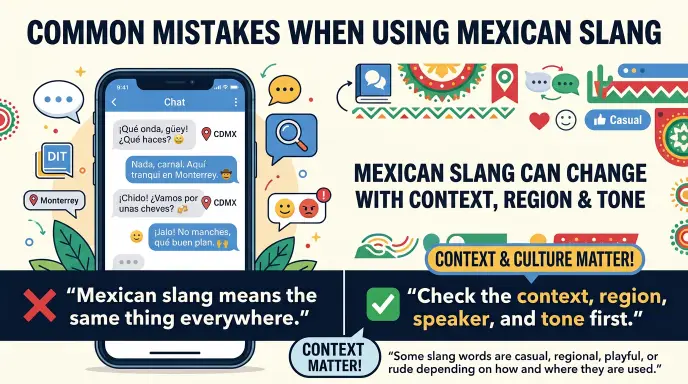
Common Mistakes When Using Mexican Slang
Using Slang Without Understanding the Tone
Some words sound friendly among close friends but rude when said to strangers.
Always consider who you are speaking to.
Translating Slang Literally
Literal translations can be confusing.
For example, lana literally relates to wool, but in Mexican slang it can mean money.
Likewise, aguas literally means “waters,” but in a slang sentence it can mean “watch out.”
Assuming Every Mexican Person Uses the Same Slang
Mexico has strong regional and social differences.
Do not assume that one slang word represents how everyone in Mexico speaks.
Using Vulgar Expressions in Formal Situations
Some Mexican expressions can be offensive or vulgar.
Avoid slang when speaking in formal professional or academic settings unless you fully understand the context.
Copying Slang From Social Media
A phrase may be popular online but sound unnatural in a real conversation.
Learn how native speakers use the expression before adding it to your own vocabulary.
When Should You Use Mexican Slang?
Mexican slang works best in relaxed situations.
You can encounter it when:
- Talking with friends
- Messaging someone you know
- Watching Mexican movies
- Reading Mexican social media
- Listening to Mexican music
- Following Mexican creators
- Learning conversational Spanish
If you are speaking with someone for the first time, it is usually safer to start with neutral Spanish and become more informal as the conversation develops.
Frequently Asked Questions About Mexico Slang
How do Mexicans say “let’s go”?
In Mexican Spanish, “let’s go” is commonly “¡Vamos!”. In casual speech, you may also hear “¡Vámonos!”, which means “let’s go” or “let’s get going.”
Is “güey” a bad word?
“Güey” is a very common Mexican slang word that can mean “dude,” “bro,” or “guy.” It can also sound rude or insulting depending on tone and context. Among friends, it is often casual and friendly, but it may be inappropriate in formal situations.
What are 10 slang words?
Ten common Mexican Spanish slang words are güey, chido, padre, lana, chamba, neta, órale, no manches, chela, and fresa.
Their meanings include “dude,” “cool,” “money,” “work,” “really/truth,” “come on,” “no way,” “beer,” and “preppy or upper-class.”
What is slang for a Mexican girl?
There is no single slang word that all Mexicans use for “Mexican girl.” “Morra” is common in Mexican slang and can mean “girl” or “young woman,” especially in casual speech. “Chava” is another common informal word for a girl or young woman.
Mexican slang insults
Common Mexican slang insults include pendejo (idiot or fool), cabrón (jerk, bastard, or tough guy), culero (jerk or coward), güey when used negatively, and no mames as a rude expression of disbelief. Meaning and offensiveness can change with tone and context.
Mexican slang for homie
Mexican Spanish has several casual ways to say “homie,” including güey, compa, carnal, and cuate. Compa and carnal are especially common for a close friend or buddy.
Mexican slang for gangster
Cholo can refer to a gangster or someone associated with a street or gang style in some Mexican and Mexican American contexts.
Malandro can also mean a criminal or gangster in some Spanish-speaking regions, but it is not uniquely Mexican.
Mexican phrases funny
Some Mexican phrases can sound funny to English speakers because of their colorful or playful wording.
Examples include “¡No manches!” (“No way!”), “¡Aguas!” (“Watch out!”), “¿Qué onda?” (“What’s up?”), and “Está cañón” (“It’s tough/crazy”). Their tone depends on the situation.
Mexican slang translator
A Mexican slang translator explains informal Mexican Spanish words and phrases in standard English.
Common examples include güey = dude, chido = cool, chamba = work/job, lana = money, neta = really/truth, and órale = come on/alright.
Conclusion
Mexico slang is a large collection of informal Mexican Spanish words and expressions used in everyday conversations, texting, social media, entertainment, and friendly interactions.
Some of the most useful examples include güey for “dude,” chido for “cool,” neta for “really” or “truth,” chamba for “work,” lana for “money,” chela for “beer,” and no manches for surprise or disbelief.
However, Mexican slang is not one fixed list. Usage can change by region, age, social group, and context. Some expressions are friendly, while others can sound rude or vulgar.
If you are learning Mexican Spanish, focus on understanding when and how people use each word instead of translating slang literally.
That will help you understand Mexican conversations, social media, movies, music, and online culture more naturally.
Discover More Articles!
Stem Meaning Slang: What Does Stem Mean in LGBTQ+ Slang?
WYO Meaning Slang: What Does WYO Mean in Text?(2026)
What Does Tweaking Mean in Slang? Meaning in Text, & Social Media

Hi, I’m Sophia Bennett, a novelist passionate about creating heartfelt stories filled with romance, emotion, and unforgettable characters. Through my books, I hope to inspire readers and take them on journeys they’ll always remember.