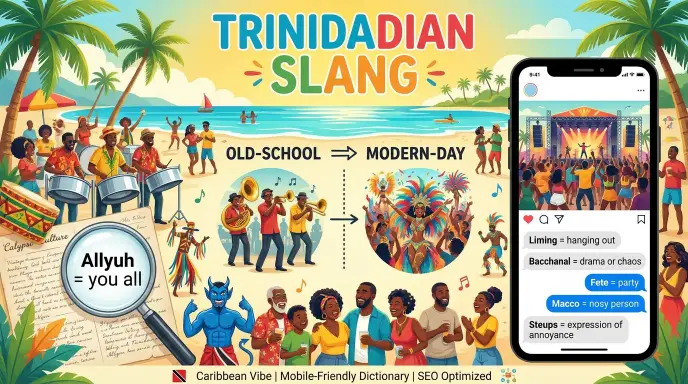
Trinidadian slang refers to the informal words, phrases, expressions, and speech patterns commonly used in Trinidad and Tobago, especially in everyday conversation, music, social media, and local culture.
Many expressions come from Trinidadian English, Trinidadian Creole, and Trinidadian Hindustani, while others reflect the country’s African, Indian, European, Caribbean, and other cultural influences.
Trinidadian slang can sound very different from standard English, but most terms become easy to understand once you know the context.
This guide explains popular Trinidadian slang, what the words mean, how people use them, and which expressions may be better understood as dialect or Creole rather than simple “slang.”
What Is Trinidadian Slang?
Trinidadian Slang Is Part of Local Speech and Culture
Trinidadian slang includes informal expressions used to show emotion, describe people, talk about food and parties, joke with friends, or react to everyday situations.
Some expressions are strongly associated with Trinidad and Tobago, while others appear throughout the wider Caribbean.
You may encounter Trinidadian expressions in:
- Everyday conversations
- Trinidadian music
- Soca and calypso
- Carnival culture
- WhatsApp chats
- TikTok
- YouTube
- Local comedy
- Sports conversations
Because Trinidad has a rich multilingual history, local speech contains influences from several languages and cultures.
Quick Answer Table
| Trinidadian Slang | Meaning |
| Bacchanal | Trouble, drama, partying, or a chaotic situation |
| Liming | Hanging out or relaxing socially |
| Doh | Don’t / do not |
| Allyuh | You all / you guys |
| Yuh | You / your, depending on context |
| Gyul | Girl |
| Bredda | Brother, male friend, or close person |
| Fete | Party or celebration |
| Wining | A Caribbean dance involving hip movement |
| Doubles | Popular Trinidadian street food |
| Trini | A person from Trinidad and Tobago |
| Steups | A sound expressing annoyance or disapproval |
| Horn | To cheat on a romantic partner |
| Macco | A person who is nosy |
| Tabanca | Deep sadness or lovesickness after a breakup |
Popular Trinidadian Slang Words and Phrases
Bacchanal
Bacchanal is one of the best known Trinidadian expressions.
It can mean drama, trouble, confusion, or a wild social situation.
For example:
“That party had plenty bacchanal.”
This could mean the party involved lots of drama or chaotic fun.
The word can also describe relationship drama:
“I don’t want no bacchanal.”
Meaning:
“I don’t want any trouble or drama.”
Liming
Liming means hanging out, relaxing, or spending time socially.
For example:
“We liming by the beach tonight.”
This means:
“We’re hanging out by the beach tonight.”
Liming is an important Caribbean social concept. It does not necessarily mean doing anything special. Sometimes the activity itself is simply spending time with friends.
Fete
A fete is a party or celebration.
The word is especially common around Carnival and soca culture.
For example:
“Which fete are you going to this weekend?”
means:
“Which party are you going to this weekend?”
Fetes can range from small gatherings to large organized events.
Allyuh
Allyuh generally means “you all,” “you guys,” or “all of you.”
For example:
“Allyuh coming with me?”
means:
“Are you all coming with me?”
This is a useful example of how Trinidadian speech can differ from Standard English grammar while remaining perfectly understandable to local speakers.
Doh
Doh commonly represents “don’t” or “do not.”
For example:
“Doh do that.”
means:
“Don’t do that.”
You may see this spelling in written representations of Trinidadian speech.
Yuh
Yuh is commonly used for “you” and, depending on context, can appear in other forms of informal Trinidadian speech.
For example:
“What yuh doing?”
means:
“What are you doing?”
The spelling reflects pronunciation and local speech patterns rather than formal Standard English.
Gyul
Gyul is a Trinidadian/Caribbean pronunciation based spelling of “girl.”
For example:
“That gyul can dance!”
means:
“That girl can dance!”
It frequently appears in Caribbean music, social media, and informal writing.
Bredda
Bredda means brother and can also refer informally to a male friend or someone you feel close to.
For example:
“Bredda, where you going?”
means:
“Brother/friend, where are you going?”
It can be friendly rather than literal. You do not necessarily need to be related to someone to call them bredda.
Steups
Steups refers to the sound people make by sucking their teeth, usually to express annoyance, disbelief, frustration, or disapproval.
It can communicate something like:
“Seriously?”
or
“I’m annoyed with this.”
The gesture itself matters here. Steups is not simply a spoken word; it can describe a recognizable non verbal reaction.
Trinidadian Slang for People
Macco
A macco is a person who is nosy or overly interested in other people’s business.
For example:
“Stop being a macco.”
means:
“Stop being so nosy.”
The related verb maccoing can describe looking into or asking about things that are not your business.
Trini
Trini is an informal term for a person from Trinidad and Tobago, particularly someone from Trinidad.
It is widely recognized and is not necessarily negative or offensive.
For example:
“She’s Trini.”
means:
“She’s from Trinidad.”
Partner
In Trinidadian speech, partner can be used broadly for a friend, companion, or acquaintance.
For example:
“Partner, what happening?”
can function like:
“Friend, what’s going on?”
The exact meaning depends on the relationship and context.
Trinidadian Slang for Relationships
Horn
Horn or horning can refer to cheating on a romantic partner.
For example:
“He horned his girlfriend.”
means:
“He cheated on his girlfriend.”
You may also encounter this word in discussions about relationships, music, jokes, and Carnival culture.
Because it describes infidelity, it can carry a negative or serious tone depending on the situation.
Tabanca
Tabanca describes a state of deep sadness, emotional distress, or lovesickness, especially after losing someone romantically.
For example:
“He catch tabanca after she left.”
This means that he became deeply heartbroken after the relationship ended.
The word has a strong place in Trinidadian and wider Caribbean vocabulary.
Trinidadian Slang for Fun and Parties
Wining
Wining is a Caribbean dance style involving rhythmic movement of the hips.
It is especially associated with soca, Carnival, fetes, and Caribbean parties.
For example:
“Everybody was wining when the song came on.”
The term can refer to dancing rather than simply “having fun.”
Carnival
Although Carnival is not slang, it is essential to understanding many Trinidadian expressions.
Trinidad and Tobago’s Carnival has a major influence on local music, dancing, fashion, parties, and everyday cultural language.
Words such as fete, bacchanal, wine, and soca frequently appear in conversations connected with Carnival.
Trinidadian Food Terms
Doubles
Doubles is one of Trinidad’s most famous foods.
It consists of fried bara filled with curried channa, usually topped with sauces and other ingredients.
You may hear:
“Let’s get some doubles.”
This simply means going to buy the popular Trinidadian street food.
Bake and Shark
Bake and shark is another well known Trinidadian food, particularly associated with Maracas Bay.
Although the phrase is not slang, food vocabulary is an important part of understanding Trinidadian culture.
Chow
In Trinidadian usage, chow can refer to a type of seasoned fruit snack, often made with fruits such as mango, pineapple, or cucumber.
It commonly includes ingredients such as pepper, salt, lime, and local seasonings.
Trinidadian Expressions
What Happening?
“What happening?” is a common informal greeting meaning something like:
- What’s going on?
- How are you?
- What’s up?
For example:
“Partner, what happening?”
This does not necessarily ask for detailed information. It can simply function as a friendly greeting.
Small Ting
Small ting can mean a small thing, minor matter, or something insignificant, depending on context.
For example:
“Is just a small ting.”
means:
“It’s only a small thing.”
The phrase can also appear in Caribbean music and informal online speech.
Real Good
Trinidadian speech can use familiar English words in distinctive combinations.
For example:
“That food real good.”
The meaning is straightforward:
“That food is really good.”
The difference lies more in local speech patterns than vocabulary alone.
Trinidadian Slang vs Jamaican Slang
People sometimes treat Caribbean slang as one large category. However, Trinidadian and Jamaican speech are not the same.
Trinidadian English and Creole developed within Trinidad and Tobago’s particular history, while Jamaican Patois developed within Jamaica’s own linguistic and cultural environment.
There are similarities because both belong to the wider Caribbean world.
However:
| Trinidadian Usage | Jamaican Usage |
| Liming | Often associated with “linking” or hanging out |
| Bacchanal | Common Trinidadian expression |
| Fete | Strongly associated with Caribbean party culture |
| Allyuh | Common Trinidadian form |
| Steups | Used in Trinidad and other Caribbean contexts |
| Trini | Trinidadian identity |
Therefore, avoid labeling every Caribbean expression as Jamaican or Trinidadian without checking its actual origin.
Is Trinidadian Slang the Same as Trinidadian Creole?
No. Slang and Creole overlap, but they are not identical.
Trinidadian speech includes different varieties and influences. Some expressions are slang, some are features of Trinidadian English or Trinidadian Creole, and others come from older Caribbean vocabulary.
This distinction matters because calling every local word “slang” can oversimplify Trinidad’s linguistic history.
Where Does Trinidadian Slang Come From?
Trinidadian vocabulary reflects the country’s complex history.
Important influences include:
- English
- African languages and traditions
- Indian languages and culture
- French Creole
- Spanish
- Caribbean Indigenous influences
- Other regional Caribbean varieties
Trinidad and Tobago’s history of migration, colonialism, trade, slavery, indentureship, and cultural exchange helped create a distinctive linguistic environment.
As a result, modern Trinidadian speech contains words and expressions from multiple cultural sources.
How Trinidadian Slang Is Used Online
Social media has helped local expressions reach audiences outside Trinidad.
You may see Trinidadian expressions in:
- TikTok comments
- Instagram captions
- WhatsApp messages
- YouTube videos
- Soca lyrics
- Carnival content
- Memes
However, online spelling can vary.
For example, people may write allyuh, all yuh, or use other informal spellings to represent pronunciation.
Therefore, spelling alone does not always tell you exactly how a speaker would say the expression.
Common Mistakes When Understanding Trinidadian Slang
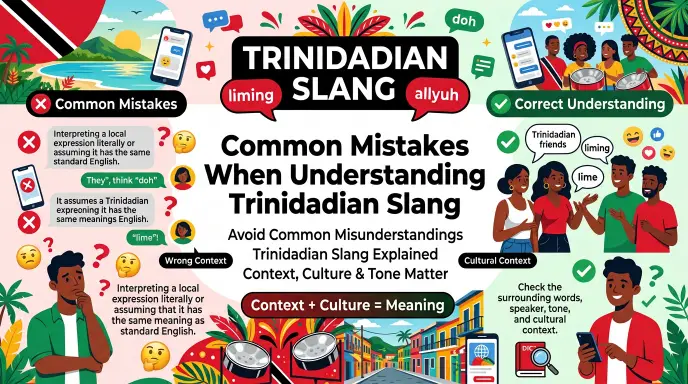
Assuming Every Caribbean Term Is Trinidadian
Many expressions cross national borders.
Treating Dialect as “Bad English”
Trinidadian speech follows its own patterns and reflects a rich linguistic history.
Assuming One Meaning Fits Every Context
Words such as bacchanal can describe drama, partying, or general chaos depending on the situation.
Ignoring Tone
An expression such as steups can communicate emotion through sound and gesture.
Using Slang Without Understanding the Culture
Some expressions work naturally among local speakers but can sound forced when outsiders use them without understanding their context.
When to Avoid Using Trinidadian Slang
Be careful with local slang when speaking to people who may not understand it.
Avoid using unfamiliar expressions in:
- Formal academic writing
- Job applications
- Official documents
- Professional reports
- Legal communication
- Formal business emails
In casual conversation, however, learning and respectfully using local expressions can be a good way to understand Trinidadian culture.
Is Trinidadian Slang Appropriate at Work?
It depends on the workplace and the people involved.
Trinidadian speakers naturally use local expressions in informal workplace conversations. However, formal documents should normally use clear Standard English unless the local expression has a specific purpose.
For example:
“We need to deal with this bacchanal.”
might be fine among coworkers who regularly use the expression.
In a formal report, however:
“We need to address this dispute.”
would be clearer.
Key Takeaways
- Trinidadian slang is part of the country’s rich informal language culture.
- Bacchanal means drama, trouble, or chaotic fun.
- Liming means hanging out or relaxing socially.
- Fete means a party or celebration.
- Allyuh means “you all.”
- Doh means “don’t.”
- Macco describes a nosy person.
- Steups represents a sound of annoyance or disapproval.
- Horn can mean cheating on a romantic partner.
- Tabanca refers to deep emotional sadness or lovesickness.
- Trinidadian slang overlaps with Trinidadian English and Creole, but the terms are not identical.
- Context and cultural background are important when interpreting these expressions.
Frequently Asked Questions
How do Trinidadians say hello?
Trinidadians may say “Wha yuh sayin’?”, “Wha happenin’?”, or simply “Good morning” or “Good afternoon.” The greeting often depends on the setting and the speaker’s style. These expressions are informal and friendly ways to ask how someone is doing.
How do you say “I love you” in Trinidadian?
In Trinidad and Tobago, people commonly say “I love you” in English. In casual Trini speech, affection can also be expressed through phrases such as “Ah love yuh”, where “ah” represents a common Trinidadian way of saying “I” in speech.
What is the slang term for a pretty girl in Trini?
A common Trinidadian Creole expression for an attractive girl is “sweet gyal.” “Gyal” is a Caribbean English Creole form of “girl,” while “sweet” can describe someone attractive or appealing. The exact expression can vary by speaker and context.
How to talk like a Trini?
To sound more like a Trini, learn common Trinidadian Creole features such as “ah” for “I,” “yuh” for “you,” and “gyal” for “girl.” Trinidadian speech also has its own rhythm, vocabulary, and expressions influenced by English, African and Indian languages, French Creole, and other Caribbean languages.
Trinidadian Slang Dictionary
A Trinidadian slang dictionary is a collection of informal words and expressions used in Trinidad and Tobago. It can include terms from Trinidadian English, Trinidadian Creole, and local speech, with meanings that may change depending on context.
Common examples include “doh” (don’t), “gyal” (girl), “lime” (hang out or socialize), and “wha yuh sayin’?” (how are you? / what’s up?).
Trinidadian Slang Words Urban Dictionary
Urban Dictionary contains user-submitted definitions for Trinidadian slang words, but its entries can vary in accuracy and may include jokes, personal interpretations, or offensive language.
For reliable meanings, it is better to compare the definition with Trinidadian usage and context rather than treating every Urban Dictionary entry as authoritative.
Trinidadian Slang Words and Meanings
Some commonly recognized Trinidadian slang and local expressions include “lime” for hanging out or socializing, “doh” for “don’t,” “gyal” for “girl,” “bacchanal” for drama, gossip, or troublesome behavior, “horn” for cheating on a romantic partner, and “wining” for a style of dancing involving rhythmic movement of the hips.
Trinidadian Slang Words
Popular Trinidadian slang and expressions include lime, bacchanal, gyal, doh, allyuh, horn, wine, tabanca, and wha yuh sayin’.
Their meanings can depend on the speaker, situation, and tone. Some terms are strongly associated with Trinidadian and Tobagonian culture, while others are part of wider Caribbean English.
Conclusion
Trinidadian slang is more than a collection of unusual words; it reflects the country’s history, culture, humor, music, and everyday social life.
Expressions such as liming, bacchanal, fete, allyuh, macco, steups, and tabanca can help you understand how Trinidadians communicate in casual settings.
At the same time, it is important to recognize the difference between slang, dialect, Creole, and cultural vocabulary. Meanings can also shift depending on the speaker and situation.
If you are learning Trinidadian expressions, focus on context rather than memorizing isolated definitions. That approach will help you understand both the words and the culture behind them.
Discover More Articles!
1960s Slang: What Did “Blade” Mean?(2026)
Tight Meaning Slang: What Does “Tight” Mean in Slang?(2026)
What Does Snatched Mean? Slang Definition, Uses & Examples.

Hi, I’m Sophia Bennett, a novelist passionate about creating heartfelt stories filled with romance, emotion, and unforgettable characters. Through my books, I hope to inspire readers and take them on journeys they’ll always remember.