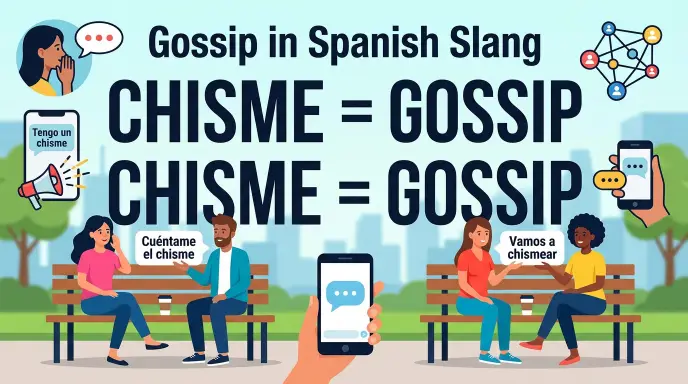
The most common Spanish slang word for gossip is “chisme,” which means gossip, rumor, or juicy personal information.
People use chisme in casual conversations when talking about news about other people, especially information that may be private, surprising, or interesting.
The verb chismear means “to gossip,” while chismoso or chismosa describes someone who loves to gossip. In Spain, you may also hear cotilleo, which is a common word for gossip.
The exact slang can change by country, but chisme is one of the most widely recognized informal terms across the Spanish-speaking world.
What Does Gossip Mean in Spanish Slang?
Chisme Is the Most Common Informal Word for Gossip
If you want to say “gossip” in Spanish slang, chisme is one of the best words to know.
Chisme can refer to:
- Gossip
- Rumors
- Juicy information
- Personal news
- Talk about other people
- Interesting but unconfirmed information
For example:
“Tengo un chisme.”
This means:
“I have some gossip.”
A person may say this when they have an interesting story about someone else.
Another common phrase is:
“Cuéntame el chisme.”
This means:
“Tell me the gossip.”
The word is usually informal and fits friendly conversations, social media posts, text messages, and casual speech.
Quick Answer: Gossip in Spanish Slang
| Spanish slang | English meaning | Use |
| Chisme | Gossip / rumor | Very common informal word |
| Chismes | Gossip / rumors | Plural |
| Chismear | To gossip | Verb |
| Chismoso | Gossiping man / gossip | Masculine |
| Chismosa | Gossiping woman / gossip | Feminine |
| Chismoso/a | Gossiping person | Informal |
| Cotilleo | Gossip | Common in Spain |
| Cotillear | To gossip | Common in Spain |
| Puro chisme | Nothing but gossip | Casual expression |
| Contar chismes | To tell gossip | Common phrase |
What Does Chisme Mean?
Chisme is a Spanish noun that commonly means gossip, rumor, or juicy information.
The word can have either a playful or negative tone.
For example:
“Tengo un chisme buenísimo.”
This means:
“I have some really juicy gossip.”
The speaker is usually excited to share an interesting story.
On the other hand:
“No me gustan los chismes.”
means:
“I don’t like gossip.”
So, the meaning depends on the situation and the speaker’s attitude.
In casual Spanish, chisme can sometimes sound playful rather than harsh. Friends may use it simply to talk about interesting personal news.
What Does Chismear Mean?
Chismear is the verb form related to chisme.
It means “to gossip” or “to talk about other people’s business.”
For example:
“Nos gusta chismear.”
This means:
“We like to gossip.”
Another example:
“Están chismeando.”
This means:
“They are gossiping.”
You may see chismear frequently in informal conversations and social media because it describes the action of sharing or discussing gossip.
Common Forms of Chismear
| Spanish | English |
| Chismear | To gossip |
| Estoy chismeando | I am gossiping |
| Está chismeando | they is gossiping |
| Estamos chismeando | We are gossiping |
| Vamos a chismear | Let’s gossip |
| Deja de chismear | Stop gossiping |
What Does Chismoso or Chismosa Mean?
A person who loves gossip can be called chismoso or chismosa.
- Chismoso = a gossiping man or boy
- Chismosa = a gossiping woman or girl
The ending changes according to the person’s gender in traditional Spanish grammar.
For example:
“Mi amiga es muy chismosa.”
This means:
“My friend is very gossipy.”
Or:
“Él es muy chismoso.”
This means:
“He is very gossipy.”
The word can be teasing and playful between friends, but it can also be an insult if the speaker strongly dislikes someone’s behavior.
What Is the Spanish Slang for “Gossip”?
There is not just one Spanish word for gossip.
The most useful terms are:
Chisme : gossip or rumor.
Chismear : to gossip.
Chismoso/chismosa : someone who gossips.
Cotilleo : gossip, especially common in Spain.
Cotillear : to gossip, especially in Spain.
The best choice depends on the country and situation.
If you are learning general Spanish slang, chisme is an excellent word to remember.
Gossip in Mexican Spanish
In Mexican Spanish, chisme is a very common informal word for gossip.
You might hear:
“Cuéntame el chisme.”
This means:
“Tell me the gossip.”
Another phrase is:
“Tengo un chisme.”
Meaning:
“I have some gossip.”
Mexican social media users may also use playful phrases built around chisme.
For example:
“Aquí venimos por el chisme.”
A natural translation is:
“We’re here for the gossip.”
The tone can be humorous and playful.
Gossip in Spanish From Other Latin American Countries
Chisme is understood in many parts of Latin America, although local vocabulary and expressions can vary.
You may hear it in conversations about:
- Friends
- Relationships
- Celebrities
- Family
- School
- Work
- Social media
- Neighborhood news
For example:
“¿Cuál es el chisme?”
means:
“What’s the gossip?”
Because chisme is widely understood, it is often a safer general choice than a highly regional expression.
Still, Spanish is spoken across many countries, and local slang can differ. A phrase that sounds very natural in Mexico may sound less common in Argentina, Colombia, Puerto Rico, Spain, or another Spanish-speaking region.
Gossip in Spanish From Spain
In Spain, cotilleo is an important word for gossip.
For example:
“No me gusta el cotilleo.”
means:
“I don’t like gossip.”
The verb cotillear means to gossip.
For example:
“Están cotilleando.”
means:
“They are gossiping.”
People in Spain also understand chisme, but cotilleo and cotillear are especially useful if you want vocabulary associated with Spanish Spanish.
Chisme vs. Cotilleo
Both words can mean gossip, but they have different regional associations.
| Word | Meaning | Common association |
| Chisme | Gossip / rumor | Latin America and widely understood |
| Cotilleo | Gossip | Spain |
| Chismear | To gossip | Widely used in many Latin American varieties |
| Cotillear | To gossip | Spain |
For a general Spanish audience, chisme is a useful starting point.
For a Spain focused audience, cotilleo is an important term to know.
How to Say “Gossip” in Spanish Texting
In Spanish texting, people can simply use chisme because it is already short.
For example:
“Tengo chisme 😂”
This means:
“I have gossip 😂”
You may also see:
“Pásame el chisme.”
Meaning:
“Give me the gossip.”
Or:
“Necesito el chisme.”
Meaning:
“I need the gossip.”
Social media has also made playful gossip language popular. People may exaggerate their excitement about hearing new information.
Popular Spanish Phrases About Gossip
Here are several useful expressions.
Cuéntame el chisme
Meaning: Tell me the gossip.
This is a direct and casual way to ask someone to share the story.
Tengo un chisme
Meaning: I have some gossip.
It often signals that an interesting story is coming.
¿Cuál es el chisme?
Meaning: What’s the gossip?
You can use this when you want to know what happened.
Puro chisme
Meaning: Nothing but gossip / pure gossip.
This can be playful or critical.
Vamos a chismear
Meaning: Let’s gossip.
This describes a casual conversation where people discuss other people’s news.
No seas chismoso
Meaning: Don’t be so nosy / Don’t gossip.
This can be serious or playful depending on the tone.
Chisme caliente
Literally, this means “hot gossip.”
It can describe especially interesting or juicy news.
How to Use Chisme in a Sentence
Here are some natural examples.
“Tengo un chisme que contarte.”
I have some gossip to tell you.
“¿Escuchaste el chisme?”
Did you hear the gossip?
“Cuéntame todo el chisme.”
Tell me all the gossip.
“No quiero chismes.”
I don’t want gossip.
“Ella siempre sabe todos los chismes.”
She always knows all the gossip.
“Estamos hablando de chismes.”
We’re talking about gossip.
“Ese chisme no es verdad.”
That rumor isn’t true.
These examples show why chisme can mean either general gossip or a specific rumor.
Does Chisme Always Mean Something Bad?
No. Chisme does not always have a strongly negative meaning.
Friends may use it playfully when discussing interesting news.
For example:
“Amiga, tengo un chisme.”
A person may say this with excitement rather than anger.
However, gossip can become negative when it spreads private information, false claims, or harmful rumors.
Therefore, the word itself does not tell you if the gossip is harmless or harmful. The context matters.
Is Chisme the Same as Rumor?
Not exactly.
Chisme can mean gossip, while rumor usually refers to information that may be unverified or unconfirmed.
For example:
“Ese chisme es falso.”
means:
“That gossip is false.”
In another context, chisme can simply mean interesting personal information without suggesting that it is false.
So, depending on context, chisme can overlap with both gossip and rumor.
Is Chisme a Bad Word?
No, chisme is not a swear word.
It is an ordinary informal Spanish word.
However, calling someone chismoso or chismosa can be negative because you are saying that the person gossips or talks about other people’s business.
For example:
“Eres muy chismosa.”
Depending on the relationship and tone, this might mean:
“You’re such a gossip.”
Between close friends, it may be teasing. In a serious situation, it can sound insulting.
Common Mistakes When Using Spanish Gossip Slang
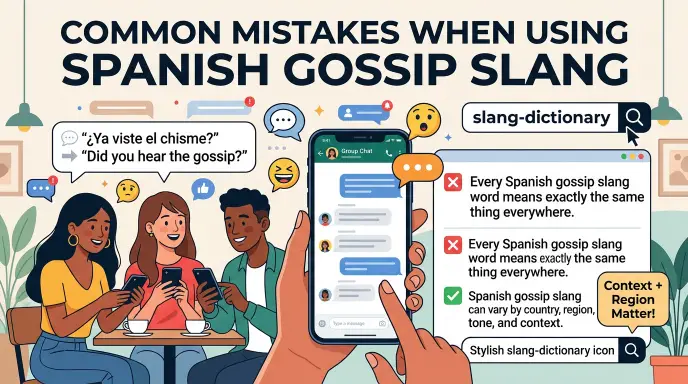
Assuming Chisme Means Only Rumor
A chisme can be a rumor, but it can also mean gossip or interesting personal information.
Always consider the context.
Using Cotilleo Everywhere
Cotilleo is strongly associated with Spain.
If your audience is mainly from Latin America, chisme may be a more broadly useful choice.
Confusing Chisme With Chismoso
These words are related but have different grammatical roles.
- Chisme = gossip
- Chismear = to gossip
- Chismoso = gossiping male/person
- Chismosa = gossiping female/person
Assuming Chismoso Is Always an Insult
The tone matters.
Friends may call each other chismoso or chismosa jokingly.
In another situation, the same word can sound critical.
Translating Every Expression Word for Word
Spanish slang often does not translate perfectly into English.
For example, “Cuéntame el chisme” literally relates to “tell me the gossip,” but in natural English, “Tell me what’s going on” may sometimes capture the conversational tone better.
Is Spanish Gossip Slang Used on TikTok and Social Media?
Yes. Chisme is especially useful for social media content because people often discuss celebrities, relationships, influencers, viral events, and online drama.
You may see phrases such as:
“Necesito el chisme.”
“Cuéntame el chisme.”
“¿Cuál es el chisme?”
“Aquí por el chisme.”
These phrases can appear in comments, captions, memes, and casual conversations.
Social media can also make chisme sound playful. People may use it to show that they are interested in a story without necessarily taking it seriously.
How Do You Say “I Love Gossip” in Spanish?
A casual way to express this idea is:
“Me encanta el chisme.”
This means:
“I love gossip.”
It can sound playful, especially when used among friends.
Another option is:
“Me encanta chismear.”
This means:
“I love gossiping.”
The first sentence focuses on the gossip itself, while the second focuses on the activity of gossiping.
How Do You Say “Stop Gossiping” in Spanish?
A simple expression is:
“Deja de chismear.”
This means:
“Stop gossiping.”
Another casual phrase is:
“No chismees.”
This means:
“Don’t gossip.”
These expressions can sound serious or playful depending on your tone.
How Do You Say “Gossip Girl” in Spanish?
There is no single slang translation that works in every context.
Depending on what you mean, you might say:
- Chismosa : a female gossip
- Chismoso : a male gossip
- Chica chismosa : gossipy girl
- Chico chismoso : gossipy boy
If you are referring specifically to the television series Gossip Girl, the title is generally kept as Gossip Girl rather than translated into ordinary Spanish slang.
Chisme in Popular Culture
Gossip has a strong place in Spanish-language entertainment and social media.
Television programs, celebrity news, podcasts, YouTube channels, TikTok videos, and online communities often discuss chismes about famous people and public events.
This does not mean every claim is true. Gossip content can include speculation or unverified information.
That is why it is important to separate:
- Gossip
- Rumor
- Confirmed information
- Personal opinion
- Satire
When reading or sharing online chisme, do not automatically treat it as fact.
When Should You Avoid Gossip Slang?
You can use chisme naturally in casual conversations, but it may not fit formal situations.
Avoid slang such as chisme or chismear in:
- Academic writing
- Formal business documents
- Official reports
- Professional presentations
- Legal writing
Instead, choose more precise words such as:
- Gossip
- Rumor
- Unverified information
- Personal discussion
- Informal discussion
The right word depends on what you actually mean.
Key Takeaways
- Chisme is one of the most common Spanish slang words for gossip.
- Chismear means to gossip.
- Chismoso describes a gossiping man or person.
- Chismosa describes a gossiping woman or person.
- Cotilleo is especially common for gossip in Spain.
- Cotillear means to gossip in Spain.
- Chisme can have a playful, neutral, or negative tone.
- The word can mean gossip, rumor, or interesting personal information depending on context.
- Spanish slang varies by country, so local usage matters.
- “Cuéntame el chisme” means “Tell me the gossip.”
Frequently Asked Questions
What is the Spanish slang for gossip?
Common Spanish slang for gossip includes chisme, chismear, and cotilleo. “Chisme” means gossip or juicy information, while “chismear” means to gossip. “Chisme” is widely understood across Spanish speaking countries, although local slang can vary.
What do Spanish people call gossip?
In Spain, cotilleo is a common word for gossip, especially talk about other people’s personal lives.
Chisme is also understood in Spanish, but “cotilleo” is especially common in Spain. For example, “Hay mucho cotilleo” means “There is a lot of gossip.”
How do Puerto Ricans say gossip?
In Puerto Rico, chisme is commonly used for gossip, and chismear means to gossip. A person who loves gossip may be described as chismoso or chismosa. Puerto Rican slang can vary by context, but these terms are widely understood.
How do you say “gossipers” in Spanish?
“Gossipers” can be translated as chismosos for a group of men or a mixed group, and chismosas for a group of women.
For one person, use chismoso for a man and chismosa for a woman. These words describe someone who likes to spread or talk about gossip.
Gossip in Spanish for a girl
For a girl, chismosa is a common Spanish word for a woman who gossips. Chisme means “gossip” itself. For example, “Ella es muy chismosa” means “She is very gossipy” or “She loves to gossip.”
Gossip in Spanish slang in English
In English, the Spanish slang word chisme can mean gossip, juicy news, or personal information about other people. Chismear means “to gossip,” while chismoso/chismosa describes someone who gossips.
Gossip in Spanish for a boy
For a boy, chismoso is a common Spanish word for someone who gossips. For example, “Él es muy chismoso” means “He is very gossipy” or “He loves to gossip.”
Gossip in Spanish slang examples
Common examples include “Cuéntame el chisme” meaning “Tell me the gossip,” “No seas chismoso” meaning “Don’t be a gossip,” and “Vamos a chismear” meaning “Let’s gossip.” The exact slang can vary across Spanish-speaking countries.
Conclusion
Chisme is one of the most useful Spanish slang words for “gossip.” You can use it when talking about rumors, personal news, juicy stories, or information about other people.
Related words include chismear for “to gossip” and chismoso/chismosa for a person who gossips.
If you are learning Spanish from Spain, cotilleo and cotillear are also important terms. Because Spanish slang varies between countries, the exact expression can change by region.
Still, chisme is a great general word to remember when you want to understand casual Spanish conversations and social media language.
Discover More Articles!
Fire Slang Meaning: What Does Fire Mean in Slang?(2026)
FS Meaning Slang: What Does FS Mean in Text?
ASL Slang Meaning: What Does ASL Mean in Text?(2026)

Hi, I’m Sophia Bennett, a novelist passionate about creating heartfelt stories filled with romance, emotion, and unforgettable characters. Through my books, I hope to inspire readers and take them on journeys they’ll always remember.