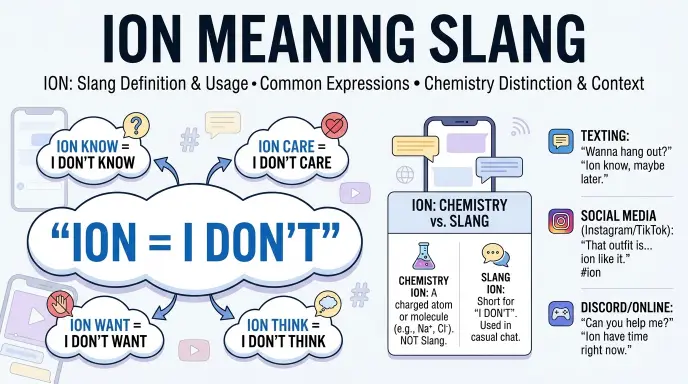
“Ion” is internet and texting slang for “I don’t.” It is a shortened spelling that people use in casual messages, social media posts, comments, and conversations.
You may see ion before another verb, such as “ion know” for “I don’t know” or “ion want to” for “I don’t want to.” The spelling comes from informal pronunciation and online writing, especially in African American English (AAVE) and related internet speech.
Although ion looks like the chemical term for an electrically charged atom or molecule, slang ion has nothing to do with chemistry. Context is important because the same spelling can have completely different meanings.
Quick Answer: What Does Ion Mean in Slang?
In slang and texting, “ion” usually means “I don’t.” It is an informal shortened form commonly used in phrases such as “ion know,” “ion care,” and “ion want it.”
Examples:
Ion know.
Meaning: I don’t know.
Ion care.
Meaning: I don’t care.
Ion want that.
Meaning: I don’t want that.
It is mainly used in casual online communication.
What Does Ion Mean in Texting?
In texting, “ion” is usually a casual way to write “I don’t.”
It is especially common when people want their messages to reflect natural speech.
For example:
Ion feel like going.
means:
I don’t feel like going.
Another example:
Ion think so.
means:
I don’t think so.
The spelling is informal, so it generally does not belong in formal emails, school assignments, or professional writing.
What Does “Ion Know” Mean?
“Ion know” means “I don’t know.”
This is one of the most common uses of ion.
For example:
Ion know what happened.
means:
I don’t know what happened.
You may see it in:
- Text messages
- TikTok comments
- Instagram posts
- Snapchat
- Discord
- X posts
- Memes
- Casual conversations
The phrase is often used simply because it matches how some speakers pronounce the words in fast, casual speech.
What Does “Ion Care” Mean?
“Ion care” means “I don’t care.”
For example:
Ion care what they say.
means:
I don’t care what they say.
Depending on tone, this can sound:
- Casual
- Dismissive
- Unbothered
- Annoyed
- Playful
The surrounding conversation helps determine the speaker’s attitude.
What Does “Ion Want To” Mean?
“Ion want to” means “I don’t want to.”
For example:
Ion want to go.
means:
I don’t want to go.
You might also see:
Ion wanna go.
This combines ion with another informal form, wanna.
Both are highly casual.
What Does “Ion Even Know” Mean?
“Ion even know” means “I don’t even know.”
For example:
Ion even know why he did that.
means:
I don’t even know why he did that.
The phrase can express confusion, surprise, frustration, or uncertainty.
What Does “Ion Wanna” Mean?
“Ion wanna” means “I don’t want to.”
Here:
- ion = I don’t
- wanna = want to
Example:
Ion wanna talk about it.
Meaning:
I don’t want to talk about it.
This is common in very casual digital communication.
What Does “Ion Think” Mean?
“Ion think” means “I don’t think.”
Example:
Ion think that’s a good idea.
Meaning:
I don’t think that’s a good idea.
It can also be followed by so:
Ion think so.
Meaning:
I don’t think so.
What Does “Ion Like” Mean?
“Ion like” means “I don’t like.”
For example:
Ion like this song.
means:
I don’t like this song.
The phrase can be used seriously or playfully.
What Does “Ion Got” Mean?
“Ion got” usually means “I don’t have” in informal speech, depending on the sentence and dialect.
For example:
Ion got no money.
can mean:
I don’t have any money.
This construction reflects informal spoken language rather than standard written English.
Where Did Ion Slang Come From?
Ion is closely associated with informal speech patterns found in African American English and has spread widely through internet culture.
It reflects a pronunciation based spelling of “I don’t.”
Online communities often turn spoken forms into written slang. Once these spellings become popular, they can spread through:
- Social media
- Hip hop
- Memes
- Short form videos
- Texting
- Music lyrics
- Online communities
This is why ion can now be recognized by people who do not personally use it.
Is Ion AAVE Slang?
Ion is commonly associated with African American English (AAVE), particularly its informal written representation online.
However, that does not mean every person who uses ion speaks AAVE.
Internet slang often spreads between communities. A term can have roots in one speech variety and later become popular across a much wider online audience.
It is therefore more accurate to say that ion is strongly associated with AAVE and internet slang rather than claiming that only one group can use it.
Why Do People Write Ion Instead of I Don’t?
People write “ion” because it represents a casual spoken pronunciation of “I don’t.”
It can make a message sound:
- More natural
- More conversational
- More relaxed
- More humorous
- More expressive
- More like spoken language
For example:
I don’t know what you’re talking about.
sounds more formal than:
Ion know what you talking about.
The second version intentionally uses informal speech patterns.
Is Ion a Word?
Ion is a word in standard English, but it has a completely different meaning.
In science, an ion is an atom or molecule with an electrical charge.
For example:
Sodium ion
is a chemistry term.
But in texting:
Ion know.
means:
I don’t know.
These are two unrelated uses.
Ion vs I Don’t
The difference is mainly formality.
| Form | Meaning | Use |
| I don’t | Standard English | Formal and informal |
| Ion | I don’t | Informal slang/texting |
| Ion know | I don’t know | Casual |
| Ion care | I don’t care | Casual |
| Ion want | I don’t want | Casual |
| Ion think | I don’t think | Casual |
Use I don’t in formal writing. Use ion when you intentionally want an informal or conversational style.
Ion Meaning on TikTok
On TikTok, “ion” usually means “I don’t.”
It often appears in captions, comments, memes, and casual dialogue.
For example:
Ion even know what this is 😭
means:
I don’t even know what this is.
The term may also appear alongside other internet slang.
For example:
Ion know bro, that’s wild.
This creates a strongly casual tone.
Ion Meaning on Snapchat
On Snapchat, people may use ion in quick messages.
For example:
Ion wanna go out tonight.
means:
I don’t want to go out tonight.
Because Snapchat conversations are usually casual, shortened forms such as ion fit naturally into that setting.
Ion Meaning on Instagram
On Instagram, ion may appear in:
- Comments
- Captions
- DMs
- Memes
- Reels
For example:
Ion care 😂
can mean:
I don’t care.
The emojis or surrounding text can change the tone.
Ion Meaning on Discord
In Discord chats, ion can appear in casual conversations between friends.
For example:
Ion know what y’all are doing.
means:
I don’t know what you all are doing.
Gaming and online communities often use informal language heavily, so pronunciation based spellings can become common.
Ion Meaning on X
On X, ion may appear in short posts where users want to sound conversational.
For example:
Ion know who needs to hear this but…
means:
I don’t know who needs to hear this, but…
This style can make a post feel more like spoken conversation.
Is Ion Rude?
No, “ion” itself is not rude or offensive.
However, some phrases containing it can sound blunt.
For example:
Ion care.
can sound dismissive.
But:
Ion know lol.
may simply express uncertainty.
Therefore, the tone comes from the complete sentence rather than the word ion itself.
Is Ion a Bad Word?
No. Ion is not a swear word.
It is an informal spelling of “I don’t.”
You can encounter it in everyday internet conversations without it being offensive.
Still, because it is slang, you should avoid it in formal writing unless you are intentionally representing someone’s speech.
Is Ion Proper English?
No, “ion” is not standard spelling for “I don’t.”
Standard English uses:
I don’t know.
Informal slang may use:
Ion know.
Both communicate the same basic idea, but they belong to different writing styles.
Can Ion Be Used in Formal Writing?
You generally should not use slang “ion” in formal writing.
Avoid it in:
- Academic essays
- Job applications
- Business emails
- Official documents
- School reports
- Professional presentations
Use I don’t instead.
However, a writer may use ion in dialogue when they want to accurately represent a character’s informal speech.
Examples of Ion in Sentences
Ion Know
Ion know where she went.
Meaning:
I don’t know where she went.
Ion Care
Ion care what they think.
Meaning:
I don’t care what they think.
Ion Want
Ion want anything right now.
Meaning:
I don’t want anything right now.
Ion Think
Ion think that’s true.
Meaning:
I don’t think that’s true.
Ion Like
Ion like that movie.
Meaning:
I don’t like that movie.
Ion Remember
Ion remember his name.
Meaning:
I don’t remember his name.
Ion Understand
Ion understand what you’re saying.
Meaning:
I don’t understand what you’re saying.
Common Mistakes When Understanding Ion Slang
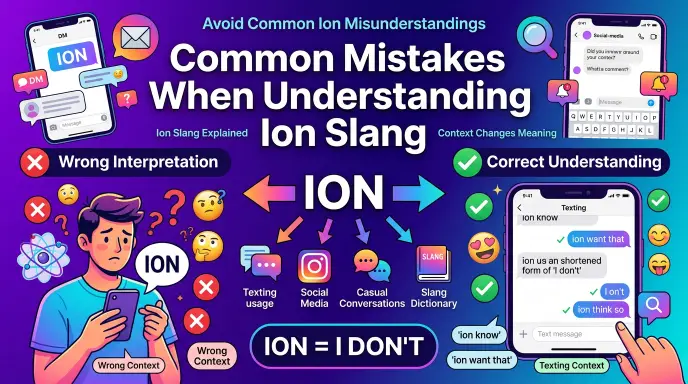
Thinking Ion Means Chemistry
The standard word ion has a scientific meaning.
But in slang:
ion = I don’t
Always check the context.
Assuming Ion Always Stands Alone
Ion usually appears as part of a phrase.
Examples include:
- Ion know
- Ion care
- Ion think
- Ion want
- Ion like
- Ion remember
Looking at the full phrase makes the meaning clearer.
Using Ion in Formal Writing
Although people understand it online, ion is not appropriate for most formal English.
Use I don’t instead.
Assuming Every Speaker Uses It
Internet slang varies by community.
Some people use ion frequently, while others never use it.
Thinking Ion Is Always Pronounced Exactly the Same
The spelling represents informal speech, and pronunciation can vary among speakers.
The intended meaning is usually clear from context.
Key Takeaways
- Ion usually means “I don’t” in texting and internet slang.
- “Ion know” = “I don’t know.”
- “Ion care” = “I don’t care.”
- “Ion want” = “I don’t want.”
- The slang is strongly associated with AAVE and online speech.
- It spread widely through social media, music, memes, and texting.
- Ion also has a completely different scientific meaning in chemistry.
- It is informal and should generally be avoided in professional writing.
- The word itself is not offensive.
- Context is important when interpreting ion meaning slang.
Frequently Asked Questions
What does “ion” mean in texting?
In texting, “ion” usually means “I don’t” or “I don’t want to,” depending on the sentence. It is an informal spelling commonly used in casual online conversations, social media, and messages. For example, “ion know” means “I don’t know,” while “ion want that” means “I don’t want that.”
What is “ion” in Gen Z slang?
In Gen Z slang, “ion” is a casual way to write “I don’t.” It often appears in short, relaxed messages and social media posts.
The meaning comes from the pronunciation of “I don’t” in some varieties of informal speech. For example, “ion care” means “I don’t care.”
Is “ion” a Black slang?
“Ion” is strongly associated with African American Vernacular English (AAVE), especially in informal speech and online writing, but it is not exclusively used by Black people.
It has also spread through social media, texting, music, and internet culture, so people from different backgrounds may use it.
What does “ion” mean from a girl?
If a girl texts “ion,” she usually means “I don’t.” Her gender does not change the basic meaning.
The exact message depends on the words around it. For example, “ion know” means “I don’t know,” while “ion wanna go” means “I don’t want to go.”
What does “ion” mean on Snapchat?
On Snapchat, “ion” usually means “I don’t.” It is informal texting slang often used in casual messages and Snapchat conversations.
For example, “ion know” means “I don’t know,” and “ion wanna go” means “I don’t want to go.” The meaning comes from how “I don’t” can sound when spoken quickly.
What does “ion” mean in Urban Dictionary?
In slang dictionaries such as Urban Dictionary, “ion” is commonly used as a shortened or phonetic form of “I don’t.” Its meaning depends on the sentence.
Someone might write “ion care” to mean “I don’t care” or “ion remember” to mean “I don’t remember.” It is mainly associated with informal internet and texting language.
What does “ion” mean on TikTok?
On TikTok, “ion” generally means “I don’t.” Users often use it in captions, comments, and casual conversations because it makes phrases shorter and more conversational.
For example, “ion even know” means “I don’t even know.” Its use can be connected to internet slang and speech patterns that became common online.
What does “ion” mean in English?
In standard English, “ion” is not normally used as a replacement for “I don’t.” In informal slang, however, it represents the spoken sound of “I don’t.”
Therefore, when you see “ion” in a text or social-media post, read the surrounding words to understand the intended meaning.
Conclusion
Ion is a popular informal spelling of “I don’t” used in texting, social media, and internet slang.
You may see it in phrases such as “ion know,” “ion care,” “ion want,” and “ion think.” These phrases are simply casual versions of “I don’t know,” “I don’t care,” “I don’t want,” and “I don’t think.”
The spelling is strongly associated with African American English and online speech, but it has spread to many different internet communities.
Social media, music, memes, and texting have helped make the expression familiar to a much wider audience.
One important point is that ion has two completely different meanings. In chemistry, an ion is an electrically charged atom or molecule. In internet slang, ion means “I don’t.” The sentence usually makes the intended meaning obvious.
Because ion is informal, it works best in casual conversations and online posts. For school, business, or professional writing, use the standard form “I don’t.”
So, if you see someone write “ion know what you mean,” they simply mean “I don’t know what you mean.” The unusual spelling is part of the informal style, not a completely different grammatical idea.
Discover More Articles!
Herring Meaning Slang: What Does “Herring” Mean in Slang?
What Does POS Mean in Texting, TikTok, and Social Media?(2026)
Slang in Japanese: 30+ Japanese Slang Words and Meanings.

Hi, I’m Sophia Bennett, a novelist passionate about creating heartfelt stories filled with romance, emotion, and unforgettable characters. Through my books, I hope to inspire readers and take them on journeys they’ll always remember.