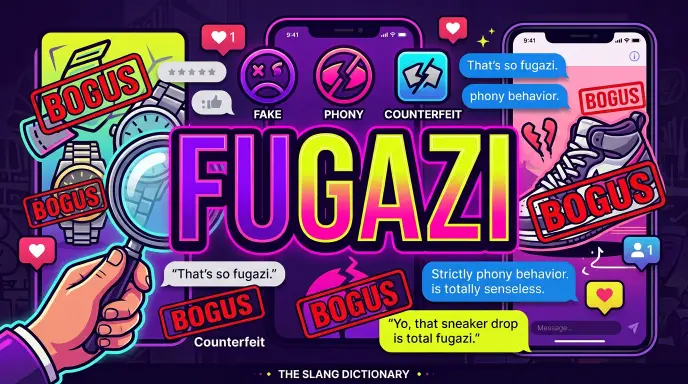
Fugazi is slang for something that is fake, phony, unreal, or not what it seems.
People may also use it for a situation that feels confusing, messed up, or impossible to trust. For example, if someone sells you a fake designer watch, you might say, “That watch is fugazi.”
The word often carries the idea that something looks real or valuable but is actually false, worthless, or misleading.
You may see fugazi in movies, music, social media, texting, and casual conversations. Its exact meaning can change slightly with context, so the words around it matter.
What Does Fugazi Mean in Slang?
Fugazi Usually Means Fake or Phony
In modern slang, fugazi usually describes something that is fake, counterfeit, made up, or deceptive. It can describe an object, person, story, deal, or situation.
For example:
- “Those shoes are fugazi.” = Those shoes are fake.
- “That whole story sounds fugazi.” = That story sounds made up.
- “He was selling fugazi watches.” = He was selling fake watches.
- “This deal feels fugazi.” = This deal does not seem genuine.
The word often suggests that something pretends to be real when it is not.
Quick Answer Table
| Term | Meaning |
| Fugazi | Fake, phony, unreal, or deceptive |
| Fugazi slang meaning | Something that is not genuine or is not what it claims to be |
| Fugazi person | Someone who seems fake, dishonest, or untrustworthy |
| Fugazi situation | A confusing, strange, or questionable situation |
| Fugazi item | A counterfeit or fake product |
| Tone | Informal, slang, sometimes humorous or negative |
What Does Fugazi Mean in Texting?
In texting, fugazi usually means fake, bogus, or not genuine.
Someone might send:
“Bro, that website is fugazi.”
They mean the website seems fake or unreliable.
You might also see it in short comments such as:
- “That account is fugazi.”
- “Fake news. Total fugazi.”
- “Those are fugazi.”
- “This whole thing is fugazi.”
Because texting is informal, fugazi can replace words such as fake, bogus, phony, or fraudulent.
However, the word does not always refer to literal counterfeits. It can also describe something that feels suspicious or unreal.
What Does Fugazi Mean When Describing a Person?
When someone calls a person fugazi, they usually mean that person seems fake, dishonest, phony, or unreliable.
For example:
“Don’t trust him. He’s fugazi.”
Here, the speaker is not saying the person is physically fake. Instead, they are criticizing the person’s behavior or personality.
The meaning can include:
- Fake personality
- Dishonest behavior
- False claims
- Pretending to be someone else
- Acting trustworthy when they are not
The expression can sound insulting, so it is better suited to casual conversations than formal settings.
What Does Fugazi Mean When Talking About Money or Deals?
Fugazi can describe a deal, business offer, investment, or money making opportunity that seems fake, questionable, or misleading.
For example:
“That investment offer sounds fugazi.”
This means the speaker thinks the offer may not be legitimate.
Similarly:
“He promised everyone easy money, but the whole thing was fugazi.”
Here, fugazi means the situation was not genuine or trustworthy.
Still, calling something “fugazi” does not automatically prove that it is a scam. It simply expresses doubt or suspicion.
Fugazi Meaning in Movies and Pop Culture
The word became widely recognizable through American pop culture, especially movies and music.
One famous use appears in the movie Donnie Brasco, where “fugazi” became strongly associated with the idea of something being fake or nonexistent. The term also appears in hip hop, television, movies, and everyday American slang.
Because of these pop culture uses, many people understand fugazi even if they do not regularly use the word themselves.
Its popularity has also helped it move beyond one specific community or setting.
Where Did the Word Fugazi Come From?
The exact origin of fugazi remains debated.
A popular explanation connects the word with Italian American slang or expressions influenced by Italian speech. Another widely repeated story links it to the Vietnam War and the phrase “Fucked Up, Got Ambushed, Zipped In”. However, that backronym is generally treated with caution rather than as a proven origin.
The safest explanation is that the modern slang sense became strongly associated with fake, bogus, or nonexistent things, especially through American popular culture.
In other words, you should avoid claiming that the Vietnam era explanation is definitely the original source.
Is Fugazi a Bad Word?
Fugazi is not usually considered a swear word, but it can sound negative or insulting.
The word itself is generally less offensive than many common swear words. However, context matters.
Calling someone’s business “fugazi” can suggest that the business is dishonest. Calling someone “fugazi” can suggest that the person is fake or untrustworthy.
Casual use
“Those sunglasses look fugazi.”
This sounds like casual slang.
More serious use
“Your documents are fugazi.”
This could sound like a serious accusation that the documents are fake.
Therefore, choose your words carefully when the situation involves someone’s reputation, business, money, or honesty.
Fugazi vs. Fake
Fake and fugazi have almost the same basic meaning, but they do not sound the same.
Fake is standard English and works in almost every situation.
Fugazi is informal slang and adds a more casual, street style, or humorous tone.
Compare:
- “These shoes are fake.”
- “These shoes are fugazi.”
Both sentences communicate the same basic idea. The second one sounds more slang heavy.
If you are writing a formal email, report, legal document, or academic paper, fake, counterfeit, false, or inauthentic usually works better.
Fugazi vs. Bogus
Bogus is another close synonym for fugazi.
Both can describe something that is fake, false, or unreliable.
For example:
- “That offer is bogus.”
- “That offer is fugazi.”
The difference mostly comes from style and context. Bogus has been established as informal English for a long time, while fugazi has a stronger slang and pop culture flavor.
Fugazi vs. Phony
Phony often focuses on people, personalities, claims, or emotions that are not genuine.
For example:
“He’s a phony.”
This means the person is pretending or acting falsely.
Fugazi can cover a wider range of things:
- People
- Products
- Stories
- Deals
- Situations
- Claims
- Objects
So, while the words overlap, fugazi can have a broader slang use.
Real Life Examples of Fugazi
Understanding examples makes the slang much easier to recognize.
Example in a conversation
Alex: “Where did you get those sneakers?”
Mike: “Online.”
Alex: “Are they real?”
Mike: “Nah, they’re fugazi.”
Here, fugazi means counterfeit or fake.
Example about a story
“His explanation sounds fugazi to me.”
The speaker thinks the explanation sounds made up or unreliable.
Example about a person
“Don’t listen to that guy. He’s fugazi.”
The speaker believes the person is fake or dishonest.
Example about an online account
“That profile looks fugazi.”
The speaker suspects that the profile is fake.
Example about a deal
“The deal looked great, but something felt fugazi.”
Here, the word means suspicious or not genuine.
Example in social media
“Bro bought fugazi designer shoes.”
This means the shoes are believed to be counterfeit.
How Is Fugazi Used on Social Media?
You may encounter fugazi on platforms where people discuss fashion, money, celebrities, online accounts, products, or questionable claims.
For example:
“That flex is fugazi.”
The speaker thinks someone is pretending to have something they do not really have.
You may also see phrases such as:
- Fugazi shoes
- Fugazi watch
- Fugazi account
- Fugazi story
- Fugazi deal
- Fugazi lifestyle
The slang works especially well when people want to call out something that looks impressive but may not be authentic.
However, social media users sometimes use slang loosely. A person may call something “fugazi” simply because they dislike it or do not believe it. That does not necessarily mean the thing has been proven fake.
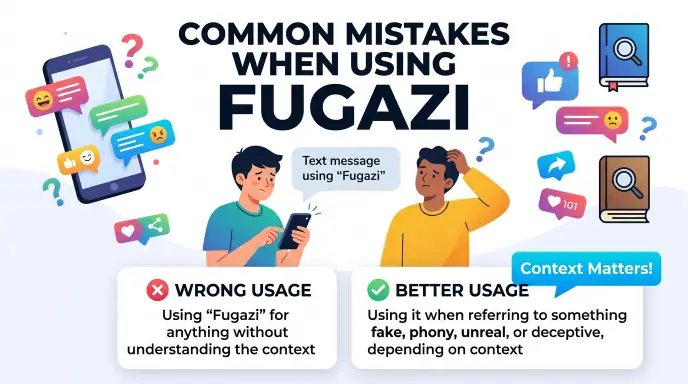
Common Mistakes When Using Fugazi
Assuming It Always Means Counterfeit
A common mistake is thinking fugazi only means a fake physical product.
It can also describe:
- A fake person
- A made up story
- A questionable claim
- A suspicious situation
- Something that seems unreal
The context determines the intended meaning.
Treating Fugazi as Formal English
Although many people understand the word, fugazi remains informal slang.
Avoid using it in important professional writing when a clearer standard word works better.
Instead of:
“The report is fugazi.”
A professional writer might say:
“The report appears inaccurate or unreliable.”
Assuming Every Suspicious Thing Is Fake
If someone says:
“That sounds fugazi.”
They may only be expressing doubt.
They are not necessarily providing proof that something is fake.
This distinction matters, especially when discussing businesses, people, financial offers, or news.
Confusing Fugazi With Its Different Pop Culture Uses
Fugazi can appear as slang, a name, or a reference in music and entertainment. Therefore, you should look at the surrounding context before deciding what the speaker means.
When Should You Avoid Using Fugazi?
You should avoid fugazi when you need precise, formal language.
For example, avoid it in:
- Academic assignments
- Legal documents
- Professional reports
- Formal business communication
- Official complaints
- News writing where precision matters
Instead, use:
- Fake
- False
- Counterfeit
- Fraudulent
- Inauthentic
- Unreliable
- Misleading
- Fabricated
In casual conversation, however, fugazi can sound natural.
Synonyms for Fugazi
Depending on the context, useful alternatives include:
| Slang/Informal | Standard or Similar Meaning |
| Fugazi | Fake |
| Bogus | Not genuine |
| Phony | Pretended or fake |
| Fake | Not real |
| Knockoff | Unauthorized copy |
| Counterfeit | Fake branded product |
| Made up | Invented or untrue |
| Sketchy | Suspicious |
| Shady | Dishonest or questionable |
| Fraudulent | Intended to deceive |
Not every synonym works in every sentence. For example, counterfeit works well for fake products, while phony often works better for fake behavior.
Why Do People Say Fugazi?
People use fugazi because it gives a casual and expressive way to say that something does not seem real.
Instead of simply saying:
“That’s fake.”
Someone might say:
“That’s fugazi.”
The slang can sound more humorous, dramatic, or streetwise.
It also carries strong associations with American movies, music, and popular culture. That cultural background helps give the word its distinctive tone.
Is Fugazi Still Used Today?
Yes, fugazi still appears in modern informal speech and online conversations, although it is not one of the most common slang words.
You may encounter it when people talk about:
- Fake designer products
- Fake social media accounts
- Questionable deals
- Pretend lifestyles
- Made up stories
- Suspicious situations
Its meaning remains closely connected to fake, bogus, or not genuine.
Because slang changes over time, its frequency can vary between age groups and communities.
Fugazi Meaning in Different Contexts
The easiest way to understand the word is to connect it to the subject being discussed.
Fugazi product: A fake or counterfeit item.
Fugazi person: Someone who seems fake or dishonest.
account: A fake online profile.
Fugazi situation: Something strange, confusing, or not what it seems.
This flexible use makes context especially important.
Key Takeaways
- Fugazi usually means fake, phony, bogus, or unreal.
- It can describe people, products, stories, deals, and situations.
- In texting, it often means “fake” or “not genuine.”
- The word is informal slang rather than formal English.
- Calling something fugazi expresses suspicion but does not automatically prove that it is fake.
- The exact origin of the slang remains debated.
- In professional writing, words such as fake, counterfeit, false, or fraudulent are usually clearer.
Frequently Asked Questions
Is Fugazi an Italian word?
“Fugazi” is not a standard Italian word. It is widely used in American slang to describe something that is fake, phony, bogus, or not what it appears to be.
The slang term is often associated with Italian-American speech, which may explain why it sounds Italian, but its exact origin is uncertain.
What is another word for “Fugazi”?
Common alternatives for “Fugazi” include fake, phony, bogus, counterfeit, fraudulent, imitation, and made-up. For example, if someone calls a watch “fugazi,” they usually mean the watch is fake or counterfeit.
How do you say Fugazi in Italian?
There is no exact standard Italian translation of the slang word “Fugazi.” Depending on the intended meaning, you could use “falso” for “fake,” “finta” for a feminine noun meaning “fake,” or “contraffatto” for “counterfeit.” The American slang term itself is not normally used as standard Italian vocabulary.
What does “fugazi fugazi” mean in Urban Dictionary?
“Fugazi fugazi” is used for emphasis to describe something as very fake, bogus, or completely made up.
The repetition gives the phrase a playful or exaggerated tone. It became especially familiar through popular culture, including the movie Donnie Brasco, where “fugazi” is explained as meaning something that is not real.
Fugazi meaning Urban Dictionary
On Urban Dictionary, “fugazi” is commonly used as slang for something fake, phony, bogus, or not genuine.
It can describe fake products, false claims, made-up stories, or someone pretending to be something they are not. User-submitted definitions can vary, so context matters.
Fugazi meaning Wolf of Wall Street
In The Wolf of Wall Street, “fugazi” refers to something fake, unreal, or deceptive. The word is used to describe something that appears valuable or genuine but actually is not. In this context, it is close to “fake,” “bogus,” or “phony.”
Fugazi meaning in English
In English slang, “fugazi” means fake, phony, bogus, or not genuine. It can describe a fake product, a made up story, a dishonest person, or something that looks real but has no real value. For example, “That designer bag is fugazi” means the bag is fake or counterfeit.
Fugazi meaning origin
The exact origin of “fugazi” is uncertain. It became widely known as American slang meaning fake, bogus, or deceptive, with strong associations with Italian-American speech and later popular culture.
The term became especially recognizable through movies and books, including Donnie Brasco, where it is used for something that is not real.
Conclusion
Fugazi means fake, phony, bogus, or not genuine in slang. You can use it for a fake product, questionable deal, made up story, suspicious account, or even a person who seems dishonest or inauthentic.
The word is informal, so it works best in casual conversations, texting, social media, and pop culture settings.
Its exact historical origin is debated, but its modern meaning is clear from context. If you need formal language, choose words such as fake, counterfeit, false, fraudulent, or inauthentic instead.
Discover More Articles!
Out of Pocket Meaning Slang: What Does It Mean?
What Does ASL Mean in Slang? Meaning in Texting and Social Media
5150 Meaning: What Does 5150 Mean in Slang?(2026)

Hi, I’m Sophia Bennett, a novelist passionate about creating heartfelt stories filled with romance, emotion, and unforgettable characters. Through my books, I hope to inspire readers and take them on journeys they’ll always remember.