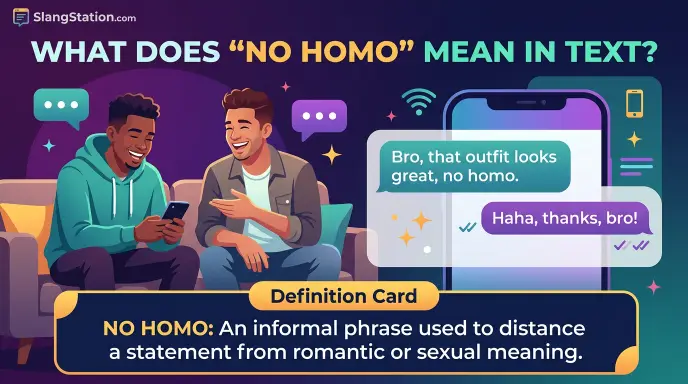
“No homo” is slang used to suggest that a comment or action is not meant romantically or sexually toward another man.
People often add it after giving a compliment, showing affection, or making a joke that could sound romantic.
For example, someone might text, “Bro, you look good today, no homo.” The sender is saying the compliment is meant in a friendly way.
You may see no homo in text messages, memes, gaming chats, TikTok comments, and online conversations.
Some people use it as a joke, while others see it as offensive because it can make same sex attraction sound like something to be ashamed of.
Understanding the phrase helps you read the message correctly and decide if it fits your own conversations.
What Does No Homo Mean in Text Messages?
Meaning: “No homo” means “I do not mean that in a romantic or sexual way.” It is often added after a statement that someone thinks could sound like flirting with another man.
Here is a simple example:
Person A: “Love you, bro. No homo.”
Person B: “LOL, love you too, man.”
Meaning: Person A is showing friendly affection but adds the phrase to make it clear that the message is not intended romantically.
The phrase is informal and is not an acronym. It is made up of ordinary words, and its meaning depends on the situation.
People may use it when they:
- Give a compliment: They want to show appreciation without making it sound like flirting.
- Show friendship: They want to express care for a male friend.
- Make a joke: They use the phrase as part of a funny or awkward message.
- Avoid being misunderstood: They want to clarify that a statement is meant in a friendly way.
However, the phrase has a controversial side. It can suggest that a man must deny being gay to protect his image.
For this reason, some people consider it homophobic or disrespectful, even when the sender thinks it is only a joke.
What Does No Homo Mean in Slang?
In slang, “no homo” is a disclaimer added to a statement that could be understood as having a same sex romantic or sexual meaning.
A disclaimer is a short statement that explains what someone means or does not mean.
For example:
Text: “Bro, you are looking handsome today. No homo.”
Meaning: The sender is giving a compliment but wants to make it clear that it is not intended as romantic interest.
The phrase became known through hip hop culture and online conversations. Today, it can appear in jokes, memes, and casual chats.
Still, the meaning is not always friendly. Depending on the speaker and the situation, it may be used to mock gay men or suggest that being mistaken for gay is embarrassing.
Important point: Saying “no homo” does not prove someone’s sexual orientation. It only tells you how the sender wants that particular statement to be understood.
What Does No Homo Mean on Social Media?
The phrase can appear on different social platforms. The basic meaning stays similar, but the tone may change with the post or conversation.
No Homo on TikTok
On TikTok, no homo may appear in comedy videos, friendship jokes, reaction clips, or memes about male friendships.
Example:
Caption: “When your best friend says you look handsome and then adds ‘no homo.’”
Meaning: The joke is about someone giving a compliment and then trying to make it sound less romantic.
Some creators use the phrase to make fun of the idea that men should hide their affection for friends. Others may use it without thinking about its effect.
No Homo on Instagram
On Instagram, people may use the phrase in comments, Stories, Reels, or direct messages.
Example:
Comment: “Best duo on this app, no homo 😂”
Meaning: The commenter is joking about a close bond between two men and wants to deny any romantic meaning.
The phrase can also appear in memes about friendship. However, it may offend people who feel that ordinary male affection should not need a disclaimer.
No Homo on Snapchat
On Snapchat, the phrase may appear in private chats between friends.
Example:
Person A: “You are my favorite person to hang out with, no homo.”
Person B: “You could have just said we’re good friends 😂”
Meaning: Person A is expressing friendship while trying to avoid a romantic interpretation.
Because Snapchat messages can feel personal, consider your relationship with the other person before using this phrase. A joke that works between close friends may not feel comfortable to someone else.
No Homo on Discord and Gaming Chats
In Discord servers and gaming chats, people may use no homo after a compliment, friendly comment, or joke.
Example:
Player A: “You carried that whole match, bro. No homo.”
Player B: “Just take the win, man!”
Meaning: Player A is praising the other player’s performance but adds the phrase as a joke.
Gaming communities often have their own humor and slang. Even so, a phrase being common in a group does not mean everyone in that group likes it.
No Homo in Texting and WhatsApp
In private text messages and WhatsApp chats, the phrase may be used between friends who share the same sense of humor.
Example:
Text: “Miss you, bro. No homo.”
Meaning: The sender misses their friend and uses the phrase to make the message sound less romantic.
A more direct alternative is “Miss you, bro—we’re good friends.” It communicates the same friendly intention without suggesting that affection needs to be defended.
Real Text Message Examples of No Homo
These examples show how the phrase may appear in different situations. The explanations focus on the likely meaning, since tone can vary from one conversation to another.
Example: Giving a Compliment
A: “Bro, that haircut looks amazing. No homo.”
B: “Thanks, man!”
Meaning: A is complimenting B’s haircut and adding a disclaimer to avoid a romantic interpretation.
Example: Showing Friendship
A: “Love you, bro. No homo.”
B: “Love you too, dude 😂”
Meaning: A is expressing friendly affection toward a close friend.
Example: Making a Joke
A: “You have the nicest smile, no homo.”
B: “Why did you have to add that? 😂”
Meaning: A gives a compliment and then tries to make it sound less romantic. B jokes about the extra clarification.
Example: Talking About Appearance
A: “That outfit looks good on you, no homo.”
B: “A compliment is a compliment, bro.”
Meaning: A wants to praise B’s outfit without suggesting romantic interest.
Example: Gaming With Friends
A: “You’re the best teammate I’ve ever had, no homo.”
B: “We won because we’re a good team!”
Meaning: A is praising B’s gaming skills and using the phrase as a casual joke.
Example: A Close Friendship
A: “I could hang out with you all day, no homo.”
B: “Same. We’re just good friends.”
Meaning: A enjoys spending time with B and wants the message to sound friendly rather than romantic.
Example: An Awkward Message
A: “You looked really good in that picture. No homo.”
B: “You can compliment people without adding that.”
Meaning: A tries to clarify the compliment, but B feels the disclaimer is unnecessary.
Example: Meme Humor
A: “Me telling my best friend he’s handsome and then saying ‘no homo.’”
B: “The disclaimer is doing all the work 😂”
Meaning: The joke points out how people sometimes add the phrase after a harmless compliment.
Example: Asking About the Phrase
A: “Why do people say no homo after a compliment?”
B: “They may worry that the compliment sounds like flirting.”
Meaning: They are discussing why people use the expression.
Example: Setting a Boundary
A: “No homo, but I love you.”
B: “You can care about your friends without explaining it away.”
Meaning: B is saying that friendship and affection do not need to be treated as embarrassing.
How Should You Reply to No Homo?
Your response depends on the sender, the tone, and how comfortable you feel with the phrase. You can keep things light or explain why you dislike it.
Funny Replies
If you and your friend are joking together, you could say:
- “Bro, the disclaimer was not needed 😂”
- “You can compliment me without the extra words.”
- “A win is a win, and a compliment is a compliment.”
- “Why are you making this so complicated? 😂”
These replies keep the conversation casual without attacking the other person.
Friendly Replies
If you want to respond without making the phrase a big issue, try:
- “Thanks, bro!”
- “I know what you mean.”
- “We’re good, man.”
- “Appreciate the compliment.”
These responses work when you simply want to move on with the conversation.
Replies That Challenge the Phrase
If you want to point out that the disclaimer is unnecessary, you can say:
- “It’s okay to compliment your friends.”
- “Being kind doesn’t have to mean flirting.”
- “You don’t need to explain away a compliment.”
- “Friendship is friendship. No disclaimer needed.”
These replies can help start a thoughtful conversation about how people express affection.
Replies When You Feel Uncomfortable
If the message feels disrespectful or the conversation becomes unwanted, you can say:
- “Please don’t use that phrase around me.”
- “Let’s keep the conversation respectful.”
- “I’m not comfortable with that joke.”
- “Can we talk about something else?”
You do not have to laugh at a joke just because the sender says they did not mean any harm. You can set a boundary in a calm and direct way.
Is No Homo Offensive?
It can be offensive because it may suggest that being gay is something negative or embarrassing. The phrase is often used to distance a speaker from the idea of same sex attraction.
For example, when someone says, “You look great today, no homo,” the compliment may be friendly. However, the extra words can imply that a compliment between men needs a warning.
People understand the phrase in different ways. Some use it as old fashioned internet humor, while others hear it as an insult or a sign of discomfort with gay people.
The context matters, but so does the impact. A person may intend a joke and still make someone else feel unwelcome.
If you want to compliment a friend, you can simply say:
“You look great today, bro.”
That sentence is clear, friendly, and does not require a disclaimer.
Where Did No Homo Come From?
The phrase is commonly traced to East Harlem and hip hop culture in the 1990s. It became more widely known through rap lyrics and internet slang in the 2000s.
In that setting, the phrase was often used after words that might be interpreted as romantic or sexual between men.
It helped the speaker distance himself from that interpretation and avoid challenges to his masculinity.
The expression later spread through online forums, social media, memes, and everyday conversation.
It became a familiar part of internet humor, but it also drew criticism for its connection to negative attitudes about homosexuality.
The phrase’s history helps explain why some people see it as more than a harmless joke. It can reflect the idea that men should prove they are straight even when they are simply being kind to each other.
No Homo vs. Similar Slang Terms
These phrases can appear in conversations about friendship, attraction, or jokes, but they do not all mean the same thing.
| Term | Meaning | Main Difference |
| No homo | A disclaimer denying romantic or sexual intent | Can carry negative implications about same sex attraction |
| Bro | A casual term for a male friend | Shows familiarity or friendship |
| Bromance | A close, affectionate friendship between men | Describes a friendship, often in a positive or humorous way |
| Pause | A slang interjection used after a statement that could sound suggestive | Often used to point out a possible double meaning |
| Full homo | An ironic reversal of “no homo” | May be used humorously to embrace rather than deny a same sex interpretation |
Example: “You’re my best bro” expresses friendship. “You’re my best bro, no homo” adds a disclaimer that the friendship is not romantic.
The extra phrase is not necessary to make the meaning clear. In many situations, the words “bro” or “best friend” already explain the relationship.
Common Misunderstandings About No Homo
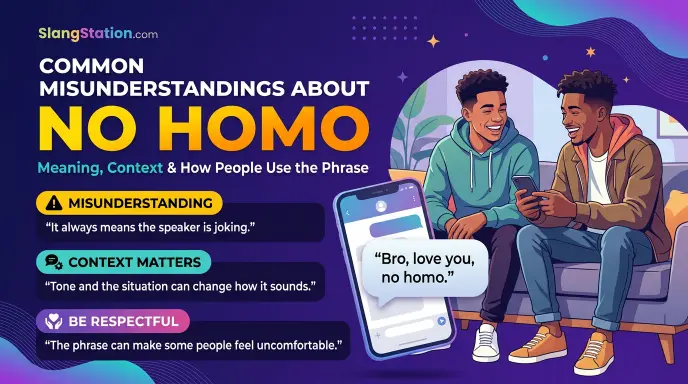
People may misunderstand this phrase because it can be used as a joke, a disclaimer, or an insult.
It does not automatically mean someone is gay. The phrase shows that the speaker wants to deny a romantic or sexual interpretation. It does not prove their sexual orientation.
It does not always mean the sender is trying to offend someone. Some people use it out of habit or because they think it is funny. Still, their intention does not erase the phrase’s possible impact.
It is not an acronym. “No homo” is a slang expression, not an abbreviation made from the first letters of other words.
It is not always harmless. The phrase can reinforce the idea that same sex attraction is embarrassing or wrong.
It does not mean every compliment is romantic. Friends can praise one another, show affection, and say they care without implying sexual interest.
The best way to understand the phrase is to look at the full message and the relationship between the people talking.
When Should You Avoid Using No Homo?
Although the phrase may appear in casual chats, there are situations where it is better to avoid it.
- Professional messages: Keep workplace communication respectful and clear.
- School conversations: Avoid jokes that could make classmates feel targeted or unwelcome.
- Conversations with strangers: You may not know how the other person feels about the phrase.
- LGBTQ+ spaces: The phrase may be viewed as disrespectful because of its history and implications.
- Serious conversations: If someone is sharing their feelings, a joke or disclaimer may make them feel dismissed.
A simple compliment is usually enough. Instead of saying, “You look good, no homo,” you can say, “You look good today.”
That version sounds natural and lets the compliment stand on its own.
Frequently Asked Questions
What does no homo mean in text messages?
“No homo” means the sender wants a statement to be understood as non romantic or non sexual. It often appears after a compliment or an affectionate message between men.
What does no homo mean on TikTok?
On TikTok, no homo is often used in jokes, memes, and videos about male friendship or compliments. Some creators use it ironically to make fun of the idea that men need to deny affection.
Is no homo slang?
Yes. No homo is informal slang, not an acronym. It is used as a disclaimer after a statement that someone thinks could sound romantic or sexual toward another man.
Is no homo rude or offensive?
It can be offensive because it may suggest that being gay is something to deny or feel ashamed of. Some people use it as a joke, but others find its meaning disrespectful.
How should you reply to no homo?
You can say “Thanks, bro,” “The disclaimer wasn’t needed,” or “It’s okay to compliment your friends.” If the phrase makes you uncomfortable, explain that calmly or change the subject.
Does no homo mean someone is gay?
No. The phrase does not prove someone’s sexual orientation. It only shows that the speaker wants to deny a romantic or sexual interpretation of a particular statement.
Is no homo still used in text messages?
Yes, it may still appear in online jokes, memes, and casual chats. Its use varies, and some people avoid it because they consider it outdated or offensive.
Conclusion
No homo means “I don’t mean that romantically or sexually.” People often use it after a compliment, a friendly comment, or a joke that might sound suggestive.
The phrase has a history in hip hop and internet culture, but it can also carry negative implications about gay people. So, context matters when you see it in a message.
If someone texts you “no homo,” read the full conversation before deciding what they mean. And if you want to show friendship or give a compliment, you can do so clearly without needing a disclaimer.
Discover More Articles!
What Does Mood Mean in Text? Slang Meaning
What Does Moots Mean on Instagram? Definition & Examples
What Does Morning Wood Mean in Text? Meaning, Uses & Examples.2026

Hi, I’m Sophia Bennett, a novelist passionate about creating heartfelt stories filled with romance, emotion, and unforgettable characters. Through my books, I hope to inspire readers and take them on journeys they’ll always remember.