1950s slang words were casual expressions used by teenagers, families, musicians, and everyday Americans.
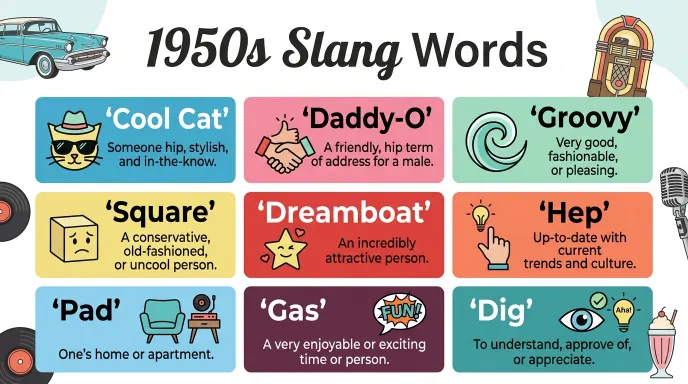
Words such as cool cat, daddy o, hep, hip, groovy, square, and gas helped shape the colorful language of the era. Many of these terms came from jazz, rock and roll, movies, radio, and youth culture.
You may know some 1950s slang because a few expressions still appear in movies, TV shows, books, and modern jokes.
However, their meanings and popularity have changed over time. For example, square once described someone who seemed old fashioned, while cool cat described a stylish or impressive person.
This guide explains popular 1950s slang words, their meanings, examples, and the culture behind them.
What Are 1950s Slang Words?
1950s slang words are informal terms and phrases that people commonly used during the 1950s. Many were linked to teenage culture, jazz, rock and roll, cars, dating, fashion, and everyday social life.
The decade brought major cultural changes. Teenagers became an important consumer group, and music helped spread new expressions. As a result, slang became a strong part of youth culture.
Some expressions faded quickly. Others stayed in English and still appear today.
Quick Answer Table
| 1950s Slang | Meaning | Common Use |
| Cool cat | A stylish or impressive person | People |
| Daddy o | A friendly way to address a man | People |
| Hep | Fashionable or knowledgeable | People |
| Hip | Aware or fashionable | Culture |
| Square | Old fashioned person | People |
| Groovy | Excellent or enjoyable | Things or events |
| Gas | Something fun | Experiences |
| Dreamboat | Attractive person | Dating |
| Cruisin’ | Driving around for fun | Cars |
| Pad | Home or apartment | Places |
| Dig | Understand or like | Conversation |
| Made in the shade | In a comfortable position | Situations |
Popular 1950s Slang Words
Cool Cat
Cool cat referred to a person who seemed stylish, confident, calm, or socially impressive.
The word cool had already been used as slang before the 1950s. Jazz culture helped strengthen this sense of being calm, sophisticated, or fashionable.
Example:
That guy is a real cool cat.
Meaning:
That person is stylish or impressive.
Daddy O
Daddy O was a friendly and informal way to address a man.
Despite the word daddy, it did not necessarily mean someone’s father. Instead, it could work like a casual nickname.
Example:
Hey, Daddy O! How’s it going?
Meaning:
Hey, man! How are you?
The expression became strongly associated with the slang and jazz culture of the period.
Hep
Hep meant fashionable, knowledgeable, or familiar with current trends.
It was closely connected with jazz culture.
Example:
He’s a hep guy.
Meaning:
He’s a fashionable or culturally aware person.
You may also see hep cat, which described someone who understood the latest music and culture.
Hip
Hip had a meaning close to hep.
It could describe someone who was aware of current music, fashion, or culture.
Example:
She’s pretty hip to the latest music.
Meaning:
She knows about the latest music and trends.
The word hip existed before the 1950s, but the decade helped spread its cultural use.
Square
Square described someone who seemed old fashioned, conventional, or out of touch.
It often appeared as the opposite of being hip.
Example:
Don’t be such a square.
Meaning:
Don’t be so old fashioned.
The word could be playful, but it could also sound insulting.
Groovy
Groovy meant excellent, enjoyable, or fashionable.
The term has roots that go back earlier than the 1950s. However, it became strongly linked with popular youth and music culture around this era and later decades.
Example:
That’s a groovy song.
Meaning:
That’s a great or enjoyable song.
Today, groovy often sounds retro because modern speakers may use it to imitate older styles.
Gas
In 1950s slang, gas could mean something very fun, exciting, or amusing.
It did not refer to gasoline in this use.
Example:
That party was a gas!
Meaning:
That party was a lot of fun.
The expression could also describe a funny person or enjoyable experience.
Dreamboat
Dreamboat was a slang term for an extremely attractive person, often someone admired romantically.
Example:
Everyone thought the movie star was a dreamboat.
Meaning:
Everyone thought the movie star was very attractive.
The word appeared in popular culture and dating talk during the era.
Pad
Pad meant home, apartment, or living place.
The term was informal and later became strongly associated with youth culture.
Example:
Come over to my pad after the movie.
Meaning:
Come to my home after the movie.
The expression helped create a casual way to talk about where someone lived.
Dig
Dig could mean understand, appreciate, or like something.
This use was especially linked to jazz and African American speech traditions.
Example:
Do you dig this music?
Meaning:
Do you understand or like this music?
The slang sense differs from the ordinary meaning of dig, which refers to making a hole in the ground.
Cruisin’
Cruisin’ referred to driving around casually for fun, often with friends or while listening to music.
Cars played a major role in American teenage culture during the 1950s.
Example:
We’re cruisin’ downtown tonight.
Meaning:
We’re driving around downtown for fun.
The expression became closely linked with cars, dating, music, and teenage freedom.
Made in the Shade
Made in the shade meant being in a comfortable, safe, or successful position.
Example:
With a new job and a new car, he’s made in the shade.
Meaning:
He’s doing very well and has little to worry about.
The phrase has roots that predate the 1950s, but it remained part of informal American speech during the era.
1950s Slang for Cool
Several expressions could describe something fashionable or impressive.
| Slang | Meaning |
| Cool | Stylish, calm, or impressive |
| Hep | Fashionable or knowledgeable |
| Hip | Aware of current culture |
| Groovy | Excellent or enjoyable |
| Cool cat | A stylish person |
Of these, cool is the biggest survivor.
People still use cool every day. However, its modern meaning is broader than its older slang use.
1950s Slang for People
The decade also had many colorful terms for people.
Cool Cat
A stylish or impressive person.
Daddy O
A friendly term for a man.
Dreamboat
An attractive person.
Square
Someone viewed as old fashioned.
Hep Cat
A fashionable or culturally aware person.
These terms often reflected the decade’s interest in music, fashion, dating, and youth identity.
1950s Slang for Fun
People also had casual ways to describe enjoyable experiences.
Gas
Something fun or amusing.
The concert was a gas!
Groovy
Something enjoyable or excellent.
That’s a groovy record.
Cruisin’
Driving around for fun.
Let’s go cruisin’ tonight.
These expressions show how closely slang connected with entertainment and leisure.
Why Was Slang So Popular in the 1950s?
Several cultural changes helped slang spread.
First, teenagers became a major cultural force. They had more spending power than many previous generations, so businesses began paying greater attention to youth culture.
Next, rock and roll became a major cultural phenomenon. Music brought new styles, attitudes, and expressions to young audiences.
Jazz also played an important role. Many slang terms had connections to jazz musicians and Black American speech communities.
Finally, radio, movies, television, and magazines helped spread expressions beyond local communities.
As a result, slang could move from one city or social group to another much faster than before.
1950s Slang and Rock and Roll
Rock and roll became one of the decade’s defining cultural movements.
Teenagers used slang to express:
- Style
- Independence
- Music taste
- Social identity
- Friendship
- Rebellion
Words such as cool, hip, and groovy became strongly associated with music and youth culture.
1950s Slang and Jazz Culture
Jazz had an especially important connection with American slang.
Terms such as hep, hip, cool, and dig have histories connected to jazz and African American communities.
However, slang does not always have one simple point of origin. Words often move between communities and change meaning over time. Therefore, it is better to treat many slang histories with care rather than claim that one person or one event created them.
1950s Slang for Teenagers
The 1950s saw teenagers become a major part of popular culture. Movies, music, cars, and new fashions gave young people their own style.
Slang helped teens show that they belonged to a new generation.
Words such as cool, hip, hep, square, and cat appeared in youth and music culture.
Cool Cat
A cool cat was a person who looked stylish, confident, or relaxed.
That guy is one cool cat.
The phrase often had a friendly or admiring tone.
Hep Cat
A hep cat was someone who understood the latest music, fashion, and culture.
He’s a hep cat who knows all the best jazz records.
The term had strong links to jazz culture.
Square
A square was someone viewed as too traditional or old fashioned.
Don’t be a square. Come with us.
The word often appeared as the opposite of hip.
1950s Slang for kids
1950s slang included informal terms for young people.
Doll
Doll could describe an attractive young woman.
She’s a real doll.
The expression could sound friendly or flattering, depending on the speaker.
Dreamboat
A dreamboat was someone considered very attractive.
That actor is a dreamboat.
The word could describe a man or woman, although it often appeared when discussing romantic attraction.
Guy
Guy was already established in English and became a common casual word for a man or boy.
That guy is pretty funny.
Unlike some 1950s expressions, guy remains common today.
1950s Dating Slang
Dating culture created many informal expressions.
Young people often met at diners, dances, movie theaters, and drive in restaurants. Cars also gave couples more privacy and freedom.
Dreamboat
As mentioned earlier, dreamboat meant an attractive person.
Going Steady
Going steady meant being in an exclusive romantic relationship.
Are you two going steady?
Meaning:
Are you officially dating each other?
The phrase became strongly associated with teenage dating culture.
Date
The word date was already common, but teenage dating became a major part of American youth culture during the decade.
1950s Slang for Money
People also used informal expressions when talking about money.
Bread
Bread could mean money.
I need some bread before we go out.
Meaning:
I need some money before we go out.
This slang meaning existed before the 1950s and remained in use afterward.
Bucks
Bucks meant dollars.
That jacket costs twenty bucks.
This expression is still common today.
Dough
Dough was another slang word for money.
He made some dough at his new job.
The expression has a long history and continued through the 1950s.
1950s Slang for Cars
Cars played a huge role in 1950s American culture.
Teenagers often connected cars with freedom, dating, music, and independence.
Cruisin’
Cruisin’ meant driving around for fun.
We’re cruisin’ downtown tonight.
Hot Rod
A hot rod was a modified car designed for speed or performance.
He just bought a new hot rod.
Hot rods became an important part of American car culture.
Wheels
Wheels was slang for a car.
Nice wheels!
Meaning:
That’s a nice car.
This use still appears occasionally today.
Jalopy
Jalopy meant an old, worn out car.
His old jalopy barely starts.
The word existed long before the 1950s, but people still used it during the decade.
1950s Slang for Parties
People also had casual expressions for fun and social events.
A Gas
A gas meant something very fun or amusing.
The party was a gas!
Blast
Blast could describe a very enjoyable time.
We had a blast last night.
This phrase remains common today.
Dig
Dig could mean liking or understanding something.
I really dig this band.
Meaning:
I really like this band.
1950s Slang Insults
Not every slang term was positive.
Some words described people who seemed boring, old fashioned, or uncool.
Square
A square was someone considered old fashioned.
He’s such a square.
Wet Blanket
A wet blanket was a person who spoiled other people’s fun.
Don’t be a wet blanket.
The phrase existed before the 1950s, but it remained part of informal speech.
Drag
A drag could describe something boring or unpleasant.
This party is a drag.
Meaning:
This party is boring.
1950s Slang for Something Cool
If someone wanted to praise something, several expressions worked.
Cool
Cool could mean excellent, stylish, or impressive.
That’s a cool car.
Groovy
Groovy could mean enjoyable or fashionable.
That’s a groovy song.
Hep
Hep meant fashionable or knowledgeable about current culture.
He’s really hep.
Hip
Hip described someone who understood current culture.
She’s hip to the latest music.
More Popular 1950s Slang Phrases
Here are some additional expressions connected with the era.
| Phrase | Meaning |
| Made in the shade | In a comfortable or successful position |
| Daddy O | Friendly term for a man |
| Cool cat | Stylish or impressive person |
| Going steady | Dating exclusively |
| What’s buzzin’? | What’s happening? |
| That’s the ticket | That’s the right idea |
| See you later, alligator | Playful goodbye |
| After while, crocodile | Playful response to goodbye |
| Dreamboat | Very attractive person |
| Pad | Home or apartment |
Some phrases were not exclusive to the 1950s. They simply remained popular or strongly associated with the era.
1950s Slang vs Modern Slang
1950s slang and modern internet slang differ in several ways.
| 1950s Slang | Modern Slang |
| Cool cat | GOAT |
| Square | NPC |
| Groovy | Fire |
| Dreamboat | Crush |
| Gas | Lit |
| Pad | Home |
| Bread | Cash |
| Going steady | In a relationship |
| Dig | Vibe with |
| Wheels | Ride |
The meanings are not always exact matches. Instead, these pairs show similar ideas across different generations.
For example, groovy could describe something enjoyable, while modern speakers might say fire or lit.
1950s Slang in Movies and Television
Movies and television helped spread certain expressions across the United States.
Teen characters often represented a new youth culture. Their clothing, music, cars, and speech became part of popular entertainment.
However, movies do not always provide a perfect record of everyday speech. Writers sometimes used slang to make characters sound youthful or rebellious.
Therefore, a phrase appearing in a 1950s movie does not automatically mean everyone used it every day.
Real Life 1950s Style Conversation
Here is a fictional example using several expressions from the period:
Jack: Hey, Daddy O! You going to the dance tonight?
Tom: You bet. Mary is my dreamboat.
Jack: Are you two going steady?
Tom: Not yet. But we’re cruisin’ there in my new wheels.
Jack: Sounds groovy. See you there!
This conversation is fictional. It shows how several period expressions might fit together without claiming that real people spoke exactly this way.
Another Example
Martha: What do you think of this new record?
Sam: I dig it. It’s groovy.
Martha: My brother thinks rock and roll is just noise.
Sam: Don’t be a square!
Here, dig means like or appreciate, while square describes someone who seems old fashioned.
When Did 1950s Slang Come From?
1950s slang did not come from one source.
Instead, several communities and cultural movements influenced the language of the decade.
These included:
- Jazz musicians
- African American communities
- Teenagers
- Rock and roll fans
- Beat culture
- Movies
- Radio
- Television
- Car culture
Some expressions had existed for decades. Others became popular during the 1950s.
Because slang changes quickly, exact dates can be difficult to establish. Therefore, it is safer to describe many terms as popular during the 1950s rather than claiming they were invented during that decade.
Why Did 1950s Slang Matter?
Slang gave people a way to express identity.
For teenagers, it could signal:
- Independence
- Music taste
- Friendship
- Fashion
- Rebellion
- Belonging
For example, calling someone a square separated them from people viewed as more modern or hip.
Likewise, words such as cool, hep, and groovy helped create a shared cultural style.
Common Mistakes When Using 1950s Slang Words

Assuming Every Slang Word Was Created in the 1950s
This is one of the biggest mistakes.
Some expressions became popular during the 1950s, but they existed before the decade. For example, cool, bread, dough, and groovy have histories that reach earlier than the 1950s.
So, it is better to say a word was popular in the 1950s rather than claim that people invented it during that decade.
Thinking All 1950s Slang Was Used Everywhere
Slang varied by region, age group, and community.
Jazz musicians, teenagers, and other groups did not always use the same expressions. Some terms also had strong connections to African American culture.
Therefore, avoid treating 1950s slang as one single style of speech.
Using Too Much Slang in One Sentence
Modern writers sometimes add many old expressions to make dialogue sound “1950s.”
That can make the conversation feel fake.
For example:
Hey, Daddy O! That groovy dreamboat is cruising in his cool wheels, and the party is a gas!
The sentence contains too many period terms.
A more natural approach uses only one or two expressions at a time.
Assuming Movies Show Everyday Speech Perfectly
Movies can help us understand the slang of an era. However, screenwriters often choose words to create a certain character or mood.
As a result, movie dialogue may sound more colorful than normal conversation.
Use historical sources carefully when studying how people actually spoke.
Confusing Old Slang With Modern Meaning
Some words survived but changed meaning.
For example, cool remains common today. However, its use has expanded far beyond the meanings associated with mid century youth culture.
Likewise, hip has several meanings in modern English.
Always consider the time period when interpreting an old expression.
Key Takeaways
- 1950s slang words reflected music, cars, dating, youth culture, and social change.
- Popular terms included cool cat, Daddy O, hep, hip, square, groovy, gas, pad, and dreamboat.
- Cool and several other terms survived into modern English.
- Many expressions existed before the 1950s but became popular during the decade.
- Jazz and African American culture played an important role in the history of several slang terms.
- Regional and social differences mattered.
- Not every phrase shown in a movie represents everyday speech.
- Context is important when using or studying historical slang.
Frequently Asked Questions
What slang words were popular in the 1950s?
Popular examples include cool cat, Daddy O, hep, hip, square, groovy, gas, dreamboat, pad, dig, bread, dough, wheels, and cruisin’. Some were strongly linked to the decade, while others had older roots but remained popular during the 1950s.
What did “cool” mean in the 1950s?
Cool could describe someone calm, stylish, confident, or impressive. It could also describe something excellent. The word had older roots, especially in jazz culture, but it became a major part of American popular language during the mid 20th century.
What did “square” mean in the 1950s?
A square was someone considered old fashioned, conventional, or out of touch with newer youth culture. Young people often used the term as the opposite of hip or hep. Depending on the situation, it could sound playful or insulting.
What did “Daddy O” mean?
Daddy O was an informal and friendly way to address a man. Despite the word “daddy,” it did not necessarily refer to someone’s father. The expression had strong links to jazz and beat culture and became associated with the slang style of the period.
What did “dreamboat” mean in the 1950s?
Dreamboat described someone considered very attractive, especially in a romantic context. People could use it when talking about a movie star, singer, date, or other attractive person. The word sounds old fashioned today and often appears when people imitate mid century speech.
What did “gas” mean in 1950s slang?
Gas could mean something very fun, exciting, or amusing. For example, saying “The party was a gas” meant the party was enjoyable. This meaning differs from the modern everyday use of gas for fuel or a substance.
What did teenagers call money in the 1950s?
Teenagers and adults could use terms such as bread and dough for money. Bucks also meant dollars. These expressions were not exclusive to teenagers or the 1950s, but they were part of the informal language used during the era.
Is 1950s slang still used today?
Some expressions remain common, while others sound dated. Cool, hip, bucks, blast, and bread have survived in various forms. Terms such as Daddy O and dreamboat are much less common and often appear today for humor or a retro effect.
Conclusion
1950s slang words offer a useful look at American youth culture, music, dating, cars, and everyday life. Expressions such as cool cat, Daddy O, square, hep, groovy, gas, dreamboat, pad, and dig helped give the decade its distinctive voice.
However, not every term started in the 1950s. Some had older roots and simply became popular during the decade.
Also, different communities used different expressions. Jazz culture, African American communities, teenagers, rock and roll fans, movies, radio, and television all helped shape the language of the period.
Today, some words remain part of normal English. Others sound distinctly retro. Learning the difference helps you understand old movies, music, books, and conversations without assuming that every phrase was used by everyone.
If you want to recreate the 1950s style, use a few expressions naturally instead of filling every sentence with old slang.
Discover More Articles!
80s Slang Words: Popular 1980s Slang Meanings, Examples, and Origins
Brazilian Slang: Popular Words and Phrases You Should Know
Bunk Slang Meaning Explained: Texting, School, and Social Media

Hi, I’m Sophia Bennett, a novelist passionate about creating heartfelt stories filled with romance, emotion, and unforgettable characters. Through my books, I hope to inspire readers and take them on journeys they’ll always remember.