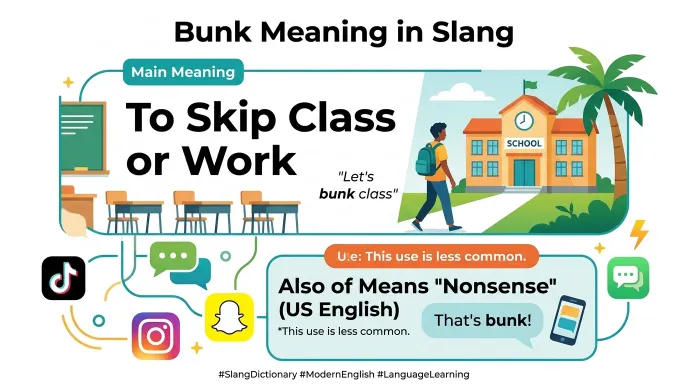
In slang, “bunk” most often means to skip school, college, work, or another activity without permission. In some places, especially India, Pakistan, and the UK, people say they are going to bunk class when they decide not to attend.
American English, bunk can also mean nonsense or something that is not true, although that use is less common today.
You may see the word bunk in text messages, social media posts, school conversations, memes, and everyday speech.
The meaning depends on the situation, so understanding the context is important. In this guide, you’ll learn the different slang meanings of bunk, where people use it, how it changes by region, and when it is appropriate to use the word.
What Does Bunk Mean in Slang? (Quick Answer)
Bunk usually means to skip school, class, college, or work on purpose without permission.
In some contexts, especially in American English, bunk can also mean nonsense or something false. The correct meaning depends on the conversation.
Quick Answer Table
| Question | Answer |
| Meaning | Skip class or work; sometimes “nonsense” |
| Tone | Casual |
| Common Users | Students, young adults, social media users |
| Popular Platforms | Texting, TikTok, Instagram, Snapchat |
| Offensive? | No |
| Formal or Informal? | Informal |
| Still Popular? | Yes, especially in South Asia and the UK |
What Does Bunk Mean?
In everyday slang, bunk usually means to skip a class, lecture, school day, or work shift without permission.
Students often use the word when they decide not to attend class. Instead, they may spend time with friends, watch a movie, or simply stay home.
Example
Emma: Are you coming to math class?
Liam: No. I’m going to bunk today.
Context: Liam says he plans to skip class instead of attending.
What Does “Bunk Class” Mean?
The phrase “bunk class” means to miss or skip a class on purpose.
It is especially common in:
- India
- Pakistan
- Bangladesh
- The UK
- Other South Asian English speaking communities
Example
Noah: Let’s bunk chemistry today.
Mia: Only if we finish our homework first.
Context: Noah suggests skipping chemistry class.
Although students often use this phrase casually, schools generally do not approve of missing class without permission.
Bunk as “Nonsense”
In American English, bunk can also mean nonsense, false information, or something unbelievable.
This meaning comes from the expression “That’s bunk!”
Example
Ava: He said he can run faster than a race car.
Lucas: That’s bunk!
Context: Lucas believes the statement is false or ridiculous.
Today, this meaning is less common than the “skip class” meaning.
Why Do People Use the Word Bunk?
People use bunk because it is short, simple, and easy to understand.
Students often use it when talking with friends. It also appears in memes, school jokes, and social media posts.
In addition, the word quickly explains the action without needing a longer sentence.
Is Bunk Still Popular?
Yes.
The slang meaning of bunk remains popular in many countries.
It is especially common among:
- High school students
- College students
- University students
- Young adults
However, the exact meaning depends on the region.
For example, students in India and Pakistan often say “bunk class.” Meanwhile, many Americans are more familiar with “skip class.”
Regional Differences
The meaning of bunk changes slightly from one country to another.
India and Pakistan
Here, bunk almost always means to skip class or college.
Example:
We’re bunking the last lecture today.
United Kingdom
British English also uses bunk off, which means to leave school or work without permission.
Example:
They bunked off school on Friday.
United States
In American English, people usually say:
- Skip class
- Skip school
- Play hooky
Although bunk can mean nonsense, it is less common in everyday speech.
Is Bunk Positive or Negative?
The word itself is neutral.
However, the action may be viewed differently depending on the situation.
Casual Use
Friends often use bunk in a light hearted way.
Example:
Let’s bunk one lecture and grab lunch.
Negative Use
Teachers and parents may see bunking as irresponsible because it means missing important classes.
As a result, the word can carry a negative meaning in educational settings.
Is Bunk Offensive?
No.
Bunk is not considered offensive or vulgar.
However, encouraging someone to skip school or work may not be appropriate.
Therefore, use the word carefully and understand the situation before saying it.
Who Uses Bunk?
The slang word is common among:
- Students
- Teenagers
- College friends
- University groups
- Social media users
Adults may also use it when talking about skipping work or remembering school days.
Bunk Meaning in Text Messages
In text messages, bunk usually means to skip school, college, work, or another planned activity.
Friends often use the word when making casual plans.
Example
Emma: Are you going to science class?
Liam: No. I’m going to bunk today.
Context: Liam plans to miss class on purpose.
Sometimes people also use bunk as a verb.
For example:
- I bunked class yesterday.
- We should not bunk again.
- They always bunk Friday lectures.
Bunk Meaning on TikTok
On TikTok, bunk often appears in videos about school life.
Creators share funny clips about:
- Missing class
- Hanging out with friends
- School memories
- Student jokes
Example
Caption: POV: You bunk one class and the teacher takes attendance.
Context: The creator jokes about getting caught after skipping class.
Many student creators use this slang because their audience understands it.
Bunk Meaning on Instagram
Instagram users often use bunk in captions, stories, and comments.
Most posts focus on college life or school memories.
Example
Caption: Bunked class for coffee with friends. ☕
Comment: Worth it! 😂
Context: The post shares a casual moment with friends after skipping class.
Bunk Meaning on Snapchat
Snapchat conversations are usually quick and informal.
Because of that, students often use bunk when making last minute plans.
Example
Noah: First lecture today?
Ava: Let’s bunk and get breakfast.
Context: Ava suggests skipping class to eat together.
Bunk Meaning on Reddit
On Reddit, the word bunk appears in student communities and discussion forums.
People may ask questions such as:
- Is it okay to bunk one class?
- Have you ever bunked an exam review?
- What’s your funniest bunk story?
Example
User: I bunked class and missed a surprise quiz.
Reply: That happens more often than you think.
Context: The discussion is about the risk of skipping class.
Bunk Meaning at School and College
Schools and colleges are where the slang is most common.
Students often use bunk when talking with classmates.
Example
Jake: Everyone is bunking the last lecture.
Sophia: I’m staying. I don’t want to miss today’s lesson.
Context: Jake wants to skip class, but Sophia chooses to attend.
Although friends may joke about bunking, missing lessons can affect grades and attendance.
Bunk Meaning at Work
Adults sometimes use bunk when talking about work, although it is less common than at school.
Example
Chris: He bunked work on Monday.
Taylor: I hope everything is okay.
Context: Chris says someone missed work without permission.
Many people simply say skip work or call in sick instead of bunk work.
Bunking, Bunked Class, and School Bunk Meaning
Bunking means deliberately missing a class, school period, lecture, or another activity that you are expected to attend. In student conversations, it usually describes the act of skipping class without permission.
The bunking class meaning is simple: a student chooses not to attend a particular class even though they are supposed to be there.
For example, a student might say, “We are bunking class today,” when they plan to skip a lesson with friends.
The phrase school bunk meaning is similar. It refers to deliberately missing school or staying away from a school period without an approved reason.
Students may use bunk school informally when talking about skipping a day or part of the school day.
You may also hear someone say “bunk the class.” This means to skip the class on purpose. For example, “They decided to bunk the class and go for lunch” means they chose not to attend the lesson.
When a student says, “I bunked class yesterday,” the phrase describes an action that already happened. The bunked class meaning is therefore simply that the person intentionally missed a class.
A class bunker is an informal expression for a student who regularly skips classes. It is not a formal English term, but it may appear in casual conversations among students.
These expressions are especially common in informal student conversations. In formal writing, however, phrases such as “missed class,” “was absent,” or “did not attend the lesson” are clearer and more appropriate.
What Emoji Matches Bunk?
People often add emojis to make the message more playful.
Common choices include:
- 😂
- 😎
- 🙈
- 🎒
- 📚
- ☕
- 🎬
Examples
- Let’s bunk today. 😂
- We bunked math. 😎
- Time for a coffee instead of class. ☕
The emoji usually shows that the message is light hearted.
Similar Slang Terms
Several slang terms have a similar meaning.
| Slang | Meaning |
| Bunk | Skip class or work |
| Skip | Miss class or work on purpose |
| Bunk Off | Leave school or work without permission (UK) |
| Play Hooky | Skip school or work (US) |
| Ditch Class | Leave or miss a class on purpose |
Although these phrases are similar, each one is more common in certain regions.
Bunk vs Skip
These two words often mean the same thing.
| Term | Meaning | Common Region |
| Bunk | Skip class | India, Pakistan, UK |
| Skip | Miss class | Worldwide |
Example
India: We bunked chemistry.
USA: We skipped chemistry.
Both sentences describe the same action.
Bunk vs Play Hooky
These expressions also have similar meanings.
| Term | Meaning |
| Bunk | Skip school or work |
| Play Hooky | Skip school or work without permission |
Play hooky is much more common in American English.
Bunk vs Bunk Off
People sometimes confuse these phrases.
| Term | Meaning |
| Bunk | Skip class or work |
| Bunk Off | Leave school or work without permission |
Bunk off is mainly used in British English.
Example
They bunked off school on Friday.
The meaning is almost the same, but the wording changes by region.
Bunk Meaning in College, Lectures, and Slang
The bunk college meaning is usually to skip a college class or lecture without permission. College students often use “bunk” when talking casually with friends about missing a lesson.
Similarly, college bunk meaning refers to the act of deliberately avoiding a college class, lecture, or other scheduled academic activity.
For example, “We are planning a college bunk today” may mean that a group of students intends to skip a class.
The phrase bunk in college meaning is therefore closely connected with student slang. If someone says, “I used to bunk in college,” they usually mean they often skipped classes during their college years.
Students may also use the phrase bunk lectures when they decide not to attend one or more lectures. For example, “They bunked the morning lectures” means they deliberately missed those lectures.
In slang, bunk definition slang can have another meaning depending on context. In expressions such as “That’s bunk,” the word can mean nonsense, something false, or something that is not believable.
This use is different from the student meaning of bunk, where it means to skip school, college, or work.
So, slang bunk can have two important meanings: skipping an expected activity, especially a class, or describing something as nonsense. Context tells you which meaning the speaker intends.
For example:
- “Let’s bunk the lecture.” → Let’s skip the lecture.
- “I bunked college today.” → I did not attend college as expected.
- “That’s bunk!” → That’s nonsense or untrue.
Because the word has more than one meaning, it is useful to look at the surrounding conversation.
When people are discussing school or college attendance, bunk almost always relates to skipping.
When someone says “That’s bunk,” the meaning is usually nonsense or something considered untrue.
Real Life Examples
Text Message
Emma: Are you coming to history?
Liam: No. I’m going to bunk today.
Context: Liam decides to miss class.
School Conversation
Noah: Everyone is bunking the last lecture.
Mia: I’ll stay. The test is tomorrow.
Context: Mia chooses not to skip class.
TikTok Caption
Bunk one class.
Miss the only surprise quiz. 😂
Context: The joke highlights an unlucky situation.
Instagram Story
Caption: Coffee first. Class later. ☕
Reply: Classic bunk day. 😂
Context: Friends joke about skipping class.
Reddit Post
User: I bunked class and missed an important announcement.
Reply: That’s why I rarely skip lectures.
Context: The reply reminds readers that bunking can have consequences.
When Should You Use Bunk?
You can use bunk when:
- Talking with friends.
- Sharing school stories.
- Posting funny student content.
- Discussing college life.
- Speaking in casual conversations.
The word fits best in informal situations.
When Should You Avoid Bunk?
Avoid using bunk when:
- Writing business emails.
- Preparing school assignments.
- Giving formal presentations.
- Speaking in professional meetings.
- Communicating with people who may not know the slang.
In formal situations, words like skip, miss, or be absent are usually clearer.
Common Mistakes When Using Bunk

Thinking Bunk Has Only One Meaning
Many people believe bunk only means to skip class. That is the most common slang meaning. However, in American English, bunk can also mean nonsense.
Always read the full conversation before deciding what the word means.
Using Bunk in Formal Writing
Bunk is an informal slang word.
Do not use it in:
- Business emails
- School reports
- Job applications
- Official letters
- Academic papers
Instead, use words like skip, miss, or be absent.
Confusing Bunk With Bunk Bed
Some learners think bunk always refers to a bunk bed.
These meanings are different.
Bunk bed: A bed with one bed above another.
Bunk (slang): To skip class or work, or to describe something as nonsense.
The surrounding words make the meaning clear.
Using Bunk in Every English Speaking Country
The slang is not equally common everywhere.
For example:
- India, Pakistan, and Bangladesh: “Bunk class” is very common.
- United Kingdom: “Bunk off” is common.
- United States: People usually say skip class or play hooky.
Knowing the regional difference helps you sound more natural.
Key Takeaways
- Bunk usually means to skip school, college, or work on purpose.
- In some American English expressions, bunk also means nonsense.
- The slang is common among students and young adults.
- It appears often in texting, social media, and school conversations.
- The word is informal but not offensive.
- Always use the context to understand the correct meaning.
Frequently Asked Questions
What does bunk mean in slang?
In slang, bunk usually means to skip school, college, work, or another activity without permission. In some American English expressions, it can also mean nonsense or something untrue.
What does bunk class mean?
Bunk class means to miss or skip a class on purpose. Students often use this phrase when they decide not to attend a lesson even though they are expected to be there.
Is bunk a bad word?
No. Bunk is not a swear word or an offensive term. However, the action of skipping school or work may be viewed negatively by teachers, parents, or employers.
Is bunk still popular?
Yes. Bunk remains popular, especially among students in India, Pakistan, Bangladesh, and the United Kingdom. Many people still use the word in casual conversations and on social media.
What does bunk mean in American English?
In American English, bunk can mean nonsense, especially in phrases like “That’s bunk!” However, Americans are more likely to say skip class or play hooky when talking about missing school.
What is the difference between bunk and skip?
Both words describe missing school or work on purpose. The main difference is regional usage. Bunk is more common in South Asia and parts of the UK, while skip is common in many English speaking countries.
Can adults use the word bunk?
Yes. Adults sometimes use bunk when talking about skipping work or remembering their school days. However, the slang is still more common among students.
Is bunk used on social media?
Yes. You can find bunk in TikTok videos, Instagram captions, Snapchat chats, Reddit posts, and text messages. Most posts involve school life, funny student stories, or college memories.
Conclusion
Bunk is a simple slang word with more than one meaning. Today, it most often means to skip school, college, or work without permission. This meaning is especially common in India, Pakistan, Bangladesh, and the United Kingdom.
In American English, bunk can also mean nonsense, although that use is less common in everyday conversation.
The easiest way to understand bunk is to look at the context. If friends are talking about school, the word usually means skipping class. If someone says, “That’s bunk,” they are calling something false or unbelievable.
Learning these meanings will help you understand the slang with confidence, no matter where you see it online or in everyday conversations.
Discover More Articles!
Motorboat Meaning Slang in Texting and Social Media
80s Slang Words: Popular 1980s Slang Meanings, Examples, and Origins
Brazilian Slang: Popular Words and Phrases You Should Know

Hi, I’m Sophia Bennett, a novelist passionate about creating heartfelt stories filled with romance, emotion, and unforgettable characters. Through my books, I hope to inspire readers and take them on journeys they’ll always remember.