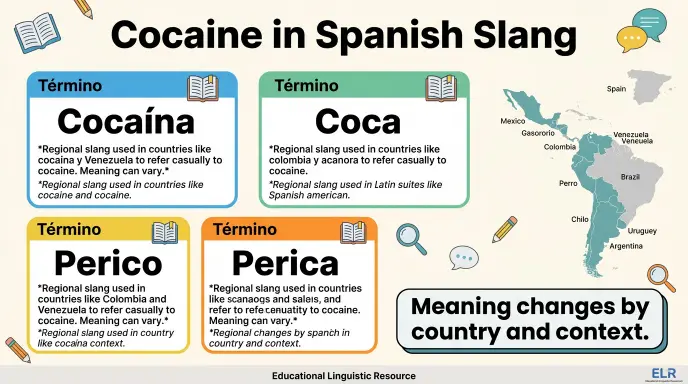
Cocaine in Spanish slang can be called “coca,” “perico,” or other regional terms, but the exact word depends on the country and context.
Spanish speaking communities do not use one single slang word for cocaine. Some terms are common in one country but may have a different meaning somewhere else.
For example, the Spanish word coca can be used informally for cocaine. Perico and perica are also linked to cocaine in some parts of Latin America.
The Association of Academies of the Spanish Language (ASALE) records perica as a word for a portion of cocaine in Colombia and Venezuela.
This guide explains common Spanish slang connected to cocaine, where the terms are used, and why context matters.
Quick Answer: What Is Cocaine Called in Spanish Slang?
Common Spanish slang terms for cocaine include coca, perico, and perica.
However, these words do not have the same meaning everywhere. Perico, for example, has many meanings in Spanish.
ASALE lists meanings related to a bird, a talkative person, food, and other regional uses. In some contexts, related forms such as perica refer to cocaine.
So, you should always look at the full sentence and the country where the speaker is from.
What Does “Coca” Mean in Spanish Slang?
Coca is a common informal term associated with cocaine.
It is a shortened form related to the Spanish word cocaína, which is the standard Spanish word for cocaine.
You may see “coca” in casual conversations, songs, movies, or online discussions about drugs. Still, the meaning can depend on the situation.
For a learner of Spanish, the safest approach is to understand coca as an informal reference to cocaine when the surrounding context is clearly about drugs.
What Does “Perico” Mean in Spanish Slang?
Perico is a good example of why Spanish slang can be confusing.
The word has many meanings. ASALE records perico as the name of a type of bird in several Spanish speaking countries. It also has regional meanings involving people, food, and other expressions.
In drug related language, related forms such as perica can refer to cocaine. ASALE specifically records perica as “a portion of cocaine” in Colombia and Venezuela.
This means you should not automatically assume that every use of perico refers to cocaine.
Context is very important.
What Does “Perica” Mean?
Perica can be a cocaine related slang term in parts of Latin America.
According to the Diccionario de americanismos from ASALE, perica has a drug related meaning in Colombia and Venezuela, where it can refer to a portion of cocaine.
But “perica” also has completely different meanings in other countries. This is common with Spanish slang.
A word may sound like drug slang in one country but mean something ordinary in another.
Why Does Spanish Cocaine Slang Change by Country?
Spanish is spoken across many countries, and each country has its own slang.
Words can change because of:
- Local culture
- Regional speech
- Youth slang
- Music
- Movies and television
- Street language
- Historical usage
- Online communities
Because of this, a slang word used in Colombia may not be common in Mexico or Spain.
This is especially important with drug related vocabulary. A term can have a strong meaning in one region and a completely different meaning somewhere else.
Spanish Slang for Cocaine by Region
There is no single universal list that works perfectly across every Spanish speaking country.
Some terms have documented regional meanings.
Colombia
Perica is documented as a term for a portion of cocaine in Colombia.
You may also encounter other informal words in Colombian media or conversations. Their meaning can depend on the speaker and setting.
Venezuela
Perica is also documented in Venezuela with the cocaine related meaning.
At the same time, perico has many non drug meanings in Venezuelan Spanish. ASALE lists several regional meanings for the word.
Mexico
Mexican Spanish has its own drug related vocabulary. Some terms can refer to cocaine or people who use it.
For example, the historical Spanish language dictionary resources record cocodrilo in Mexican usage as a word associated with a person who uses cocaine.
This does not mean that “cocodrilo” normally means cocaine in everyday Mexican Spanish. It is a specialized slang use.
Spain
Spain also has informal drug vocabulary, but Latin American terms may not be understood in the same way there.
A word that is familiar in Colombia may sound unusual or confusing to a Spanish speaker from Madrid.
That is why country and context should always be considered.
“Coca” vs. “Cocaína”
The difference is simple.
Cocaína is the standard Spanish word for cocaine.
Coca can be an informal or shortened reference in drug related conversation.
For example, someone writing a formal article would normally use cocaína, while informal speech may use a shorter term.
This is similar to how English speakers may use both a formal drug name and informal slang.
Is “Perico” Always About Cocaine?
No.
This is one of the biggest mistakes people make when learning Spanish slang.
The word perico has many meanings. ASALE lists it as a word for a bird and also gives several regional meanings unrelated to drugs.
For example, in some Spanish speaking regions, perico can describe a talkative person. In other places, it can refer to certain foods or other local expressions.
So, if you see “perico” in a Spanish sentence, do not automatically translate it as cocaine.
Look at the surrounding words.
Cocaine Slang in Spanish Music and Media
Drug related slang sometimes appears in Spanish language music, films, television, and online content.
The word may be used to create a realistic character, describe a setting, or discuss drug culture.
However, the meaning is not always literal.
A song lyric may use a slang term as part of storytelling or cultural expression. A movie character may use street language that is specific to a certain region.
This is another reason why direct word for word translation can be misleading.
Cocaine Slang on Social Media
Social media has made regional slang easier to spread.
A Spanish speaking user in one country may see slang from another country on TikTok, Instagram, YouTube, or X.
As a result, people sometimes use words they learned online rather than from their local community.
This can create confusion.
A term may appear frequently online but still sound unusual in everyday speech in a particular country.
Cocaine Slang in Texting
In texting, drug related slang can appear in short messages, memes, lyrics, or discussions.
The meaning usually comes from context.
For example, a message about partying, drugs, or substance use may make a slang term easier to understand. But the same word in another conversation may have an ordinary meaning.
This is especially true for perico, because it has several documented meanings unrelated to cocaine.
Why Context Matters So Much
Context can completely change the meaning of a Spanish slang word.
Consider perico.
If someone is talking about birds, “perico” may simply refer to a parrot or related bird.
If someone is talking about food, the word can have another regional meaning.
If the conversation is about drugs, a related form such as perica may have a cocaine related meaning in Colombia or Venezuela.
The same spelling can therefore lead to very different translations.
Common Mistakes When Understanding Cocaine Slang
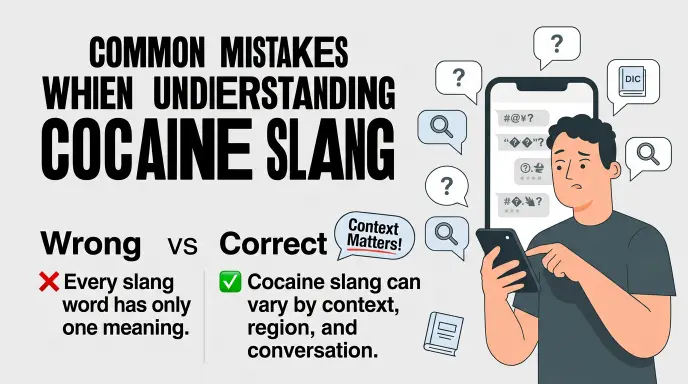
Assuming One Slang Word Works Everywhere
Spanish slang is regional.
Do not assume that a word used in Colombia has exactly the same meaning in Mexico, Spain, Argentina, or another Spanish speaking country.
Thinking “Perico” Always Means Cocaine
This is incorrect.
Perico has several meanings, including ordinary meanings unrelated to drugs.
Confusing “Coca” With the Formal Word
Cocaína is the standard Spanish word for cocaine. “Coca” is more informal and depends on context.
Translating Every Slang Word Literally
Literal translation can produce strange results.
Slang often has cultural meanings that do not appear in a basic Spanish English dictionary.
Ignoring the Country
Always check where the speaker is from.
Regional dictionaries such as ASALE’s Diccionario de americanismos mark meanings by country, which shows how much Spanish vocabulary can vary across Latin America.
Is Cocaine Slang Offensive?
Drug slang is informal and can be sensitive.
The words themselves may not always be swear words, but using drug slang in the wrong setting can sound inappropriate.
For example, it may not belong in:
- Formal school writing
- Professional emails
- Business documents
- Official reports
- Formal conversations
If you are writing formally, cocaína is usually clearer than regional slang.
How to Understand Cocaine Slang in Movies
When watching a Spanish language movie, pay attention to the country and characters.
A character from Colombia may use vocabulary that differs from a character from Mexico.
The scene also matters.
If the conversation is about food, “perico” may have nothing to do with drugs. If the scene is about drug use, the meaning may be different.
Subtitles can also simplify slang. A translator may replace a regional term with a more general English word.
How to Understand Cocaine Slang in Songs
Music can use slang in a creative way.
A Spanish language song may include regional words, metaphors, or street expressions. The meaning may also depend on the artist’s country.
Do not assume that one slang term has the same meaning in every song.
If the exact meaning matters, check the lyrics in context and consider the artist’s region.
Is “Perico” a Spanish Slang Word?
Yes, but it is not only a slang word for cocaine.
The word has many regional meanings. ASALE records several ordinary meanings for perico, while related perica has a documented cocaine related meaning in Colombia and Venezuela.
This makes “perico” a good example of why Spanish slang needs context.
Other Drug Related Spanish Terms
Spanish has many informal words connected with drugs, but meanings vary widely.
Some terms may describe:
- A particular drug
- A person who uses drugs
- A substance in general
- A quantity
- A way of talking about drugs
- Drug related behavior
These words should not be treated as universal Spanish vocabulary.
Some may be old, local, or limited to certain social groups.
What Is the Correct Spanish Word for Cocaine?
The standard Spanish word is cocaína.
If you want to communicate clearly with Spanish speakers from different countries, cocaína is the safest general term.
Slang such as coca or regional terms such as perica are more dependent on context and location.
Key Takeaways
- Cocaína is the standard Spanish word for cocaine.
- Coca can be used informally in drug related contexts.
- Perica has a documented cocaine related meaning in Colombia and Venezuela.
- Perico has many meanings and does not always refer to cocaine.
- Spanish drug slang changes from country to country.
- Context is very important when translating Spanish slang.
- Formal writing should normally use cocaína instead of regional slang.
- A slang word seen online may not be common in everyday speech in every Spanish speaking country.
FAQs
What is the slang term for cocaine?
Common slang terms for cocaine include coke, blow, snow, powder, white, yayo, and nose candy. These terms can vary by country, community, and context.
What does coke mean in Spanish?
In Spanish, “coke” can refer to cocaine in slang, but common Spanish terms include coca, cocaína, and perico. The exact term varies by region.
How do Mexicans say coke?
In Mexican Spanish, “coca” can refer to cocaine, while “perico” is also a commonly recognized slang term for cocaine. Usage can vary by region and context.
Spanish slang for drugs
Spanish has different slang terms for drugs depending on the country and the specific drug. For cocaine, terms such as coca, perico, coke, and yayo may appear in informal speech.
Slang varies widely across Spain and Latin America, so the same word may have a different meaning in another region.
Funny slang for cocaine
Some humorous or playful slang terms for cocaine include snow, blow, nose candy, white, and powder.
These expressions are informal and can appear in jokes, songs, movies, or casual conversations.
Their meaning depends on the context, and some terms can have other meanings outside drug slang.
Slang words for cocaine
Common slang words for cocaine include coke, blow, snow, powder, yayo, white, and nose candy.
In Spanish speaking communities, coca and perico are also used in some regions. Drug slang changes over time and differs by country, city, and social group.
Cocaine in Portuguese
The standard Portuguese word for cocaine is cocaína. Informal slang varies by country, especially between Brazil and Portuguese speaking regions elsewhere. In Brazil, coca can also be used as an informal shortened form in some contexts.
Yayo in Spanish
Yayo is a slang term associated with cocaine, especially in parts of Latin America and in Spanish-language drug slang.
It is not the standard Spanish word for cocaine; cocaína is the standard term. The use and recognition of “yayo” can vary by country and context.
Conclusion
Cocaine in Spanish is formally called “cocaína,” while informal slang can include “coca” and regional terms such as “perica.” However, there is no single slang word that works across every Spanish speaking country.
The word perico shows why context matters. It has several meanings unrelated to drugs, while perica has a documented cocaine related meaning in Colombia and Venezuela.
If you are learning Spanish slang, always consider the country, conversation, and surrounding words before choosing a translation.
Discover More Articles!
Fugazi Meaning: What Does Fugazi Mean in Slang?
ASMR Meaning: What Does ASMR Stand For?
Delulu Meaning: What Does Delulu Mean in Slang?(2026)

Hi, I’m Sophia Bennett, a novelist passionate about creating heartfelt stories filled with romance, emotion, and unforgettable characters. Through my books, I hope to inspire readers and take them on journeys they’ll always remember.