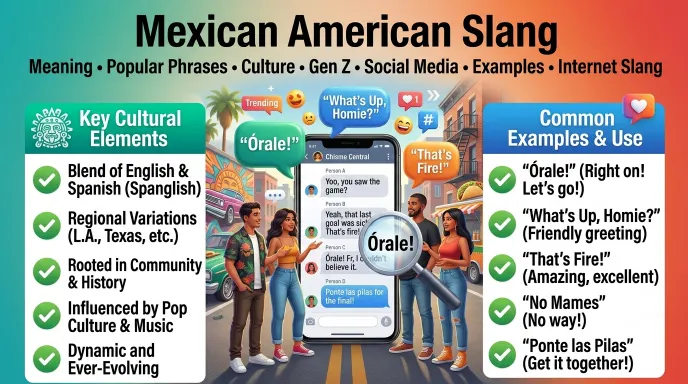
Mexican American slang refers to the unique mix of English, Spanish, and cultural expressions used by many Mexican Americans in everyday conversations.
These words and phrases have developed over generations and are especially common in communities across California, Texas, Arizona, Nevada, and other parts of the United States with large Mexican American populations.
Mexican American slang is influenced by several factors, including Mexican Spanish, American English, regional dialects, pop culture, and social media.
As a result, many expressions carry cultural significance and may have different meanings depending on the speaker and location.
Today, you’ll hear Mexican American slang in music, movies, TikTok videos, family conversations, and everyday life.
Some terms are playful and affectionate, while others should be used carefully because they can be offensive depending on the context.
In this guide, you’ll learn the most common Mexican American slang terms, their meanings, origins, and how people use them in real-world conversations.
What Is Mexican American Slang? (Quick Answer)
Mexican American slang is a blend of English and Spanish expressions commonly used by Mexican Americans in the United States.
These terms often reflect cultural identity, family traditions, regional influences, and everyday experiences. Popular examples include words like órale, vato, carnal, güey, and jale.
| Term | Meaning | Usage |
| Vato | Guy or dude | Casual |
| Carnal | Brother or close friend | Informal |
| Güey | Dude, man | Everyday speech |
| Órale | Wow, let’s go, okay | Multiple meanings |
| Jale | Job or work | Casual |
| Simón | Yes | Informal |
Is Mexican American Slang Different From Mexican Spanish?
Yes. Although Mexican American slang shares many words with Mexican Spanish, it has developed its own identity over time.
Many Mexican Americans grow up speaking:
- English at school.
- Spanish at home.
- A combination of both with friends.
This blending of languages has created unique expressions that may not be commonly used in Mexico itself.
For example, some phrases sound perfectly natural in Los Angeles or San Antonio but may feel unfamiliar to someone living in Mexico City.
Why Is Mexican American Slang So Popular?
Several factors have contributed to the popularity of Mexican American slang:
- Strong cultural identity.
- Influence of music and film.
- Social media platforms.
- Multigenerational communities.
- The blending of English and Spanish.
Additionally, artists, comedians, and creators have introduced many of these expressions to wider audiences through TikTok, YouTube, and television.
Common Mexican American Slang Words
Vato
One of the most recognizable terms, vato means “guy,” “dude,” or “man.”
Example
“That vato is always late.”
Meaning:
That guy is always late.
Although usually friendly, the tone can affect how it’s perceived.
Carnal
Carnal literally means “brother,” but it’s often used to refer to a close friend.
Example
“What’s up, carnal?”
Meaning:
What’s up, brother?
This term is generally affectionate and commonly heard in Mexican American communities.
Güey
Perhaps one of the most popular expressions, güey (sometimes written as wey) means:
- Dude
- Man
- Buddy
Example
“Come on, güey!”
Meaning:
Come on, dude!
Depending on the tone, it can be friendly or slightly critical.
Órale
Órale is one of the most versatile slang terms.
It can mean:
- Let’s go!
- Wow!
- Okay!
- Hurry up!
- I understand.
Examples
“Órale, let’s get going.”
“Órale! That’s amazing.”
The meaning changes depending on the situation.
Jale
Jale usually means “work” or “job.”
Example
“I have to go to jale.”
Meaning:
I have to go to work.
This expression remains common in many Mexican American households.
Simón
Simón is an informal way of saying “yes.”
Example
“Are you coming tonight?”
“Simón!”
Meaning:
Yes!
The Influence of Spanglish
One of the defining features of Mexican American slang is Spanglish, which combines English and Spanish within the same sentence.
Examples include:
- “I’m going to the tienda.”
- “Let’s grab some tacos after work, güey.”
- “My mom called me, so I have to go home.”
This natural blending reflects the bilingual experiences of many Mexican Americans.
Where Is Mexican American Slang Commonly Used?
You’ll frequently hear these expressions in:
- California
- Texas
- Arizona
- Nevada
- New Mexico
- Illinois
You’ll also encounter them on:
- TikTok
- YouTube
- Snapchat
- X (formerly Twitter)
- Podcasts
- Music and films
As social media continues to grow, Mexican American slang has become increasingly visible across the internet.
Mexican American Slang in Music and Pop Culture
Artists have played an important role in popularizing these expressions.
You’ll often hear Mexican American slang in:
- Hip hop
- Regional Mexican music
- Movies
- Television shows
- Stand-up comedy
For many people, these words represent more than slang they symbolize heritage, identity, and community.
Real-Life Conversation Examples
Example 1
Alex: Who’s that?
Ben: That’s my carnal.
Meaning:
That’s my close friend.
Example 2
Emma: Are you ready?
Sophia: Órale, let’s go!
Meaning:
Let’s go!
Example 3
Ryan: Do you have work tomorrow?
Jake: Yeah, I have jale at 8.
Meaning:
I have work at 8.
Example 4
Chris: Are you serious?
David: Simón!
Meaning:
Yes!
Example 5
Olivia: Why is he laughing?
Noah: That güey is always laughing.
Meaning:
That guy is always laughing.
Mexican American Slang on Social Media
Social media has helped Mexican American slang reach audiences far beyond the United States. Today, millions of people encounter these expressions through viral videos, memes, and online communities.
You’ll frequently see Mexican American slang on:
- TikTok
- YouTube Shorts
- Snapchat
- X (formerly Twitter)
- Facebook groups
Many creators use these expressions to connect with their audience, share cultural experiences, or add humor to their content.
Social Media Examples
“Órale, that video was hilarious!”
“This vato really showed up two hours late.”
“My carnal always has the best stories.”
“Simón, I’ll be there in five minutes.”
Because these terms are so recognizable, they often appear in comments and captions across multiple platforms.
Regional Differences in Mexican American Slang
Not all Mexican American communities use the exact same slang.
For example:
| Region | Common Influences |
| California | Chicano culture, Spanglish |
| Texas | Tex-Mex expressions |
| Arizona | Southwestern influences |
| Nevada | California influence |
| Illinois | Urban bilingual communities |
As a result, a term that’s popular in Los Angeles may be less common in Houston or Chicago.
Additionally, younger generations continue to create new expressions, which means Mexican American slang is constantly evolving.
Additional Mexican American Slang Terms
Chale
Chale is an expression used to show disappointment or frustration.
Example
“Chale, I forgot my wallet.”
Meaning:
Oh no, I forgot my wallet.
Neta
Neta means:
- Really?
- Seriously?
- Truth
Examples
“¿Neta?”
Meaning:
Really?
“La neta, I don’t know.”
Meaning:
Honestly, I don’t know.
Feria
Feria is slang for money.
Example
“Do you have feria for lunch?”
Meaning:
Do you have money for lunch?
Morra
Morra refers to a girl or young woman.
Example
“That morra is really smart.”
Meaning:
That girl is really smart.
Morro
Morro refers to a boy or young man.
Example
“That morro plays soccer every day.”
Meaning:
That boy plays soccer every day.
Compa
Compa is short for compadre and means:
- Friend
- Buddy
- Companion
Example
“Thanks for helping me, compa.”
Meaning:
Thanks for helping me, friend.
Troca
In many communities, troca means:
- Truck
- Pickup truck
Example
“I just bought a new troca.”
Meaning:
I just bought a new truck.
The Role of Family in Mexican American Slang
Family plays an important role in preserving Mexican American slang.
Many people first learn these expressions from:
- Parents
- Grandparents
- Siblings
- Cousins
- Friends
Consequently, certain phrases are passed down through generations and become part of a family’s everyday vocabulary.
For example, it’s common to hear grandparents use terms like:
- Simón
- Órale
- Chale
- Neta
Meanwhile, younger generations may combine those words with modern internet slang.
Spanglish and Cultural Identity
Mexican American slang is closely connected to identity.
For many people, speaking a mix of English and Spanish represents:
- Family heritage
- Community pride
- Cultural connection
- Personal expression
This is one reason why Spanglish remains so common.
Examples include:
“I’m heading to jale after lunch.”
“Tell my carnal I’ll call him later.”
“Órale, let’s take a picture.”
These combinations feel natural to bilingual speakers and reflect the experiences of millions of people across the United States.
Common Mistakes When Using Mexican American Slang
Although these expressions are popular, there are several mistakes people should avoid.
Assuming Every Mexican American Uses the Same Words
Language varies significantly by:
- Age
- Region
- Family background
- Community
Therefore, not everyone will use the same slang.
Using Terms Without Understanding the Context
Some expressions can have multiple meanings.
For example:
- Güey can be friendly or insulting.
- Órale can express excitement or agreement.
- Neta can mean “truth” or “seriously?”
Understanding the context helps prevent misunderstandings.
Overusing Slang
Using too many slang words at once can sound unnatural.
Instead of saying:
“Órale, güey, my carnal and compa are coming after jale.”
Most people naturally mix slang with standard English or Spanish.
Formal vs. Informal Usage
| Situation | Use Mexican American Slang? |
| Friends | Yes |
| Family | Yes |
| Social Media | Yes |
| Text Messages | Yes |
| Casual Gatherings | Yes |
| Business Emails | No |
| School Essays | No |
| Professional Meetings | No |
As with most slang, these expressions work best in informal settings.
Similar Cultural Slang Around the United States
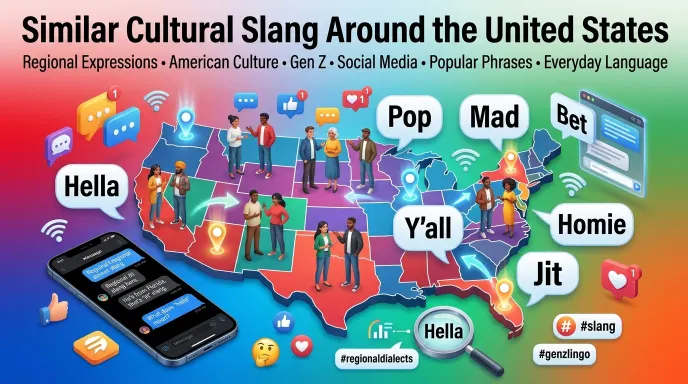
Many communities have their own regional slang.
| Community | Example |
| Southern | Y’all |
| New York | Bodega |
| Hawaii | Brah |
| Florida | Jit |
| Chicago | Shorty |
| Mexican American | Güey |
These terms highlight how language evolves differently across regions and cultures.
Why Mexican American Slang Continues to Grow
Mexican American slang remains influential because it is:
- Authentic
- Adaptable
- Culturally significant
- Widely shared online
- Passed down through generations
Moreover, social media ensures that new audiences continue to discover these expressions every day.
If someone is saying órale, güey, or simón, these words help preserve a rich cultural tradition while continuing to evolve alongside modern language.
Frequently Asked Questions
What is Mexican American slang?
Mexican American slang refers to informal words and expressions commonly used by Mexican Americans in the United States.
It often combines English and Spanish and reflects cultural identity, family traditions, and regional influences.
What are some common Mexican American slang words?
Some of the most popular Mexican American slang terms include:
- Güey Dude or man
- Órale Wow, okay, or let’s go
- Carnal Brother or close friend
- Vato Guy or dude
- Jale Work or job
- Simón Yes
- Neta Really or honestly
- Compa Friend or companion
- Morra Girl
- Feria Money
These expressions are widely recognized in many Mexican American communities.
Is Mexican American slang the same as Mexican Spanish?
No.
While the two share many similarities, Mexican American slang has developed its own identity through the influence of English, Spanglish, and life in the United States.
For example, someone in Los Angeles may use words differently than someone in Mexico City.
What does güey mean?
Güey (also spelled wey) usually means:
- Dude
- Guy
- Man
- Buddy
Example:
“Come on, güey!”
Meaning:
Come on, dude!
Depending on the tone, it can be friendly or slightly insulting.
What does órale mean?
Órale is one of the most versatile Mexican American slang terms.
It can mean:
- Let’s go!
- Wow!
- Okay!
- Hurry up!
- I understand.
The intended meaning depends entirely on the context.
Is Mexican American slang used on TikTok?
Yes.
TikTok has significantly increased the visibility of Mexican American slang. Creators frequently use expressions like güey, órale, and simón in videos, captions, and comments.
As a result, millions of users around the world are becoming familiar with these terms.
Is Mexican American slang appropriate in professional settings?
Generally, no.
These expressions are considered informal and are best suited for:
- Friends
- Family
- Social media
- Casual conversations
For professional communication, standard English or Spanish is usually more appropriate.
Why is Spanglish important in Mexican American culture?
Spanglish reflects the bilingual experiences of many Mexican Americans.
It allows speakers to:
- Express cultural identity.
- Connect with family traditions.
- Blend two languages naturally.
- Communicate more comfortably.
Consequently, Spanglish remains an important part of Mexican American communities throughout the United States.
Is every Mexican American familiar with these slang terms?
Not necessarily.
Language varies based on:
- Age
- Location
- Family background
- Personal experiences
Some people use slang regularly, while others prefer standard English or Spanish.
Why is Mexican American slang becoming more popular?
Several factors have contributed to its growing popularity:
- TikTok
- Music
- Movies
- Podcasts
- YouTube
Social media has made these expressions more accessible than ever before, helping them reach audiences around the world.
Conclusion
Mexican American slang is more than just a collection of informal words it’s a reflection of culture, identity, and community. By blending English, Spanish, and regional influences, these expressions tell the story of generations of Mexican Americans across the United States.
From widely recognized terms like güey, órale, and carnal to everyday expressions such as jale and simón, Mexican American slang continues to evolve while remaining deeply connected to family traditions and cultural pride.
If you’ve encountered these words on TikTok, heard them in music, or used them in conversations with friends, understanding their meanings provides valuable insight into one of the most influential bilingual cultures in the United States.
As social media continues to connect people across borders, Mexican American slang will likely remain an important and recognizable part of everyday language for years to come.
Discover More Articles!
Cooked Meaning Slang: What It Really Means Today
GTL Slang Meaning: Definition, Origin, Uses & Examples
Bellend British Slang Meaning: Definition, Origin & Examples

Hi, I’m Sophia Bennett, a novelist passionate about creating heartfelt stories filled with romance, emotion, and unforgettable characters. Through my books, I hope to inspire readers and take them on journeys they’ll always remember.