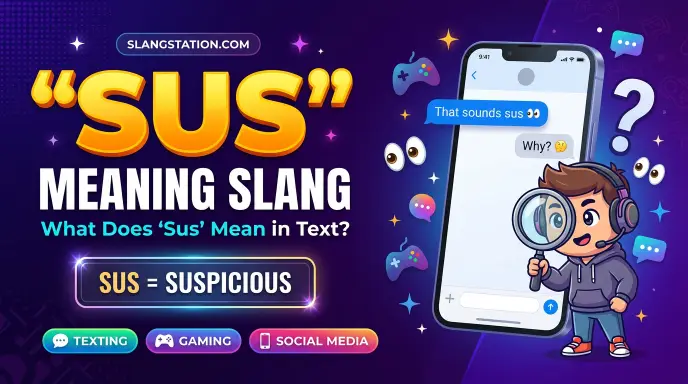
Sus is slang for “suspicious” or “suspect.” People use it in text messages and online chats when someone seems shady, dishonest, strange, or untrustworthy. For example, if your friend suddenly hides their phone, you might text, “That’s sus!”
You may see sus on TikTok, Snapchat, Instagram, WhatsApp, Discord, and in gaming chats. It is popular in casual conversations because it is short, easy to type, and works well for jokes.
The word became widely known through the online game Among Us, where players try to identify an impostor hiding among the crew. However, people used sus before the game became popular.
In this guide, you will learn what sus means in slang, how people use it in different situations, how to reply when someone says it, and if it is rude or offensive.
What Does Sus Mean in Text?
In texting, sus means suspicious or suspect. It describes a person, action, story, or situation that seems strange or makes you question if something is true.
For example:
A: He said he was asleep all night.
B: But he liked your post at 3 a.m. That’s sus.
Here, sus means the person’s story seems questionable.
People also use the word when something feels unusual, even if they do not have proof that anyone has done something wrong.
For example:
- “Why are you acting so sus?” means “Why are you acting so suspicious?”
- “That excuse sounds sus” means “That excuse sounds questionable.”
- “This website looks sus” means “This website does not seem trustworthy.”
- “Bro is sus” means “That person is acting suspicious.”
The word is usually informal. It can sound serious in a conversation about trust, but it is often used playfully between friends.
Is Sus Slang, an Acronym, or an Abbreviation?
Sus is an informal shortened form of suspicious or suspect. It is not an acronym because its letters do not stand for a separate phrase.
People use it as a quick way to describe something questionable.
For example, instead of typing “That seems suspicious,” someone might simply write:
“That seems sus.”
Both sentences express doubt, but sus sounds more casual and conversational.
What Does Sus Mean in Everyday Chat?
In everyday chat, sus can describe almost anything that seems questionable.
Someone might use it when a friend gives an unusual excuse, a stranger sends a strange message, or a person acts differently from normal.
For example:
A: Why did he suddenly delete all his messages?
B: That’s sus.
The speaker does not necessarily know that the person did anything wrong. They are saying the behavior seems strange.
This distinction matters because calling something sus is not the same as proving it is suspicious. It often expresses a feeling or suspicion rather than a fact.
What Does Sus Mean on Social Media?
On social media, sus often appears in comments, memes, short videos, and reactions to strange behavior.
People use it to question someone’s actions or make a joke about something that does not add up.
For example:
“Bro said he didn’t eat my fries, but the evidence is right there. Sus.”
The comment suggests that the person’s explanation does not seem believable.
The word is also common in humorous situations. A person might call a harmless action sus simply because it looks unusual.
Sus Meaning on TikTok
On TikTok, sus often appears in comedy videos, reaction clips, relationship discussions, and memes.
For example:
“POV: Your friend says they’re five minutes away, but they’re still at home.”
A comment might say:
“That’s sus 😭”
Here, sus means the friend’s claim seems questionable.
TikTok users may also use the word to describe strange trends, suspicious online behavior, or a joke that sounds inappropriate.
However, context matters. In a serious video about scams or dishonesty, sus may express real concern rather than humor.
Sus Meaning on Snapchat
On Snapchat, people may use sus in private chats, group messages, or replies to stories.
For example:
A: Who were you texting last night?
B: Nobody.
A: Hmm, sus.
The sender is suggesting that the answer seems questionable.
Friends may also use the word playfully when someone acts secretive or gives an unusual explanation.
For example:
“Why did you leave the group chat so fast? Sus 😂”
This does not necessarily mean the sender truly distrusts the other person. It could simply be teasing.
Sus Meaning on Instagram
On Instagram, sus appears in comments, Reels, captions, and direct messages.
Someone might comment “sus” under a video when a person’s actions seem strange or when a joke has a questionable meaning.
For example:
“Why did he look at the camera like that? Sus.”
The commenter is reacting to something that seems unusual.
People may also use sus when discussing suspicious accounts, fake giveaways, misleading posts, or messages that look like scams.
If an account asks for your password or sends an unexpected link, calling it sus may be a warning that you should check it carefully.
Sus Meaning on WhatsApp
On WhatsApp, sus is often used in casual conversations with friends and family.
For example:
A: She said she forgot my birthday.
B: But she posted about it yesterday. That’s sus.
The speaker thinks the explanation does not match the available information.
In a family group chat, someone might use sus as a joke. In a conversation about money, privacy, or trust, however, the word may express a more serious concern.
Sus Meaning in SMS and Text Messages
In ordinary SMS messages, sus means the same thing: suspicious, questionable, or strange.
For example:
- “That number looks sus.”
- “Your excuse is sus.”
- “This deal sounds sus.”
- “Why are you being sus?”
Because text messages do not always show facial expressions or tone of voice, a short message like “sus” can be misunderstood. It may be a joke, a playful accusation, or a genuine warning.
What Does Sus Mean in Gaming?
Sus became especially well known through the multiplayer game Among Us.
In the game, players try to identify the impostor who is secretly working against the crew. Players often discuss suspicious actions and vote for someone they believe is the impostor.
A player might say:
“Red is sus.”
This means the player thinks the red character may be the impostor.
For example, someone may see a player leave a room after a teammate is eliminated. They might report the action and say, “That was sus.”
The word spread beyond Among Us because players used it in everyday chats, memes, and social media posts. Today, people who have never played the game may still understand the term.
Does Sus Always Mean Someone Is Lying?
No. Sus means something seems suspicious or questionable, but it does not prove that someone is lying.
For example:
“Your story sounds sus.”
This means the story raises doubts. It does not automatically mean the story is false.
In gaming, someone might be called sus because they moved strangely or gave an unclear answer. The player could be innocent.
The same idea applies to real life. It is better to look at the facts before deciding that someone has done something wrong.
Ten Realistic Chat Examples Using Sus
These examples show how people use sus in casual conversations.
Example One: A Strange Excuse
A: He said his phone died, but he was posting stories all night.
B: That’s sus.
A: Exactly. Something doesn’t add up.
Here, sus means the explanation seems questionable.
Example Two: A Friend Acting Secretive
A: Why did you hide your screen when I walked in?
B: I didn’t!
A: Okay, that’s sus.
The speaker finds the behavior suspicious, although it may have an innocent explanation.
Example Three: A Gaming Chat
A: I saw Blue near the room.
B: Blue is sus.
A: Let’s discuss it before voting.
This example uses sus in the style of Among Us.
Example Four: A Suspicious Link
A: Someone sent me a link saying I won a free phone.
B: That sounds sus. Don’t enter your details yet.
A: I’ll check if the offer is real.
Here, sus is a warning to be careful.
Example Five: A Funny Situation
A: My dog keeps staring at the empty corner.
B: Bro, that’s sus 😭
A: Don’t scare me!
The word is used humorously because the situation seems strange.
Example Six: Relationship Talk
A: He said he was busy, but I saw him at the party.
B: That’s a little sus.
A: I want to hear his explanation first.
Here, sus expresses doubt without proving dishonesty.
Example Seven: A Strange Message
A: An unknown account keeps asking where I live.
B: That’s sus. Don’t share your address.
A: Yeah, I’m blocking it.
The word signals concern about someone’s behavior.
Example Eight: A Friend’s Sudden Change
A: She never talks to me, but now she wants my homework.
B: Kinda sus.
A: I’ll ask why she needs it.
The speaker thinks the sudden request is questionable.
Example Nine: A Group Chat Joke
A: Who ate the last slice of pizza?
B: Not me.
A: You have pizza sauce on your shirt. Sus!
Here, sus is a playful accusation.
Example Ten: A Weird Online Offer
A: This site says I can get a new laptop for five dollars.
B: That is extremely sus.
A: I’ll avoid entering my payment details.
The word describes an offer that seems too good to be true.
How to Reply When Someone Says Sus
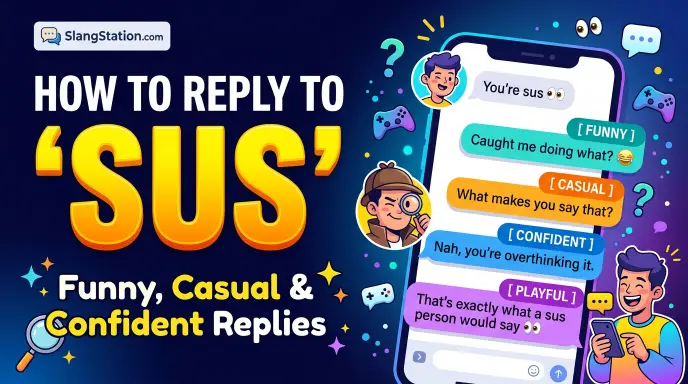
Your reply depends on if the person is joking, questioning your behavior, or warning you about something.
Funny Replies
If a friend jokingly calls you sus, you can answer with humor:
- “You have no proof!”
- “I’m innocent, your honor.”
- “Stop investigating me 😭”
- “That’s what the impostor would say.”
- “Trust me, I’m totally normal.”
- “The evidence is fake!”
These replies work best when the conversation is playful and everyone understands the joke.
Casual Replies
If someone says something seems suspicious, you can respond naturally:
- “What seems suspicious?”
- “Why do you think that?”
- “Fair enough.”
- “I can see why you’d think that.”
- “Maybe, but there’s another explanation.”
These responses keep the conversation relaxed without turning it into an argument.
Friendly Replies
If someone is concerned about a link, account, or situation, you can say:
- “Good catch. I’ll check it.”
- “Thanks for letting me know.”
- “I’ll be careful.”
- “Let’s make sure it’s real first.”
- “I’ll look into it before doing anything.”
These replies are useful when sus is being used as a warning rather than a joke.
Neutral Replies
If someone questions your behavior, you can answer clearly:
- “I understand why it looked strange.”
- “There’s a simple explanation.”
- “I wasn’t trying to hide anything.”
- “Let me explain what happened.”
- “Can you tell me what made you suspicious?”
A calm answer can help clear up misunderstandings.
Is Sus Rude or Offensive?
Sus is generally not a swear word or a slur. In most casual conversations, it is a mild term meaning suspicious or questionable.
However, the way someone uses it can affect how it sounds.
Calling a friend sus after a silly joke is usually harmless. Calling a classmate sus in front of everyone may embarrass them. In a serious relationship or workplace discussion, the word can sound accusatory.
Is Sus Safe to Use With Friends?
Usually, yes. Friends often use it as playful teasing.
For example:
“Why did you take the last cookie and blame the cat? Sus!”
The tone makes it clear that the accusation is a joke.
Still, not everyone enjoys being accused of lying or acting strangely. If someone seems upset, stop joking and explain what you meant.
Is Sus Appropriate at School or Work?
Sus is common in informal speech, but it may not fit every situation.
With friends at school, it is usually fine. In a formal assignment, business email, job interview, or official report, words such as “suspicious,” “questionable,” or “unusual” are clearer and more professional.
For example, instead of writing:
“This email looks sus.”
You could write:
“This email looks suspicious and may not be legitimate.”
The second sentence is better for a formal setting.
Who Uses Sus?
People of different ages use sus, especially those who communicate through online games, social media, and messaging apps.
It is common among teenagers, young adults, gamers, and people familiar with internet slang. However, it is not limited to Gen Z.
Is Sus a Gen Z Word?
Sus is strongly associated with modern internet culture and Gen Z slang, but the word itself is older.
It was used as a shortened form of suspicious or suspect before Among Us became popular. The game’s success helped make the term widely recognizable among younger online audiences.
Today, people use sus even when they are not talking about gaming.
Where Is Sus Most Common?
You may see it in:
- TikTok comments and videos
- Instagram posts and direct messages
- Snapchat chats
- WhatsApp group messages
- SMS conversations
- Discord servers
- Online multiplayer games
- Memes and internet jokes
There is no single platform where everyone uses it most. Its frequency changes by community and trend.
Where Did Sus Come From?
Sus developed as a shortened form of words such as “suspicious” and “suspect.” Informal shortenings like this are common in spoken English and casual writing.
The term existed before modern social media. However, the online game Among Us, released in 2018, helped bring it into mainstream internet culture.
The game’s popularity grew sharply in 2020, when players frequently used phrases such as “Red is sus” to discuss possible impostors.
Memes, gaming streams, TikTok videos, and online conversations helped spread the expression beyond gaming communities.
Although the game’s popularity made sus much more visible, it did not invent the word from scratch.
Sus vs. Suspicious: What’s the Difference?
Sus and suspicious have similar meanings, but they suit different situations.
| Word | Meaning | Type | Usage | Popularity |
| Sus | Suspicious or questionable | Slang | Casual chats, memes, gaming | Common online |
| IDK | I don’t know | Text abbreviation | Everyday messages | Very common |
| IDC | I don’t care | Text abbreviation | Casual conversations | Very common |
| IMO | In my opinion | Text abbreviation | Messages and online discussions | Common |
| BRB | Be right back | Chat abbreviation | Texting and gaming | Common |
The main difference is that sus describes something that seems suspicious, while IDK, IDC, IMO, and BRB are shortened phrases used to communicate more quickly.
In formal writing, “suspicious” is usually the better choice. In casual messages, “sus” sounds shorter and more relaxed.
Real-World Usage Example
Imagine that your friend tells you they cannot attend a birthday party because they are sick. Later, you see a public photo showing them at a concert that same evening.
You might message another friend:
“Didn’t he say he was sick? This is sus.”
You are saying that the explanation seems questionable because the information does not match.
However, there may be another explanation. The photo could be old, or your friend may have felt better later. Calling something sus expresses doubt; it does not prove that a person lied.
This is a useful way to understand the word in everyday life. It describes your reaction to something that seems unusual, incomplete, or difficult to believe.
Common Mistakes When Using Sus
One mistake is assuming that sus always means someone is guilty. The word expresses suspicion, not proof.
Another mistake is using it in a serious conversation when you intend to joke. A friend may interpret “You’re sus” as an accusation if they cannot hear your tone.
People also sometimes confuse sus with “sauce,” another internet term that can refer to the source of something, particularly in memes or online communities. The two words have different meanings.
Finally, avoid using sus to make unfair accusations about people based on rumors. If something concerns you, ask questions and check the facts rather than treating suspicion as certainty.
Frequently Asked Questions
What does sus mean in text messages?
Sus means suspicious or suspect. People use it when a person, story, action, or situation seems strange or questionable.
What does sus mean on TikTok?
On TikTok, sus usually means suspicious, shady, or questionable. It can be used seriously or as a joke in comments and videos.
Is sus slang?
Yes. Sus is informal slang shortened from suspicious or suspect. It is common in texting, gaming, and social media.
Is sus rude or offensive?
Usually, no. It is a mild slang term, but it can sound accusatory or hurtful if someone uses it to embarrass another person.
How should you reply to sus?
If someone is joking, you can reply, “I’m innocent!” If they seem serious, ask what looks suspicious and explain the situation calmly.
What does “you’re sus” mean?
It means “you’re acting suspicious” or “I don’t fully trust what you’re saying.” Depending on the context, it may be a joke or a serious concern.
What does sus mean in Among Us?
In Among Us, sus means a player seems suspicious and might be the impostor. Players use it when discussing clues or unusual behavior.
Does sus mean suspicious or suspect?
It can mean either. In everyday online conversations, it is most often understood as a shortened form of “suspicious.”
Is sus still used online?
Yes. It remains recognizable in gaming, messaging, and social media, although how often people use it varies by platform and community.
Can sus be used in formal writing?
It is better to use “suspicious” or “questionable” in formal writing. Sus is informal and works best in casual conversations.
Conclusion
Sus slang means suspicious or suspect. People use it when something seems strange, dishonest, questionable, or difficult to believe.
The term is common in text messages, TikTok comments, Instagram chats, Discord, and online gaming.
The game Among Us helped make sus widely popular, but the word existed before the game. Today, it can express real concern or serve as a playful joke among friends.
Use it freely in casual conversations when the tone is clear. In formal settings, or when discussing serious accusations, choose clearer language and remember that something seeming suspicious does not prove that anyone has done something wrong.
Discover More Articles!
What Does Null Mean in Text Message? Real Meaning & Examples
Torta Meaning Slang: What Does Torta Mean?(2026)
What Does Snow Bunny Slang Mean in Text? Real Meaning & Examples

Hi, I’m Sophia Bennett, a novelist passionate about creating heartfelt stories filled with romance, emotion, and unforgettable characters. Through my books, I hope to inspire readers and take them on journeys they’ll always remember.