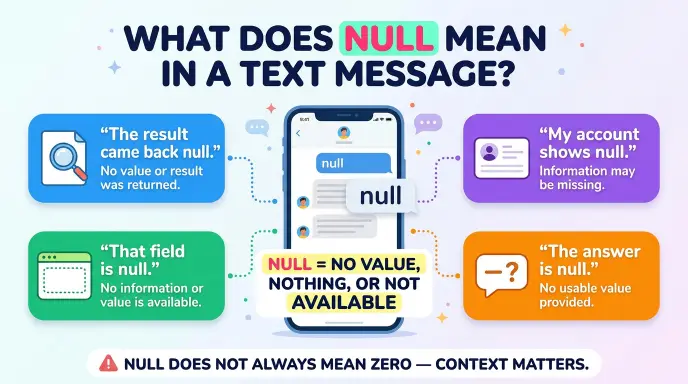
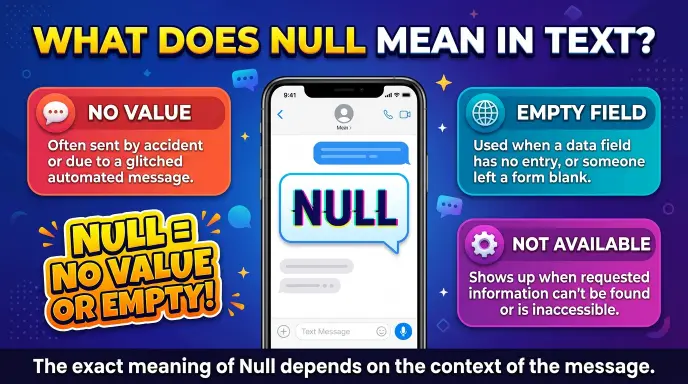
“Null” in a text message usually means “nothing,” “no value,” or “no information,” but its exact meaning depends on the context.
You may see it in texting, apps, social media, online forms, or messages when something is missing or has no assigned value.
People often search for “what does null mean in text message” after seeing the word appear unexpectedly in a message, notification, comment, or app. Unlike common texting slang such as LOL or IDK, “null” is not usually slang.
In everyday English, null can mean invalid, empty, or having no value. In technology, it has a more specific meaning related to missing or undefined data. That technical use is why you may sometimes see “null” appear automatically in a text or app.
Null Meaning in Text Message
In a text message, null usually means that something has no value, is empty, or is not available.
For example, if an app tries to display a person’s name but the name was never entered, it might show:
“Message from null”
This does not necessarily mean the sender intentionally wrote “null.” The word may have appeared because the app did not receive the information it expected.
“Null” is therefore different from most internet slang. It is generally a technical or descriptive term, not an abbreviation.
What Does Null Mean in Simple English?
In simple terms, null can mean “nothing is there” or “there is no value.”
For example:
“The phone number is null.”
This could mean that no phone number was provided.
Another example:
“The result is null.”
This can mean that there is no result or usable value.
The exact interpretation depends on the system or conversation.
Is Null Slang?
Usually, no.
Null is a normal English word that is also widely used in computing, programming, databases, and technology.
Someone might use it casually to mean “nothing,” but seeing “null” in a text or app does not automatically make it slang.
Why Does “Null” Appear in Text Messages?
If you see “null” in a message, notification, or chat unexpectedly, it may be caused by a technical issue.
An app may be expecting information such as:
- a person’s name
- a message
- a date
- a location
- an image
- a status
- a number
If that information is missing, the software may display null instead.
For example, imagine an app normally displays:
“Alex sent you a message.”
If the sender’s name is missing from the data, the app could accidentally display:
“Null sent you a message.”
The user did not necessarily type “null.” It may simply be a data-display problem.
Where People See Null
The word can appear in many digital environments.
Null in Text Messages
In normal texting, someone might use “null” to mean there is nothing to report.
For example:
A: “Any updates?”
B: “Null so far.”
Here, the person means there are no updates.
However, if “null” appears automatically in a message notification, it may be a technical issue rather than something the sender intended.
Null on TikTok
On TikTok, users may encounter “null” because of an app display issue, missing information, or a technical error.
Someone may also use the word intentionally in a joke or caption.
For example:
“My social life = null.”
Here, “null” is being used creatively to mean “nothing.”
Null on Snapchat
If Snapchat shows “null” where a name, message, or other information should appear, the word may be related to missing data or an app issue.
A person can also use “null” jokingly in a conversation, although this is much less common than ordinary slang.
Null on Instagram
Instagram users may see “null” in unusual places when information fails to load correctly.
For example, a username, caption, location, or other field might display incorrectly.
If someone writes “null” intentionally in a caption, they may simply be using the word to mean empty, nothing, or nonexistent.
Null on WhatsApp
WhatsApp messages normally do not require users to use the word “null.”
If it appears unexpectedly, the cause may be an issue with how information is being processed or displayed.
In a regular conversation, however, someone could use “null” to mean “nothing.”
Null in SMS
In ordinary SMS conversations, “null” is uncommon.
If someone sends:
“Null.”
they may be using it as a short way to say “nothing,” “none,” or “no information.”
But because this is not a standard texting abbreviation, you may need to ask what they mean.
Real Chat Examples
Here are realistic examples showing how “null” can be used in different contexts.
Example One: No Updates
A: Any news about the application?
B: Null so far.
A: Hopefully we hear back soon.
Here, null means “nothing” or “no information.”
Example Two: Technical Meaning
A: Why does the app show “null” next to my name?
B: It probably didn’t load your profile information.
A: Oh, okay.
Example Three: Asking for Clarification
A: What does null mean here?
B: It means there isn’t a value.
A: Got it.
Example Four: Casual Joke
A: How’s your weekend dating life?
B: Null 😂
A: Same.
Here, the person is joking that there is nothing happening.
Example Five: Empty Result
A: Did you find anything in the search?
B: Null.
A: Nothing at all?
Example Six: Missing Information
A: Why does the form say null for my address?
B: You probably didn’t enter one.
A: That explains it.
Example Seven: No Plans
A: What’s your plan for tonight?
B: Null. I’m staying home.
A: Sounds peaceful.
Example Eight: App Problem
A: Your profile is showing “null.”
B: Seriously?
A: Yeah, maybe the app is glitching.
Example Nine: Simple Explanation
A: What does null mean in programming?
B: Basically, it means there isn’t a value there.
A: That makes sense.
Example Ten: Casual Text
A: Any reason you’re not going out?
B: Null. Just tired.
A: Fair enough.
How to Reply When Someone Says “Null”
Your reply should depend on what the sender means.
Funny Replies
If your friend is using “null” as a joke, you could respond:
- “Absolutely nothing 😂”
- “Zero information detected.”
- “So… nothing?”
- “Null and void 😂”
- “That sounds very technical.”
Casual Replies
You can keep your response simple:
- “Got it.”
- “Okay.”
- “Nothing then?”
- “Makes sense.”
- “Fair enough.”
Friendly Replies
If someone says their plans are “null,” you could reply:
- “Want to make some plans?”
- “Same here 😂”
- “Maybe that’s a good thing.”
- “A quiet night sounds nice.”
Neutral Replies
If you are unsure what the person means, ask:
- “What do you mean by null?”
- “Do you mean nothing?”
- “Are you saying there is no information?”
- “Is that a technical error?”
This is especially useful because “null” can have different meanings in different situations.
Is Null Rude or Offensive?
No, “null” is not normally rude or offensive.
It is a neutral word.
When someone uses it to mean “nothing,” it usually has no offensive meaning.
However, tone can change how any word feels. If someone responds with only:
“Null.”
to a serious question, it could sound cold or dismissive.
That is not because the word itself is offensive. It is because the short response may seem unfriendly.
Is Null Safe to Use With Friends?
Yes.
You can use “null” casually with friends if they understand what you mean.
However, saying “nothing” is usually clearer in everyday conversation.
Is Null Appropriate at School?
Yes, especially when discussing computers, mathematics, programming, databases, or technology.
For example, a student might write:
“A null value means that no value has been assigned.”
That is perfectly normal.
In a regular essay, however, do not replace ordinary words with “null” just to sound technical.
Is Null Appropriate at Work?
Yes. In technology-related workplaces, “null” is a standard technical term.
Developers, database administrators, analysts, and IT professionals commonly use it.
In nontechnical communication, however, you may want to use simpler wording such as “missing,” “empty,” or “not available.”
Who Uses the Word Null?
Unlike many slang expressions, “null” is not tied to one age group.
It is used by people who work with technology as well as people who encounter the term in apps and digital services.
Gen Z Usage
Gen Z users may use “null” jokingly online, especially when describing something as nonexistent.
For example:
“My motivation today: null.”
This is more of a creative internet-style use than a standard Gen Z slang definition.
Programmers and Tech Users
People who work with software are much more likely to use “null” in its technical sense.
For example:
“The API returned a null value.”
Here, the term has a precise technical meaning.
Everyday Internet Users
Regular users may encounter “null” without intentionally using it.
It can appear when an app, website, database, or notification fails to display missing information properly.
Origin of the Term
The word null is much older than modern internet culture.
It comes from language associated with ideas such as “nothing,” “none,” or “not valid.” The concept later became especially important in mathematics, logic, databases, and computer programming.
As digital systems became common, “null” developed a technical role.
In programming and databases, null is commonly used to represent the absence of a value. This is why modern apps may sometimes show the word to users when they should have displayed something else.
How Did Null Become Common Online?
Technology made the word much more visible to ordinary people.
Most users do not need to understand programming to encounter null. A website might accidentally display it when a field is empty or data is missing.
For example, an application may expect:
Name: Sarah
But if the name field contains no value, a poorly designed interface might display:
Name: null
The user then sees a technical term that was never meant to appear.
This is one reason people search for “what does null mean in text message.”
Null vs Nothing
Although these words can sometimes communicate the same general idea, they are not always interchangeable.
Nothing is an everyday word.
Null is more technical and can specifically describe the absence of a value.
For example:
“I have nothing to say.”
This is natural everyday English.
But:
“The database field is null.”
This is technical language.
Using “null” in everyday conversation can sound unusual unless you are joking or talking about technology.
Null vs Empty
“Null” and “empty” can also be different in technical contexts.
An empty text field may contain a blank string, while a null field may mean that no value was provided at all.
For ordinary users, both may look like “nothing.”
But programmers and database systems may treat them differently.
That technical distinction is one reason “null” appears so often in programming discussions.
Null vs Zero
Another common misunderstanding is thinking that null means zero.
It does not necessarily mean zero.
For example:
0 = a value of zero
null = no value
Imagine a score field.
A score of 0 means the person received zero points.
A null score may mean that no score has been entered yet.
This difference is important in databases and software.
Real-World Example of Null
Imagine you fill out an online form.
The form asks for your middle name, but you leave the field blank.
The website stores your information in a database. If the middle-name field has no value, the system may store it as null.
Later, if the website is poorly designed, it might display:
Middle Name: null
The word does not mean that your middle name is literally “null.” It means that the system has no middle-name value stored.
This is one of the most common ways ordinary users encounter the term.
Common Mistakes When Using Null
A common mistake is assuming that null always means “bad” or “wrong.”
It does not.
A null value can simply mean that information was not provided.
Another mistake is treating null as the same thing as zero. In technical systems, they can represent very different states.
People also sometimes assume that “null” is internet slang because they see it in messages or social media. Usually, it is not slang.
Finally, if someone sends you “null” in a text, do not automatically assume they are using the technical definition. They may simply mean “nothing,” or they could be referring to a specific app or system.
Frequently Asked Questions
What does null mean in text messages?
In a text message, null usually means nothing, no value, or no information. The exact meaning depends on the conversation and context.
What does null mean on TikTok?
On TikTok, “null” can refer to missing information or an app-related display issue. Users may also use it jokingly to mean “nothing.”
Is null slang?
Usually, no. Null is primarily a normal English and technical term, especially in computing and databases. It can be used casually online, but it is not standard slang.
Is null rude or offensive?
No. “Null” is generally neutral and is not considered rude or offensive.
How should you reply to null?
If someone uses “null” to mean “nothing,” you can reply normally. If you are unsure, ask, “What do you mean by null?” to clarify.
Why Does Null Sometimes Appear Instead of a Name?
If you receive a message or notification that says something like:
“Null sent you a message.”
it does not necessarily mean someone named Null contacted you.
More likely, the system expected a name but received no usable value.
The same thing can happen with usernames, locations, dates, captions, or other information.
For example:
“Location: null”
usually means no location information was available.
This is particularly common when different systems exchange data and one system does not provide a field that another system expects.
Should You Use Null in Normal Texting?
You can, but it may not be the clearest choice.
If you mean “nothing,” simply saying “nothing” is easier for most people to understand.
Use “null” when:
- you are discussing technology,
- you are talking about missing data,
- the other person understands technical language,
- or you are deliberately using it as a joke.
For everyday conversations, simple language is usually better.
Conclusion
“Null” in a text message usually means nothing, no value, or missing information. It is not normally a texting abbreviation or slang term.
You may see it in messages, apps, websites, notifications, and social media when information is missing or a system fails to display data correctly.
In technology, null has a more specific meaning: it generally represents the absence of a value. It is different from zero and does not necessarily mean that something is wrong.
If a friend uses “null” casually, they may simply mean “nothing.” If an app displays it unexpectedly, it may be a technical or data issue.
When the meaning is unclear, look at the context or ask the sender. That is the easiest way to understand what null means in your particular message.
Discover More Articles!
What Does Truffle Butter Slang Mean in Text? Meaning & Examples 2026
NYC Slang: Meanings, Examples & Popular Terms
What Does NTP Mean in Text? Real Meaning & Examples

Hi, I’m Sophia Bennett, a novelist passionate about creating heartfelt stories filled with romance, emotion, and unforgettable characters. Through my books, I hope to inspire readers and take them on journeys they’ll always remember.