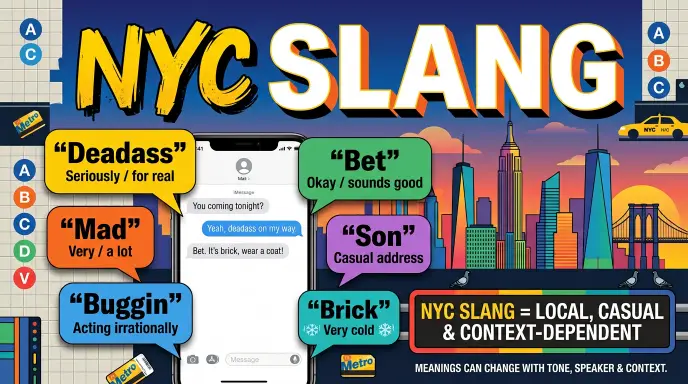
NYC slang means the informal words, phrases, and expressions commonly associated with New York City and its local culture.
You may see NYC slang in texting, TikTok comments, Instagram posts, music, movies, and everyday conversations.
New York City has a strong local way of speaking. Its slang has been shaped by many cultures, neighborhoods, generations, and communities. Some terms are closely linked to New York, while others have spread far beyond the city.
People search for NYC slang because they hear a word online or in a conversation and want to know what it means. A person who has never lived in New York may understand the words but miss the local meaning or tone.
NYC Slang Meaning in Text
NYC slang refers to informal words and phrases connected with New York City speech and culture. It is not one single abbreviation or acronym. Instead, it is a broad group of expressions that New Yorkers may use in casual conversation.
Some NYC slang terms describe people, places, attitudes, food, transportation, or everyday situations. Others come from particular neighborhoods or cultural communities.
For example, a New Yorker might say “deadass” to mean “seriously” or “I am being completely honest.” Someone might say “mad” before an adjective to mean “very” or “a lot,” as in “mad tired.”
Another familiar expression is “brick,” which can describe extremely cold weather.
You may also hear “bodega,” a word strongly associated with New York City. A bodega is a small neighborhood store that sells everyday items and often stays open for long hours.
Not every person in New York uses every slang term. Language can change from one neighborhood, age group, and social circle to another.
Is NYC Slang an Acronym?
No. NYC slang is not an acronym.
“NYC” itself is an abbreviation for New York City, while “slang” refers to informal language.
Together, NYC slang simply means slang associated with New York City.
Why Is NYC Slang Different?
New York City has long been home to people from many cultural and linguistic backgrounds. That diversity has influenced the city’s vocabulary and speech patterns.
Music, television, movies, sports, neighborhoods, and social media have also helped spread New York expressions.
Some terms that once sounded very local can now be recognized across the United States and even in other countries.
Popular NYC Slang Words and Phrases
There are many expressions associated with New York City. Their meaning can depend on the speaker and context.
Deadass
Deadass usually means “seriously,” “for real,” or “I am telling the truth.”
Example:
“You deadass forgot your keys again?”
A natural reply could be:
“Yeah, deadass. I left them at home.”
The term is especially associated with New York speech and has become common online.
Mad
In NYC slang, mad can mean “very,” “a lot,” or “extremely.”
For example:
“That pizza was mad good.”
This does not mean the speaker is angry. It means the pizza was very good.
Brick
Brick is commonly used to describe extremely cold weather.
Example:
“It’s brick outside today.”
Someone hearing this for the first time might think about a building material, but the context makes the meaning clear.
Bodega
A bodega is a small neighborhood convenience store, often found in New York City.
Example:
“I’m going to the bodega. You need anything?”
Bodegas are strongly connected with New York’s everyday neighborhood culture.
The City
New Yorkers may casually call Manhattan “the city,” especially when speaking from another part of the New York metropolitan area.
However, the exact meaning can depend on the speaker and location.
Schlep
Schlep means to carry, drag, or travel somewhere with effort or inconvenience.
Example:
“I don’t want to schlep all the way across town.”
The word has roots in Yiddish and became part of New York’s broader everyday vocabulary.
Buggin’
Buggin’ can mean acting strangely, overreacting, worrying, or imagining something that is not true.
Example:
“You buggin’ if you think I’m paying that much.”
The tone can range from playful to serious.
Frontin’
Frontin’ means pretending, showing off, or acting like something is true when it is not.
Example:
“He’s frontin’. He doesn’t even know the guy.”
This expression is also used outside New York, especially in hip-hop and online speech.
Son
In some New York speech, son can be used as a casual way to address another person.
Example:
“Son, where are you going?”
The meaning depends heavily on tone and relationship. It does not necessarily mean someone’s actual son.
Word
Word can be used to show agreement or acknowledgment.
Example:
A: “I’ll meet you at eight.”
B: “Word.”
It can mean something like “okay,” “for sure,” or “I understand.”
Where People Use NYC Slang
NYC slang appears in everyday speech, but it has also become common online.
NYC Slang on TikTok
TikTok has helped local slang travel beyond New York.
Users may use terms such as “deadass,” “mad,” “brick,” and “bodega” in videos, comments, jokes, and captions.
Some creators also explain New York vocabulary to people from other parts of the country.
A word may become popular on TikTok even among people who have never visited New York.
NYC Slang on Snapchat
Snapchat conversations are usually casual, making slang a natural part of the platform.
Friends may use NYC expressions when joking, making plans, or reacting to something.
For example:
“It’s brick outside 😭”
This simply means the weather is extremely cold.
NYC Slang on Instagram
Instagram comments and captions often include regional expressions.
Someone might write:
“Deadass 😂”
to show strong agreement or surprise.
NYC slang may also appear in posts about New York food, neighborhoods, sports, fashion, and music.
NYC Slang on WhatsApp
WhatsApp has no special NYC slang feature. People simply use the expressions naturally in their messages.
A New Yorker might text:
“I’m mad tired. I’ll call you tomorrow.”
The meaning is easy to understand once you know that “mad” can mean “very.”
NYC Slang in SMS
Traditional text messages can contain the same slang used in spoken conversation.
People often shorten words, remove endings, or use informal expressions because texting is fast and relaxed.
However, NYC slang is not limited to texting. Much of it comes from spoken language.
Real Chat Examples
Here are realistic examples showing how NYC slang can appear in everyday messages.
Example One
A: You coming outside?
B: It’s brick out there.
A: Put on a jacket 😂
B: I’m staying inside.
Example Two
A: Did you really see him at the bodega?
B: Deadass.
A: No way.
B: I’m serious.
Example Three
A: This pizza is mad good.
B: I told you that place was fire.
A: We need to come back.
Example Four
A: You said you were five minutes away.
B: I am.
A: You been saying that for 30 minutes 😂
B: Don’t start buggin’.
Example Five
A: You really paid that much for those shoes?
B: Yeah.
A: Deadass?
B: Deadass.
Example Six
A: I’m going to the bodega.
B: Grab me a drink.
A: Word.
B: Appreciate you.
Example Seven
A: He’s acting like he knows everybody.
B: He’s frontin’.
A: That’s what I thought.
Example Eight
A: You want to come downtown?
B: I don’t feel like schlepping all the way over there.
A: Fair enough 😂
Example Nine
A: It’s mad crowded today.
B: That’s New York for you.
A: True.
Example Ten
A: You deadass forgot my birthday?
B: I know 😭 I’m sorry.
A: You’re wild for that.
B: I’ll make it up to you.
How to Reply When Someone Uses NYC Slang
You do not need to use slang yourself to respond naturally. The best reply depends on the expression and the situation.
Funny Replies
If your friend uses New York slang, you could reply:
- “Okay, New Yorker 😂”
- “You really said deadass.”
- “I knew that was coming.”
- “Bro is bringing the NYC vocabulary today.”
- “I need a New York slang dictionary.”
Casual Replies
Simple replies work well:
- “For real?”
- “Got you.”
- “I understand.”
- “That’s wild.”
- “Seriously?”
- “Okay, word.”
Friendly Replies
If someone says:
“It’s brick outside.”
You could respond:
“I believe you. Stay warm!”
If someone says:
“I’m going to the bodega.”
You might say:
“Grab me something while you’re there.”
Neutral Replies
If you do not understand a term, there is nothing wrong with asking:
- “What does that mean?”
- “Is that NYC slang?”
- “I’ve never heard that before.”
- “What do you mean by that?”
- “Can you explain?”
Asking is often better than guessing.
Is NYC Slang Rude or Offensive?
Most NYC slang is not automatically rude or offensive.
Words such as “deadass,” “brick,” and “mad” can be completely harmless in casual conversation.
However, some expressions may sound aggressive depending on the speaker’s tone.
For example, calling someone “son” may sound friendly among friends but disrespectful in another situation.
Is NYC Slang Safe to Use?
Generally, common slang is fine in casual conversations when you understand what it means.
The key is knowing your audience.
A phrase that sounds natural between friends may not sound appropriate in a formal email or professional meeting.
Is NYC Slang Appropriate at School?
Some mild slang can appear in casual conversations between students.
However, students should be more careful when speaking to teachers, writing assignments, or giving presentations.
Regional slang is not necessarily wrong, but formal schoolwork usually calls for standard English unless the assignment specifically discusses language or culture.
Is NYC Slang Appropriate at Work?
It depends on the workplace.
Casual expressions may be fine between coworkers who know each other well. However, professional communication should generally use clear and neutral language.
If you are writing to a customer, manager, client, or someone you do not know well, standard English is usually safer.
Who Uses NYC Slang?
NYC slang is associated with many different age groups and communities.
Older New Yorkers
Some expressions have been used in New York for decades. Older New Yorkers may use words that younger people recognize but do not use as often.
Gen Z
Gen Z has helped spread many regional expressions through TikTok, Instagram, memes, music, and other online platforms.
A young person outside New York may use “deadass” because they learned it online.
That does not necessarily mean they use other NYC slang or speak with a New York accent.
Millennials
Millennials may recognize NYC slang from growing up with New York television, movies, music, sports, and internet culture.
Online Communities
Gaming communities, meme pages, music fans, and social media users can all spread regional slang.
Once an expression becomes popular online, it can move far beyond the place where it started.
Origin of NYC Slang
There is no single origin for NYC slang because New York City slang is a mixture of expressions that developed at different times and in different communities.
New York has always been a linguistically diverse city. English spoken there has been influenced by immigrant communities, African American English, Caribbean languages and cultures, Yiddish, Italian American speech, and many other traditions.
Music has also played a major role.
Hip-hop and other New York music scenes helped introduce local words and phrases to audiences around the world. Movies, television shows, radio, and later social media continued that process.
Why Is New York Slang So Influential?
New York has a huge cultural footprint.
The city is associated with music, fashion, sports, food, television, film, finance, nightlife, and street culture. Expressions connected with the city can therefore travel quickly.
The internet has made that process even faster.
A phrase that once stayed mostly within a neighborhood can now appear in a viral TikTok viewed by millions of people.
Does All NYC Slang Come From New York?
Not necessarily.
Some words associated with New York have older roots or come from other languages and cultures. Others became popular in New York and later spread across the United States.
That is why it is often inaccurate to say that every NYC slang word was invented in New York.
Language develops through communities, contact, and repeated use.
NYC Slang vs Standard Texting Abbreviations
NYC slang is different from common texting abbreviations.
| Term | Meaning | Type | Usage | Popularity |
| NYC slang | Informal words and phrases associated with New York City | Regional slang | Conversation, texting, social media, music | High online visibility |
| IDK | I don’t know | Abbreviation | Texting and online chat | Very common |
| IDC | I don’t care | Abbreviation | Texting and social media | Very common |
| IMO | In my opinion | Abbreviation | Texting, comments, discussions | Common |
| BRB | Be right back | Abbreviation | Texting, chat, gaming | Common |
The major difference is that NYC slang describes a regional style of informal language, while IDK, IDC, IMO, and BRB are specific abbreviations.
Real-World Usage Example
Imagine someone who has just moved to New York City.
On a cold morning, their coworker says:
“It’s brick today.”
The new resident may think the person is talking about a brick. But another New Yorker explains that “brick” means the weather is extremely cold.
Later, the coworker says:
“I’m going to the bodega. You need anything?”
Now the newcomer learns another local expression.
That evening, they text a friend:
“I’m learning mad NYC slang.”
This is a simple example of how regional language can be learned naturally through everyday interaction.
The same thing happens online. Someone may see “deadass” in a TikTok comment, look it up, and then start recognizing it in other New York-related conversations.
Why NYC Slang Spreads Online
Social media has made regional language much easier to share.
A New York creator can post a video that reaches viewers in California, Texas, Florida, Canada, or another country within hours.
Viewers hear words they have never encountered before and may start using them themselves.
Music also plays an important role. New York has had a major influence on hip-hop and popular culture, allowing local expressions to reach global audiences.
This does not mean everyone who uses NYC slang is from New York. Online language often travels far from its original community.
Common Mistakes With NYC Slang
One common mistake is assuming every slang word is used by every New Yorker.
New York City is enormous, and speech varies by neighborhood, generation, background, and social group.
Another mistake is forcing slang into every sentence.
If you are trying to sound like a New Yorker, copying several slang terms at once can sound unnatural.
It is better to understand a word first and use it only when it fits naturally.
A third mistake is assuming that online usage always matches real-life speech. Social media can exaggerate slang because people use certain expressions for humor, memes, or entertainment.
Finally, remember that some words may have different meanings in different communities.
Context always matters.
Frequently Asked Questions
What does NYC slang mean in text messages?
NYC slang refers to informal words and expressions associated with New York City. In text messages, people may use terms such as “deadass,” “mad,” “brick,” or “word.”
What does NYC slang mean on TikTok?
On TikTok, NYC slang usually refers to New York expressions used in videos, comments, captions, memes, and jokes. Social media has helped many of these terms spread outside New York.
Is NYC slang?
NYC slang is a broad category of regional slang, not one specific slang word. It includes many informal expressions associated with New York City and its communities.
Is NYC slang rude or offensive?
Most NYC slang is not automatically rude or offensive. However, some expressions can sound aggressive or inappropriate depending on the words, tone, and situation.
How should you reply to NYC slang?
If you understand the phrase, respond naturally. If you do not understand it, simply ask what it means. There is no need to guess or copy the slang.
More NYC Slang You May Hear
If you are learning New York vocabulary, you may come across many other expressions.
Some terms describe emotions or reactions. Others describe people, neighborhoods, weather, money, food, or everyday activities.
The meaning can also change over time. A word that was strongly associated with one generation may become less common later, while social media can bring an older expression back into circulation.
That is one reason slang dictionaries are useful. They help explain not just what a word means, but also how people actually use it.
Final Takeaway
NYC slang is the informal language connected with New York City’s culture and communities. It includes expressions such as deadass, mad, brick, bodega, buggin’, frontin’, and word, although usage varies between people and neighborhoods.
You may encounter these expressions in conversations, text messages, TikTok videos, Instagram comments, music, movies, and memes.
Some NYC slang is now widely understood outside New York, while other expressions remain more local. Social media continues to spread these words to new audiences.
If you are not sure what a New York slang term means, check the context before using it. And if you are writing something formal, standard English is usually the better choice.
Learning regional slang is not only about memorizing words. It is also about understanding the culture, tone, and situation behind them.
Absolutely — here is the complete 2000+ word article for “NYC slang”, following the same pattern.
What Does NYC Slang Mean in Text? Real Meaning, Examples & Social Media Use
NYC slang means the informal words, phrases, and expressions commonly associated with New York City and its local culture.
You may see NYC slang in texting, TikTok comments, Instagram posts, music, movies, and everyday conversations.
New York City has a strong local way of speaking. Its slang has been shaped by many cultures, neighborhoods, generations, and communities. Some terms are closely linked to New York, while others have spread far beyond the city.
People search for NYC slang because they hear a word online or in a conversation and want to know what it means.
A person who has never lived in New York may understand the words but miss the local meaning or tone.
NYC Slang Meaning in Text
NYC slang refers to informal words and phrases connected with New York City speech and culture.
It is not one single abbreviation or acronym. Instead, it is a broad group of expressions that New Yorkers may use in casual conversation.
Some NYC slang terms describe people, places, attitudes, food, transportation, or everyday situations. Others come from particular neighborhoods or cultural communities.
For example, a New Yorker might say “deadass” to mean “seriously” or “I am being completely honest.” Someone might say “mad” before an adjective to mean “very” or “a lot,” as in “mad tired.”
Another familiar expression is “brick,” which can describe extremely cold weather.
You may also hear “bodega,” a word strongly associated with New York City. A bodega is a small neighborhood store that sells everyday items and often stays open for long hours.
Not every person in New York uses every slang term. Language can change from one neighborhood, age group, and social circle to another.
Is NYC Slang an Acronym?
No. NYC slang is not an acronym.
“NYC” itself is an abbreviation for New York City, while “slang” refers to informal language.
Together, NYC slang simply means slang associated with New York City.
Why Is NYC Slang Different?
New York City has long been home to people from many cultural and linguistic backgrounds. That diversity has influenced the city’s vocabulary and speech patterns.
Music, television, movies, sports, neighborhoods, and social media have also helped spread New York expressions.
Some terms that once sounded very local can now be recognized across the United States and even in other countries.
Popular NYC Slang Words and Phrases
There are many expressions associated with New York City. Their meaning can depend on the speaker and context.
Deadass
Deadass usually means “seriously,” “for real,” or “I am telling the truth.”
Example:
“You deadass forgot your keys again?”
A natural reply could be:
“Yeah, deadass. I left them at home.”
The term is especially associated with New York speech and has become common online.
Mad
In NYC slang, mad can mean “very,” “a lot,” or “extremely.”
For example:
“That pizza was mad good.”
This does not mean the speaker is angry. It means the pizza was very good.
Brick
Brick is commonly used to describe extremely cold weather.
Example:
“It’s brick outside today.”
Someone hearing this for the first time might think about a building material, but the context makes the meaning clear.
Bodega
A bodega is a small neighborhood convenience store, often found in New York City.
Example:
“I’m going to the bodega. You need anything?”
Bodegas are strongly connected with New York’s everyday neighborhood culture.
The City
New Yorkers may casually call Manhattan “the city,” especially when speaking from another part of the New York metropolitan area.
However, the exact meaning can depend on the speaker and location.
Schlep
Schlep means to carry, drag, or travel somewhere with effort or inconvenience.
Example:
“I don’t want to schlep all the way across town.”
The word has roots in Yiddish and became part of New York’s broader everyday vocabulary.
Buggin’
Buggin’ can mean acting strangely, overreacting, worrying, or imagining something that is not true.
Example:
“You buggin’ if you think I’m paying that much.”
The tone can range from playful to serious.
Frontin’
Frontin’ means pretending, showing off, or acting like something is true when it is not.
Example:
“He’s frontin’. He doesn’t even know the guy.”
This expression is also used outside New York, especially in hip-hop and online speech.
Son
In some New York speech, son can be used as a casual way to address another person.
Example:
“Son, where are you going?”
The meaning depends heavily on tone and relationship. It does not necessarily mean someone’s actual son.
Word
Word can be used to show agreement or acknowledgment.
Example:
A: “I’ll meet you at eight.”
B: “Word.”
It can mean something like “okay,” “for sure,” or “I understand.”
Where People Use NYC Slang
NYC slang appears in everyday speech, but it has also become common online.
NYC Slang on TikTok
TikTok has helped local slang travel beyond New York.
Users may use terms such as “deadass,” “mad,” “brick,” and “bodega” in videos, comments, jokes, and captions.
Some creators also explain New York vocabulary to people from other parts of the country.
A word may become popular on TikTok even among people who have never visited New York.
NYC Slang on Snapchat
Snapchat conversations are usually casual, making slang a natural part of the platform.
Friends may use NYC expressions when joking, making plans, or reacting to something.
For example:
“It’s brick outside 😭”
This simply means the weather is extremely cold.
NYC Slang on Instagram
Instagram comments and captions often include regional expressions.
Someone might write:
“Deadass 😂”
to show strong agreement or surprise.
NYC slang may also appear in posts about New York food, neighborhoods, sports, fashion, and music.
NYC Slang on WhatsApp
WhatsApp has no special NYC slang feature. People simply use the expressions naturally in their messages.
A New Yorker might text:
“I’m mad tired. I’ll call you tomorrow.”
The meaning is easy to understand once you know that “mad” can mean “very.”
NYC Slang in SMS
Traditional text messages can contain the same slang used in spoken conversation.
People often shorten words, remove endings, or use informal expressions because texting is fast and relaxed.
However, NYC slang is not limited to texting. Much of it comes from spoken language.
Real Chat Examples
Here are realistic examples showing how NYC slang can appear in everyday messages.
Example One
A: You coming outside?
B: It’s brick out there.
A: Put on a jacket 😂
B: I’m staying inside.
Example Two
A: Did you really see him at the bodega?
B: Deadass.
A: No way.
B: I’m serious.
Example Three
A: This pizza is mad good.
B: I told you that place was fire.
A: We need to come back.
Example Four
A: You said you were five minutes away.
B: I am.
A: You been saying that for 30 minutes 😂
B: Don’t start buggin’.
Example Five
A: You really paid that much for those shoes?
B: Yeah.
A: Deadass?
B: Deadass.
Example Six
A: I’m going to the bodega.
B: Grab me a drink.
A: Word.
B: Appreciate you.
Example Seven
A: He’s acting like he knows everybody.
B: He’s frontin’.
A: That’s what I thought.
Example Eight
A: You want to come downtown?
B: I don’t feel like schlepping all the way over there.
A: Fair enough 😂
Example Nine
A: It’s mad crowded today.
B: That’s New York for you.
A: True.
Example Ten
A: You deadass forgot my birthday?
B: I know 😭 I’m sorry.
A: You’re wild for that.
B: I’ll make it up to you.
How to Reply When Someone Uses NYC Slang
You do not need to use slang yourself to respond naturally. The best reply depends on the expression and the situation.
Funny Replies
If your friend uses New York slang, you could reply:
- “Okay, New Yorker 😂”
- “You really said deadass.”
- “I knew that was coming.”
- “Bro is bringing the NYC vocabulary today.”
- “I need a New York slang dictionary.”
Casual Replies
Simple replies work well:
- “For real?”
- “Got you.”
- “I understand.”
- “That’s wild.”
- “Seriously?”
- “Okay, word.”
Friendly Replies
If someone says:
“It’s brick outside.”
You could respond:
“I believe you. Stay warm!”
If someone says:
“I’m going to the bodega.”
You might say:
“Grab me something while you’re there.”
Neutral Replies
If you do not understand a term, there is nothing wrong with asking:
- “What does that mean?”
- “Is that NYC slang?”
- “I’ve never heard that before.”
- “What do you mean by that?”
- “Can you explain?”
Asking is often better than guessing.
Is NYC Slang Rude or Offensive?
Most NYC slang is not automatically rude or offensive.
Words such as “deadass,” “brick,” and “mad” can be completely harmless in casual conversation.
However, some expressions may sound aggressive depending on the speaker’s tone.
For example, calling someone “son” may sound friendly among friends but disrespectful in another situation.
Is NYC Slang Safe to Use?
Generally, common slang is fine in casual conversations when you understand what it means.
The key is knowing your audience.
A phrase that sounds natural between friends may not sound appropriate in a formal email or professional meeting.
Is NYC Slang Appropriate at School?
Some mild slang can appear in casual conversations between students.
However, students should be more careful when speaking to teachers, writing assignments, or giving presentations.
Regional slang is not necessarily wrong, but formal schoolwork usually calls for standard English unless the assignment specifically discusses language or culture.
Is NYC Slang Appropriate at Work?
It depends on the workplace.
Casual expressions may be fine between coworkers who know each other well. However, professional communication should generally use clear and neutral language.
If you are writing to a customer, manager, client, or someone you do not know well, standard English is usually safer.
Who Uses NYC Slang?
NYC slang is associated with many different age groups and communities.
Older New Yorkers
Some expressions have been used in New York for decades. Older New Yorkers may use words that younger people recognize but do not use as often.
Gen Z
Gen Z has helped spread many regional expressions through TikTok, Instagram, memes, music, and other online platforms.
A young person outside New York may use “deadass” because they learned it online.
That does not necessarily mean they use other NYC slang or speak with a New York accent.
Millennials
Millennials may recognize NYC slang from growing up with New York television, movies, music, sports, and internet culture.
Online Communities
Gaming communities, meme pages, music fans, and social media users can all spread regional slang.
Once an expression becomes popular online, it can move far beyond the place where it started.
Origin of NYC Slang
There is no single origin for NYC slang because New York City slang is a mixture of expressions that developed at different times and in different communities.
New York has always been a linguistically diverse city. English spoken there has been influenced by immigrant communities, African American English, Caribbean languages and cultures, Yiddish, Italian American speech, and many other traditions.
Music has also played a major role.
Hip-hop and other New York music scenes helped introduce local words and phrases to audiences around the world. Movies, television shows, radio, and later social media continued that process.
Why Is New York Slang So Influential?
New York has a huge cultural footprint.
The city is associated with music, fashion, sports, food, television, film, finance, nightlife, and street culture. Expressions connected with the city can therefore travel quickly.
The internet has made that process even faster.
A phrase that once stayed mostly within a neighborhood can now appear in a viral TikTok viewed by millions of people.
Does All NYC Slang Come From New York?
Not necessarily.
Some words associated with New York have older roots or come from other languages and cultures. Others became popular in New York and later spread across the United States.
That is why it is often inaccurate to say that every NYC slang word was invented in New York.
Language develops through communities, contact, and repeated use.
NYC Slang vs Standard Texting Abbreviations
NYC slang is different from common texting abbreviations.
| Term | Meaning | Type | Usage | Popularity |
| NYC slang | Informal words and phrases associated with New York City | Regional slang | Conversation, texting, social media, music | High online visibility |
| IDK | I don’t know | Abbreviation | Texting and online chat | Very common |
| IDC | I don’t care | Abbreviation | Texting and social media | Very common |
| IMO | In my opinion | Abbreviation | Texting, comments, discussions | Common |
| BRB | Be right back | Abbreviation | Texting, chat, gaming | Common |
The major difference is that NYC slang describes a regional style of informal language, while IDK, IDC, IMO, and BRB are specific abbreviations.
Real-World Usage Example
Imagine someone who has just moved to New York City.
On a cold morning, their coworker says:
“It’s brick today.”
The new resident may think the person is talking about a brick. But another New Yorker explains that “brick” means the weather is extremely cold.
Later, the coworker says:
“I’m going to the bodega. You need anything?”
Now the newcomer learns another local expression.
That evening, they text a friend:
“I’m learning mad NYC slang.”
This is a simple example of how regional language can be learned naturally through everyday interaction.
The same thing happens online. Someone may see “deadass” in a TikTok comment, look it up, and then start recognizing it in other New York-related conversations.
Why NYC Slang Spreads Online
Social media has made regional language much easier to share.
A New York creator can post a video that reaches viewers in California, Texas, Florida, Canada, or another country within hours.
Viewers hear words they have never encountered before and may start using them themselves.
Music also plays an important role. New York has had a major influence on hip-hop and popular culture, allowing local expressions to reach global audiences.
This does not mean everyone who uses NYC slang is from New York. Online language often travels far from its original community.
Common Mistakes With NYC Slang
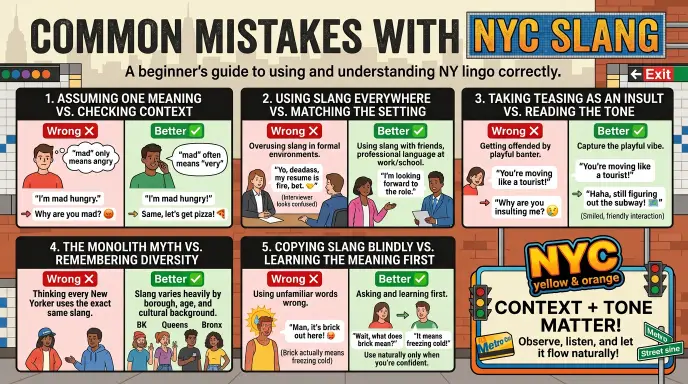
One common mistake is assuming every slang word is used by every New Yorker.
New York City is enormous, and speech varies by neighborhood, generation, background, and social group.
Another mistake is forcing slang into every sentence.
If you are trying to sound like a New Yorker, copying several slang terms at once can sound unnatural.
It is better to understand a word first and use it only when it fits naturally.
A third mistake is assuming that online usage always matches real-life speech. Social media can exaggerate slang because people use certain expressions for humor, memes, or entertainment.
Finally, remember that some words may have different meanings in different communities.
Context always matters.
Frequently Asked Questions
What does NYC slang mean in text messages?
NYC slang refers to informal words and expressions associated with New York City. In text messages, people may use terms such as “deadass,” “mad,” “brick,” or “word.”
What does NYC slang mean on TikTok?
On TikTok, NYC slang usually refers to New York expressions used in videos, comments, captions, memes, and jokes. Social media has helped many of these terms spread outside New York.
Is NYC slang?
NYC slang is a broad category of regional slang, not one specific slang word. It includes many informal expressions associated with New York City and its communities.
Is NYC slang rude or offensive?
Most NYC slang is not automatically rude or offensive. However, some expressions can sound aggressive or inappropriate depending on the words, tone, and situation.
How should you reply to NYC slang?
If you understand the phrase, respond naturally. If you do not understand it, simply ask what it means. There is no need to guess or copy the slang.
More NYC Slang You May Hear
If you are learning New York vocabulary, you may come across many other expressions.
Some terms describe emotions or reactions. Others describe people, neighborhoods, weather, money, food, or everyday activities.
The meaning can also change over time. A word that was strongly associated with one generation may become less common later, while social media can bring an older expression back into circulation.
That is one reason slang dictionaries are useful. They help explain not just what a word means, but also how people actually use it.
Final Takeaway
NYC slang is the informal language connected with New York City’s culture and communities. It includes expressions such as deadass, mad, brick, bodega, buggin’, frontin’, and word, although usage varies between people and neighborhoods.
You may encounter these expressions in conversations, text messages, TikTok videos, Instagram comments, music, movies, and memes.
Some NYC slang is now widely understood outside New York, while other expressions remain more local. Social media continues to spread these words to new audiences.
If you are not sure what a New York slang term means, check the context before using it. And if you are writing something formal, standard English is usually the better choice.
Learning regional slang is not only about memorizing words. It is also about understanding the culture, tone, and situation behind them.
Discover More Articles!
What Does Dodo Mean in Slang? Meaning & Social Media Use
Dominican Slang: Meanings, Words & Examples(2026)
What Does Truffle Butter Slang Mean in Text? Meaning & Examples 2026

Hi, I’m Sophia Bennett, a novelist passionate about creating heartfelt stories filled with romance, emotion, and unforgettable characters. Through my books, I hope to inspire readers and take them on journeys they’ll always remember.