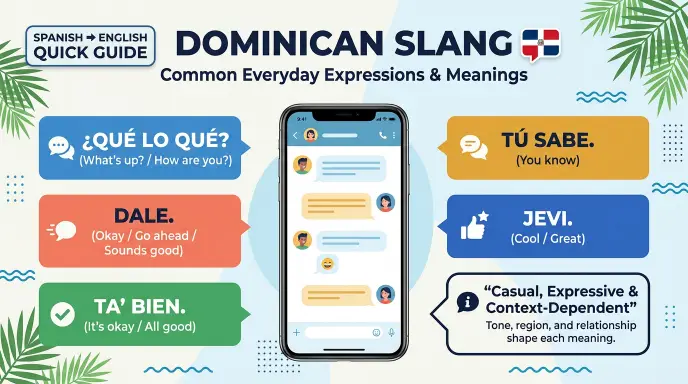
Dominican slang is the informal language used in the Dominican Republic and by many Dominicans living around the world.
It includes unique words, shortened expressions, playful phrases, and everyday terms that can sound very different from standard Spanish.
If you hear Dominican Spanish in a conversation, on TikTok, Instagram, music, or among friends, you may notice words such as vaina, jevi, tigre, pana, bacano, guagua, chin, and que lo que. These terms often carry meanings that depend on the situation and the speaker.
Dominican slang is especially interesting because it reflects the country’s history, humor, music, Caribbean culture, and fast moving everyday speech.
Some expressions are friendly and casual, while others can sound rude if you use them with the wrong person.
What Is Dominican Slang?
Dominican slang refers to informal words and expressions commonly used by people from the Dominican Republic.
Most of these terms are part of everyday Dominican Spanish rather than completely separate from Spanish.
The meaning can also change with tone and context. A word that sounds strange or even negative in another Spanish-speaking country may have a normal or friendly meaning in the Dominican Republic.
For example, vaina is one of the most flexible Dominican slang words. Depending on the situation, it can mean something like “thing,” “stuff,” “matter,” or “situation.”
Likewise, jevi means “cool” or “great.” It comes from the English word “heavy,” but Dominican speakers use it as a casual Spanish expression.
Popular Dominican Slang Words
Here are some common Dominican slang terms and their basic meanings.
| Dominican Slang | Meaning in English |
| Vaina | Thing, stuff, situation, or matter |
| Jevi | Cool, great, nice |
| Pana | Friend, buddy |
| Tigre | Clever or street-smart person |
| Bacano | Cool, awesome |
| Chin | A little bit |
| Guagua | Bus |
| Que lo que | What’s up? |
| Tiguere | Street-smart or crafty person |
| Chévere | Cool, good, or nice |
| Jarto | Full, tired, or fed up, depending on context |
| Coño | Strong exclamation; similar to “damn” |
| Loco | Bro, dude, or unbelievable person, depending on context |
| Manín | Bro, close friend |
| Dime a ve | Tell me / what’s up |
| Un chin | A little |
| Ahorita | Soon, in a little while, or sometimes now, depending on context |
Not every Dominican speaker uses every slang word in the same way. Age, location, family background, and social group can all affect vocabulary.
Dominican Slang for Friends
Dominican Spanish has several informal ways to talk about friends.
Pana
Pana means “friend,” “buddy,” or “pal.”
For example:
“Ese es mi pana.”
This means:
“That’s my friend.”
You may hear pana in casual conversations between friends.
Manín
Manín is another friendly way to address a male friend. In English, it can feel similar to “bro,” “dude,” or “my guy.”
Example:
“¿Qué lo que, manín?”
A natural English translation would be:
“What’s up, bro?”
Loco
Loco literally means “unbelievable,” but friends can also use it as a casual form of address.
For example:
“Loco, ven acá.”
Depending on the tone, this can simply mean:
“Bro, come here.”
Because tone matters, loco can be friendly or insulting.
What Does “Que Lo Que” Mean?
Que lo que, often written as KLK, is one of the expressions strongly associated with Dominican Spanish.
It is commonly used as a casual greeting similar to:
- What’s up?
- What’s going on?
- How are you?
- What’s good?
For example:
“KLK, manín?”
This can mean:
“What’s up, bro?”
The shortened form KLK is especially useful in texting and social media because it is quick to type.
What Does “Vaina” Mean?
Vaina is one of the most flexible words in Dominican slang.
It can refer to a thing, object, problem, situation, idea, or almost anything when the exact word is not important.
For example:
“Pásame esa vaina.”
Depending on the situation, this could mean:
“Pass me that thing.”
Another example is:
“¿Qué es esa vaina?”
This can mean:
“What is that thing?”
or:
“What is this situation?”
The exact meaning comes from context.
Because vaina is so flexible, English speakers should not expect one fixed translation.
What Does “Jevi” Mean?
Jevi means “cool,” “great,” “nice,” or “awesome.”
It is often used when someone likes something.
For example:
“Tu camisa está jevi.”
That means:
“Your shirt is cool.”
You may also hear:
“La fiesta estuvo jevi.”
This means:
“The party was great.”
The spelling jevi reflects how the English sound “heavy” was adapted into Dominican Spanish.
What Does “Tigre” or “Tiguere” Mean?
In Dominican slang, tigre or tiguere does not always refer to the animal.
A tiguere can be a person who is clever, street-smart, socially skilled, or good at finding ways to handle situations.
The word can have a positive, negative, or neutral tone.
For example:
“Ese tipo es un tiguere.”
Depending on context, this could mean:
“That guy is street-smart.”
It could also suggest that the person is crafty or knows how to get what he wants.
Because of this, tiguere is a word where context matters a lot.
What Does “Bacano” Mean?
Bacano generally means “cool,” “awesome,” or “great.”
For example:
“Ese carro está bacano.”
This means:
“That car is awesome.”
It can describe people, clothes, places, ideas, objects, or experiences.
However, bacano is not exclusive to the Dominican Republic. It appears in other varieties of Latin American Spanish too, so the exact cultural association can depend on the country.
What Does “Chin” Mean?
Chin means “a little bit” or “a small amount.”
You may hear:
“Dame un chin.”
This means:
“Give me a little.”
Another example:
“Espera un chin.”
That means:
“Wait a little.”
This is a very useful Dominican expression because it can appear in everyday conversations.
What Does “Guagua” Mean in Dominican Spanish?
In the Dominican Republic, guagua commonly means bus.
For example:
“Voy en guagua.”
This means:
“I’m going by bus.”
The word guagua has different meanings in different Spanish-speaking countries. In some places, it can refer to a baby or another object.
That is why regional context matters when learning Spanish slang.
Dominican Slang on TikTok and Social Media
Dominican slang appears in social media posts, captions, comments, memes, videos, music, and casual messages.
Short expressions are especially useful online because they make conversations faster and more informal.
You may see:
- KLK
- vaina
- jevi
- pana
- manín
- tiguere
- chin
- bacano
Music also plays an important role in spreading Dominican vocabulary beyond the Dominican Republic.
Dominican artists, Caribbean music, and online creators have helped expose more people to Dominican expressions.
Still, seeing a word online does not always mean every Dominican person uses it every day.
Real Dominican Slang Chat Examples
Example One
A: KLK, manín?
B: Todo bien. ¿Y tú?
A: Aquí, tranquilo.
Meaning:
A: What’s up, bro?
B: All good. You?
A: Just chilling.
Example Two
A: ¿Cómo estuvo la fiesta?
B: Estuvo jevi.
Meaning:
A: How was the party?
B: It was great.
Example Three
A: Pásame esa vaina.
B: ¿Cuál?
A: La que está ahí.
Meaning:
A: Pass me that thing.
B: Which one?
A: The one over there.
Example Four
A: Dame un chin de jugo.
B: Claro.
Meaning:
A: Give me a little juice.
B: Sure.
Example Five
A: Ese carro está bacano.
B: Sí, está durísimo.
Meaning:
A: That car is awesome.
B: Yeah, it’s really cool.
Example Six
A: ¿Vas en guagua?
B: Sí, voy ahora.
Meaning:
A: Are you taking the bus?
B: Yeah, I’m going now.
Example Seven
A: Ese pana siempre me ayuda.
B: Sí, es buen amigo.
Meaning:
A: That friend always helps me.
B: Yeah, he’s a good friend.
Example Eight
A: Loco, ¿dónde estás?
B: Ya voy.
Meaning:
A: Bro, where are you?
B: I’m on my way.
Example Nine
A: Ese tiguere sabe cómo resolver.
B: Sí, él se las busca.
Meaning:
A: That guy knows how to handle things.
B: Yeah, he knows how to make things work.
Example Ten
A: Espérame un chin.
B: Dale, no hay problema.
Meaning:
A: Wait for me a little.
B: Sure, no problem.
How to Use Dominican Slang Naturally
If you are learning Dominican Spanish, do not try to use every slang word at once.
Start with expressions whose meanings are clear and friendly. Words such as pana, jevi, chin, and KLK are easier to understand in casual conversations.
Listen to how native speakers use a word before copying it. This is especially important with terms such as tiguere, coño, and vaina, because their tone can change based on the situation.
Also, remember that Dominican Spanish is not the same as every other form of Caribbean or Latin American Spanish.
Is Dominican Slang Rude or Offensive?
Most Dominican slang is not automatically rude.
Words such as pana, jevi, bacano, and chin are generally casual rather than offensive.
However, some expressions can become vulgar or disrespectful depending on the word, tone, and situation.
For example, coño is a strong Spanish exclamation. Friends may use it casually, but it may not be appropriate in a formal workplace, classroom, or professional conversation.
If you are speaking with someone you do not know well, standard Spanish is usually the safer choice.
Who Uses Dominican Slang?
Dominican slang is used by people from many age groups, especially in informal conversations.
Young people may use slang heavily in:
- Text messages
- TikTok
- Snapchat
- Group chats
- Music and memes
Older speakers may also use many of these expressions, especially words that have been part of Dominican speech for a long time.
However, slang changes over time. Some expressions become less common, while new expressions appear through music, social media, and youth culture.
Dominican Slang and Gen Z
Gen Z speakers often mix traditional Dominican expressions with newer internet language.
For example, someone might use KLK in a text while also using English internet slang such as “LOL,” “bro,” or “fr.”
This mixing is common in online communication, especially among bilingual speakers and young people living outside the Dominican Republic.
Social media also allows Dominican expressions to reach people who have never visited the Dominican Republic.
Where Did Dominican Slang Come From?
Dominican slang developed from the history and culture of the Dominican Republic.
Dominican Spanish has been influenced by Spanish, African languages and cultural traditions, Caribbean speech, English, and contact with other communities.
Some slang words have very old regional roots, while others developed more recently through music, television, migration, and the internet.
The exact origin of many individual slang expressions is difficult to identify. A word may have several influences rather than one clear starting point.
That is why it is better to explain Dominican slang through its current use instead of claiming that every expression has one proven origin.
Dominican Slang Compared With Common Texting Slang
| Term | Meaning | Type | Usage | Popularity |
| Dominican slang | Informal Dominican expressions | Regional slang | Daily speech and online chat | High in Dominican communities |
| IDK | I don’t know | Text abbreviation | Texting and social media | Very high |
| IDC | I don’t care | Text abbreviation | Texting and chat | Very high |
| IMO | In my opinion | Text abbreviation | Online discussions | High |
| BRB | Be right back | Text abbreviation | Texting and chat | Common |
Dominican slang is different from English texting abbreviations because it comes from a regional variety of Spanish. Still, both types of language make informal communication shorter and more expressive.
Dominican Slang vs. Standard Spanish
Standard Spanish and Dominican Spanish share the same basic language, but everyday vocabulary can differ.
For example:
Standard Spanish:
“Dame un poco.”
Dominican slang:
“Dame un chin.”
Both communicate the idea of asking for a small amount, but the second expression has a distinctly informal regional flavor.
The same thing happens with greetings, transportation words, descriptions, and expressions of emotion.
Learning these differences can help you understand Dominican conversations without assuming that unusual words are mistakes.
Dominican Slang From a Girl or Guy
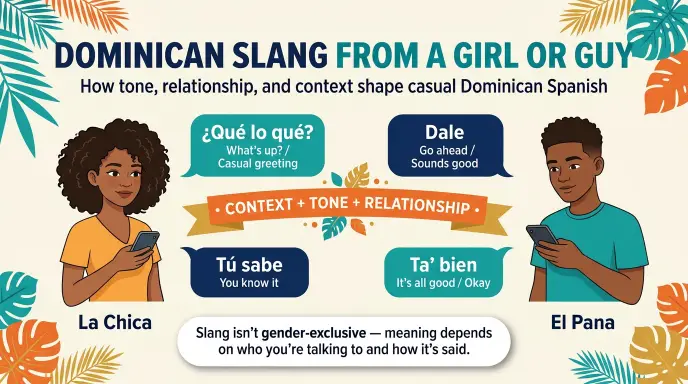
Dominican slang usually does not have a completely different meaning simply because a girl or guy uses it.
The bigger difference comes from tone and context.
For example, if someone says:
“KLK?”
They are probably using a casual greeting regardless of gender.
Likewise, pana, jevi, and chin can be used in many everyday situations.
If a slang word seems confusing, look at the complete message rather than trying to interpret the speaker’s gender.
How to Understand Dominican Slang in Context
Context is the most important part of understanding regional slang.
Look at:
- The full sentence
- The relationship between speakers
- The tone
- The situation
- The country or region
- Other words in the message
For example, vaina can refer to many different things. You cannot always translate it word-for-word.
Likewise, tiguere can sound like praise in one situation and criticism in another.
A literal dictionary translation may not capture the real meaning.
A Real-World Dominican Slang Example
Imagine two Dominican friends meeting after work.
One friend says:
“KLK, manín?”
The other responds:
“Todo bien. ¿Qué hacemos?”
They decide to get something to eat. One friend says:
“Vamos a ese sitio. Está jevi.”
Later, the first friend asks:
“¿Me das un chin de tu refresco?”
In a short conversation, you can hear several informal expressions:
- KLK = What’s up?
- manín = bro/friend
- jevi = cool/great
- chin = a little bit
This shows how Dominican slang can make ordinary conversation sound more local, relaxed, and expressive.
Frequently Asked Questions
What is Dominican slang for “pretty girl”?
A common Dominican way to say “pretty girl” is “mami” or “linda”. “Mami” can sound flirtatious and affectionate, while “linda” simply means pretty or beautiful.
How do Dominicans say “let’s go”?
Dominicans commonly say “¡Vamo’!”, a casual shortened form of “¡Vamos!” meaning “let’s go.” You may also hear “¡Vámonos!” when someone means “let’s leave.”
How to flirt in Dominican slang?
You can use casual expressions such as “Qué linda tú eres” (“You’re so pretty”) or “Mami, tú estás dura” (“Girl, you look amazing/hot”). The tone matters because some expressions can sound bold or very flirtatious.
What is Dominican slang for “cool”?
“Chévere” is a common Dominican way to say “cool,” “great,” or “awesome.” For example, “Eso está chévere” means “That’s cool.”
Dominican slang curse words
Common Dominican curse words and insults include coño, mierda, carajo, cojones, and cabron. Their strength can change with tone and context, and some are also used casually among friends.
Dominican slang sentences
Examples include “¿Qué lo qué?” (“What’s up?”), “Eso está chévere” (“That’s cool”), “Vamo’ a darle” (“Let’s go / let’s do it”), and “¿Tú ta’ bien?” (“Are you okay?”). Dominican Spanish often shortens words in casual speech.
Dominican slang words
Common Dominican slang includes “qué lo qué” for “what’s up,” “vaina” for “thing/stuff,” “chévere” for “cool,” “tiguere” for a street smart or savvy person, “jevi” for “cool/good,” and “pana” for “friend.”
Dominican slang for girl
Common informal terms include “jeva” for a girl or young woman, “chamaquita” for a young girl, and “mami” as an affectionate or flirtatious term. The appropriate word depends on the relationship and context.
Conclusion
Dominican slang is a lively part of Dominican Spanish. Words such as KLK, vaina, jevi, pana, tiguere, chin, guagua, and bacano can make conversations sound more natural and distinctly Dominican.
If you are learning these expressions, focus on their meaning in context instead of translating every word literally. Some terms have several meanings, and their tone can change depending on who is speaking.
For casual conversations with Dominican friends, slang can help you understand the culture and communicate more naturally. In school, work, or formal situations, however, standard Spanish is usually the safer choice.
Discover More Articles!
What Does Null Mean in Text? Meaning & Examples
What Does NOC Mean in Text? Meaning & Examples(2026)
What Does Dodo Mean in Slang? Meaning & Social Media Use

Hi, I’m Sophia Bennett, a novelist passionate about creating heartfelt stories filled with romance, emotion, and unforgettable characters. Through my books, I hope to inspire readers and take them on journeys they’ll always remember.