Truffle butter slang is a vulgar sexual slang term with an explicit meaning. It is usually used as a crude joke, shock humor, or sexual reference rather than as a normal food related phrase. You may see it in texting, TikTok comments, Snapchat, Instagram, memes, or online discussions.
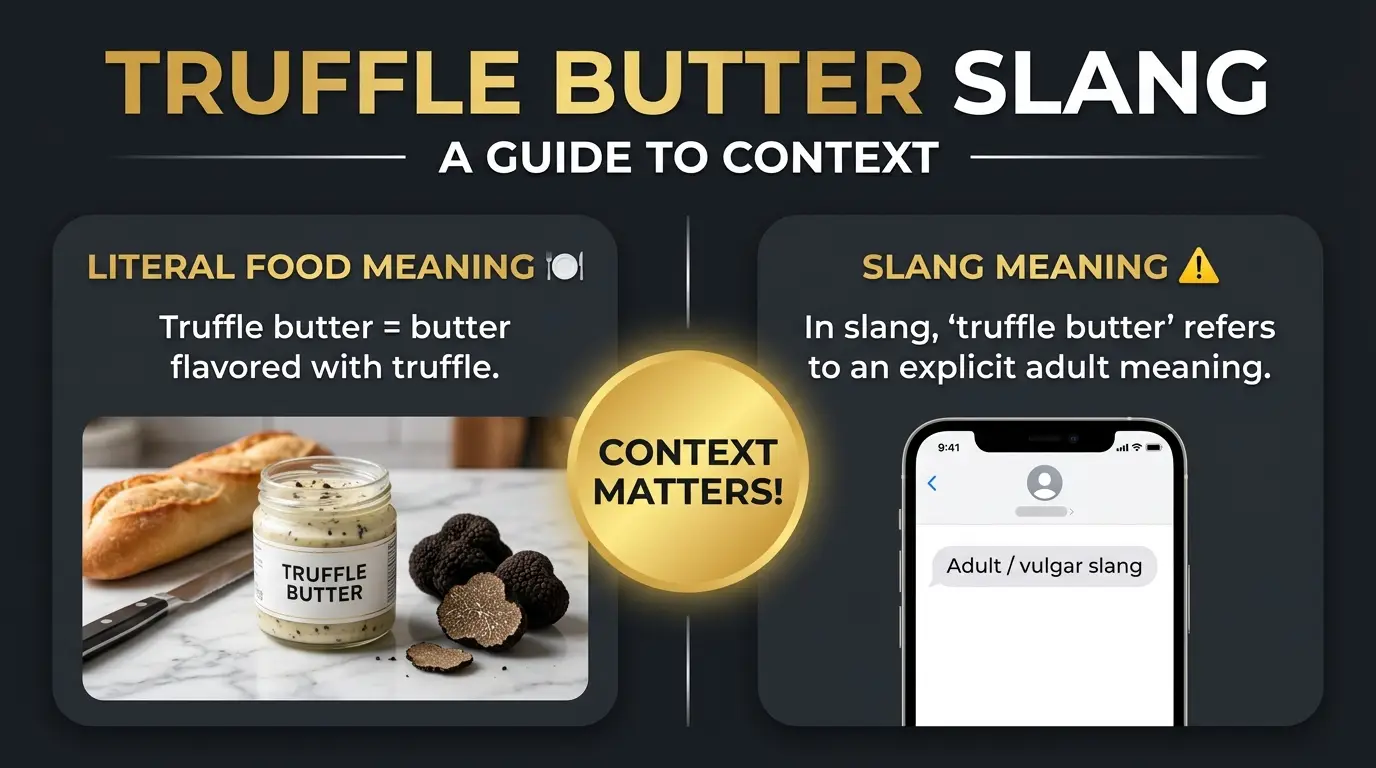
The confusing part is that truffle butter also has a completely innocent meaning. It can literally refer to butter flavored with truffle, a type of edible fungus. So the meaning depends heavily on the context.
People often search for “truffle butter slang” after seeing the phrase in a meme, comment, song reference, or private message. They want to know if someone is talking about food or using the phrase as sexual slang.
Truffle Butter Slang Meaning in Text
When truffle butter appears as slang, it generally refers to a vulgar sexual expression involving bodily fluids. It is considered crude and explicit, so it is not normally used in polite conversation.
This slang meaning is very different from the literal meaning of truffle butter. In cooking, truffle butter is simply butter mixed with truffle or truffle flavoring. In online slang, however, the phrase can have an adult meaning.
That difference is important because you should not automatically assume the slang meaning every time you see the words.
For example:
“I bought truffle butter for the pasta.”
This is almost certainly about food.
But:
“That meme is about truffle butter 💀.”
Here, the speaker may be referring to the vulgar slang meaning.
The term is slang, not an acronym or abbreviation. It does not stand for a set of letters like IDK or BRB. Instead, an ordinary food phrase developed an additional vulgar meaning in internet and popular culture.
Is Truffle Butter Always Slang?
No. Truffle butter has two very different meanings.
The first is completely ordinary. A restaurant menu, recipe, grocery list, or cooking video may use the phrase literally.
The second is an adult slang meaning. It appears more often in jokes, memes, music references, and conversations intended for mature audiences.
Context is the easiest way to tell them apart.
If the conversation mentions pasta, steak, recipes, restaurants, mushrooms, or cooking, the literal meaning is probably intended. If it appears alongside sexual jokes, NSFW content, or crude memes, the slang meaning is more likely.
Why Does the Slang Meaning Sound So Strange?
Internet slang often takes ordinary words and gives them unexpected meanings. Food terms, animal names, body related words, and everyday expressions can all become slang.
That does not mean the original meaning disappears.
“Truffle butter” is a good example because someone unfamiliar with online slang may naturally think about food first. A person who knows the slang may recognize the adult reference immediately.
This is why context matters more than the words alone.
Where People Use Truffle Butter Slang
The slang meaning can appear across several online platforms. However, it is not a standard everyday expression that everyone uses.
Truffle Butter on TikTok
On TikTok, the phrase may appear in comments, jokes, reaction videos, memes, or references to adult humor.
Because TikTok has a large young audience, people may also encounter the phrase while trying to understand something they saw in a comment. Some users deliberately use coded or indirect language when discussing mature subjects.
The phrase can also appear in videos discussing internet slang or controversial lyrics.
If you see “truffle butter” under a completely unrelated video, the commenter may be making a crude joke rather than discussing food.
Truffle Butter on Snapchat
On Snapchat, slang is often used in private conversations, jokes, stories, and messages between friends.
Someone might use the phrase as an adult joke or reference. Since Snapchat conversations can be casual and personal, slang can be more direct than it would be in a public setting.
Still, it is not a phrase you should assume everyone understands or appreciates.
Truffle Butter on Instagram
Instagram comments and memes are another place where the slang meaning may appear.
You might see it under a meme, in a caption, or in a discussion involving adult humor. Sometimes users mention slang simply because they want to shock other people or make a joke.
Instagram also contains plenty of food content, so context remains important. A cooking creator discussing truffle butter is probably talking about an actual ingredient.
Truffle Butter on WhatsApp
WhatsApp has no special meaning for the phrase. Its meaning depends entirely on the conversation.
Friends might use it jokingly in a private chat, while someone else might use the same words literally when talking about food.
If a person sends the phrase without context, asking what they mean is often the safest approach.
Truffle Butter in SMS and Text Messages
Traditional SMS messages can contain the slang too, especially when people are discussing memes, music, jokes, or adult topics.
There is no special texting abbreviation for it. Unlike “LOL,” “IDK,” or “BRB,” the phrase is not designed to save typing time.
It is usually written out because the phrase itself is the reference.
Real Chat Examples
The following examples show how the meaning can change depending on context. They use the phrase naturally without treating the vulgar meaning as normal everyday language.
Example One: Confused by a Meme
A: Why does everyone keep saying truffle butter?
B: In that meme, they’re using the slang meaning.
A: Oh, I thought they meant food.
B: Same at first 😂
Example Two: Food Meaning
A: What sauce did you use?
B: Truffle butter with garlic.
A: That sounds amazing.
B: It was really good.
Here, there is no slang meaning. The conversation is clearly about food.
Example Three: Internet Joke
A: Did you see that comment section?
B: Yeah 😭
A: Someone wrote “truffle butter” for no reason.
B: That’s just internet humor.
Example Four: Asking for Clarification
A: What does truffle butter mean here?
B: It’s slang in this context.
A: Is it appropriate to repeat?
B: Probably not in a school or work chat.
Example Five: Private Joke
A: You actually sent that meme?
B: Yep.
A: You knew what truffle butter meant, right?
B: Unfortunately, yes 💀
Example Six: Restaurant Conversation
A: The restaurant has truffle butter fries.
B: Wait, seriously?
A: Yes lol.
B: I need to try those.
Again, this is the literal food meaning.
Example Seven: Explaining a Comment
A: Why did they call that truffle butter?
B: It was an adult joke.
A: Got it. I’ll stay out of that comment section.
Example Eight: Meme Reaction
A: This meme is wild.
B: The truffle butter reference made it worse 😂
A: I wasn’t expecting that at all.
Example Nine: Neutral Question
A: Is truffle butter slang?
B: It can be, but it also has a normal food meaning.
A: So it depends on context?
B: Exactly.
Example Ten: Warning a Friend
A: Can I use “truffle butter” in my school presentation?
B: If you’re talking about the food, sure.
A: What if I’m talking about the slang?
B: Definitely avoid that.
How to Reply When Someone Says “Truffle Butter”
Your response should depend on the situation. If the person clearly means the slang definition, you do not have to continue the conversation.
Funny Replies
If you’re talking with a friend and the conversation is already joking, you might respond with:
- “I did not need to know that 😂”
- “Internet slang is getting ridiculous.”
- “That took a weird turn.”
- “Please explain why you said that 💀”
- “I was thinking about actual butter!”
A funny response works best when everyone involved is comfortable with the joke.
Casual Replies
If you want to keep things simple, you could say:
- “What do you mean?”
- “You mean the slang?”
- “Are you talking about the food?”
- “I know that reference.”
- “That’s a pretty random thing to say.”
These responses avoid making the conversation more explicit.
Friendly Replies
If a friend uses the term and you want to respond without being rude:
- “Lol, I know what you mean.”
- “That’s definitely an internet reference.”
- “I’ve seen that slang before.”
- “I thought you meant the food at first.”
Neutral Replies
If you are unsure about the person’s intention, a neutral response is best:
- “What do you mean by that?”
- “Can you clarify?”
- “Are you referring to the food or the slang?”
- “I’m not sure I understand the reference.”
This is especially useful because the phrase genuinely has an innocent meaning too.
Is Truffle Butter Rude or Offensive?
The slang meaning is vulgar and sexually explicit. It can be inappropriate in many everyday situations.
That does not mean the phrase itself is always offensive. Someone talking about actual truffle butter in a recipe is not using vulgar slang.
The important distinction is between the literal food meaning and the adult slang meaning.
Is It Safe to Use With Friends?
That depends on the people involved.
Close friends sometimes use vulgar slang as humor. Even then, you should consider if everyone understands the reference and is comfortable with it.
A joke that seems funny to one person can make another person uncomfortable.
Is It Appropriate at School?
The slang meaning is generally not appropriate for school conversations, assignments, presentations, or messages to teachers.
If your topic is food and you genuinely need to discuss truffle butter as an ingredient, that is completely different. In that situation, you are using the ordinary culinary meaning.
Is It Appropriate at Work?
The adult slang meaning is best avoided in professional communication.
Work chats, emails, meetings, presentations, and customer conversations are not good places for sexual slang. Even if someone uses it jokingly, repeating it could create an uncomfortable or unprofessional situation.
Who Uses This Term?
The slang meaning is mostly associated with internet culture and adult humor, rather than everyday speech.
People who spend time around memes, music references, social media jokes, and online communities may recognize it.
Gen Z Usage
Some Gen Z users may recognize the term because of internet culture and social media. However, that does not mean it is a common Gen Z abbreviation.
It is better described as a vulgar internet slang expression than as a standard Gen Z texting term.
Unlike common abbreviations such as “LOL,” “TBH,” or “IDK,” people do not normally use “truffle butter” in every kind of conversation.
Younger Users
Younger internet users may encounter the term without knowing its adult meaning. This is one reason people search for definitions online.
Seeing a phrase in a meme does not automatically mean the person posting it understands the original reference.
Adults
Adults may recognize the phrase from popular culture, online jokes, music, or sexual slang.
Even among adults, though, it is not appropriate for every setting. It remains a crude expression.
How Often Does It Appear Online?
The phrase is relatively niche compared with common texting slang.
You are more likely to see it in a specific joke, meme, adult conversation, or cultural reference than in an ordinary text message.
Origin of the Term
The origin of truffle butter is unusual because the phrase existed as a normal food term before its slang use became known.
Truffle butter is a real culinary product made with butter and truffle or truffle flavoring. The slang meaning later became associated with sexual humor and popular internet culture.
The adult use is also strongly connected with a well known music reference that helped spread the phrase beyond smaller online circles. After appearing in popular culture, the expression became easier to recognize as a vulgar slang term.
However, the exact point at which people first started using the phrase with its sexual meaning is difficult to establish with certainty. Slang often develops informally, and users can create or reuse expressions without recording a clear starting date.
Internet Culture and Slang
Internet culture often takes a familiar phrase and gives it a second meaning.
Once a phrase appears in memes, songs, social posts, jokes, and comment sections, more people may encounter it. Some users then repeat it without knowing its original background.
That is why slang definitions can be confusing. The meaning may change depending on the community, platform, and context.
Truffle Butter vs Common Texting Slang
It is useful to compare truffle butter with familiar abbreviations. This shows why the term does not work like standard texting shortcuts.
| Term | Meaning | Type | Usage | Popularity |
| Truffle butter | A vulgar sexual slang reference; also a real food | Slang / phrase | Memes, jokes, adult conversations, or food discussions | Niche |
| IDK | I don’t know | Abbreviation | Texting, social media, chats | Very common |
| IDC | I don’t care | Abbreviation | Texting, social media, chats | Very common |
| IMO | In my opinion | Abbreviation | Texting, comments, online discussions | Common |
| BRB | Be right back | Abbreviation | Texting, chats, gaming | Common |
The biggest difference is that IDK, IDC, IMO, and BRB are practical texting abbreviations, while “truffle butter” is a phrase with a separate slang meaning.
Real World Usage Example
Imagine a student sees the phrase “truffle butter” in an Instagram comment under a meme.
They may assume it refers to food because they have heard of truffle butter in cooking. Another friend may recognize it as adult slang.
Instead of repeating the phrase without knowing what it means, the student checks its definition and learns that it has both a literal and vulgar meaning.
Now consider a completely different situation.
Someone is reading a restaurant menu and sees:
“Steak with truffle butter.”
There is no reason to interpret that as slang. The menu is clearly talking about a food ingredient.
This example shows why context is so important. The exact same words can have completely different meanings.
How to Tell Which Meaning Someone Intended
Look at the words surrounding the phrase.
If the conversation includes:
- pasta
- steak
- fries
- recipes
- mushrooms
- restaurants
- cooking
- sauces
then the literal food meaning is likely.
If the conversation includes:
- adult jokes
- NSFW content
- sexual references
- crude memes
- provocative comments
then the slang meaning may be intended.
When there is still doubt, simply ask what the person means. There is no need to guess.
Common Mistakes With Truffle Butter Slang
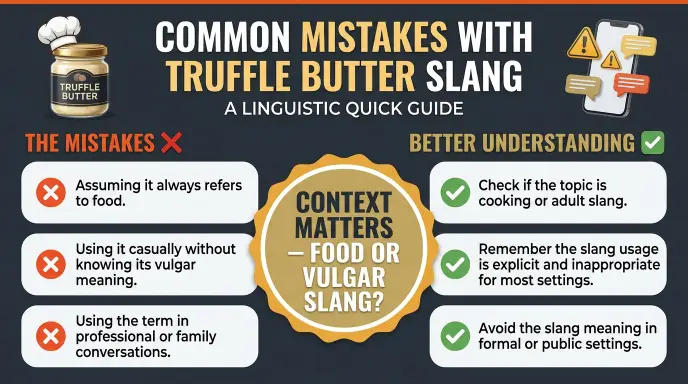
One common mistake is assuming every mention is sexual. That is incorrect because truffle butter is also a legitimate food product.
Another mistake is using the slang meaning in a formal setting without realizing how vulgar it sounds.
Some people also repeat internet slang because they saw it in a meme. They may not know the background or adult meaning.
A good rule is simple: understand the context before repeating unfamiliar slang.
This is especially important when communicating with teachers, employers, customers, family members, or people you do not know well.
Frequently Asked Questions
What does truffle butter mean in text messages?
In text messages, “truffle butter” can be a vulgar sexual slang reference. However, it can also literally mean butter flavored with truffle. The surrounding conversation determines the meaning.
What does truffle butter mean on TikTok?
On TikTok, “truffle butter” may be used as an adult joke, meme reference, or slang expression. It can also refer to actual food in cooking content.
Is truffle butter slang?
Yes, “truffle butter” can be slang when it is used with its vulgar sexual meaning. It is also a normal culinary phrase, so not every use is slang.
Is truffle butter rude or offensive?
The slang meaning is vulgar and sexually explicit, so it can be rude or inappropriate in many situations. The literal food meaning is not offensive.
How should you reply to truffle butter?
If you are unsure what someone means, ask for clarification. If they clearly mean the vulgar slang, you can give a neutral response or simply avoid continuing the topic.
Conclusion
Truffle butter slang is a vulgar internet expression with an adult sexual meaning. At the same time, truffle butter is also a completely normal food, so context matters.
You may see the slang reference in memes, social media comments, music related discussions, or private conversations. It is not a standard texting abbreviation like IDK, IMO, or BRB.
If someone uses it around you and you are unsure what they mean, asking for clarification is the easiest solution. And if the slang meaning is intended, remember that it is not suitable for most school, workplace, or formal situations.
The safest approach with unfamiliar slang is simple: understand the context before you repeat it.
What Does Truffle Butter Slang Mean in Text? Real Meaning, Examples & Social Media Use
Truffle butter slang is a vulgar sexual slang term with an explicit meaning. It is usually used as a crude joke, shock humor, or sexual reference rather than as a normal food related phrase. You may see it in texting, TikTok comments, Snapchat, Instagram, memes, or online discussions.
The confusing part is that truffle butter also has a completely innocent meaning. It can literally refer to butter flavored with truffle, a type of edible fungus. So the meaning depends heavily on the context.
People often search for “truffle butter slang” after seeing the phrase in a meme, comment, song reference, or private message. They want to know if someone is talking about food or using the phrase as sexual slang.
Truffle Butter Slang Meaning in Text
When truffle butter appears as slang, it generally refers to a vulgar sexual expression involving bodily fluids. It is considered crude and explicit, so it is not normally used in polite conversation.
This slang meaning is very different from the literal meaning of truffle butter. In cooking, truffle butter is simply butter mixed with truffle or truffle flavoring. In online slang, however, the phrase can have an adult meaning.
That difference is important because you should not automatically assume the slang meaning every time you see the words.
For example:
“I bought truffle butter for the pasta.”
This is almost certainly about food.
But:
“That meme is about truffle butter 💀.”
Here, the speaker may be referring to the vulgar slang meaning.
The term is slang, not an acronym or abbreviation. It does not stand for a set of letters like IDK or BRB.
Instead, an ordinary food phrase developed an additional vulgar meaning in internet and popular culture.
Is Truffle Butter Always Slang?
No. Truffle butter has two very different meanings.
The first is completely ordinary. A restaurant menu, recipe, grocery list, or cooking video may use the phrase literally.
The second is an adult slang meaning. It appears more often in jokes, memes, music references, and conversations intended for mature audiences.
Context is the easiest way to tell them apart.
If the conversation mentions pasta, steak, recipes, restaurants, mushrooms, or cooking, the literal meaning is probably intended.
If it appears alongside sexual jokes, NSFW content, or crude memes, the slang meaning is more likely.
Why Does the Slang Meaning Sound So Strange?
Internet slang often takes ordinary words and gives them unexpected meanings. Food terms, animal names, body related words, and everyday expressions can all become slang.
That does not mean the original meaning disappears.
“Truffle butter” is a good example because someone unfamiliar with online slang may naturally think about food first. A person who knows the slang may recognize the adult reference immediately.
This is why context matters more than the words alone.
Where People Use Truffle Butter Slang
The slang meaning can appear across several online platforms. However, it is not a standard everyday expression that everyone uses.
Truffle Butter on TikTok
On TikTok, the phrase may appear in comments, jokes, reaction videos, memes, or references to adult humor.
Because TikTok has a large young audience, people may also encounter the phrase while trying to understand something they saw in a comment. Some users deliberately use coded or indirect language when discussing mature subjects.
The phrase can also appear in videos discussing internet slang or controversial lyrics.
If you see “truffle butter” under a completely unrelated video, the commenter may be making a crude joke rather than discussing food.
Truffle Butter on Snapchat
On Snapchat, slang is often used in private conversations, jokes, stories, and messages between friends.
Someone might use the phrase as an adult joke or reference. Since Snapchat conversations can be casual and personal, slang can be more direct than it would be in a public setting.
Still, it is not a phrase you should assume everyone understands or appreciates.
Truffle Butter on Instagram
Instagram comments and memes are another place where the slang meaning may appear.
You might see it under a meme, in a caption, or in a discussion involving adult humor. Sometimes users mention slang simply because they want to shock other people or make a joke.
Instagram also contains plenty of food content, so context remains important. A cooking creator discussing truffle butter is probably talking about an actual ingredient.
Truffle Butter on WhatsApp
WhatsApp has no special meaning for the phrase. Its meaning depends entirely on the conversation.
Friends might use it jokingly in a private chat, while someone else might use the same words literally when talking about food.
If a person sends the phrase without context, asking what they mean is often the safest approach.
Truffle Butter in SMS and Text Messages
Traditional SMS messages can contain the slang too, especially when people are discussing memes, music, jokes, or adult topics.
There is no special texting abbreviation for it. Unlike “LOL,” “IDK,” or “BRB,” the phrase is not designed to save typing time.
It is usually written out because the phrase itself is the reference.
Real Chat Examples
The following examples show how the meaning can change depending on context. They use the phrase naturally without treating the vulgar meaning as normal everyday language.
Example One: Confused by a Meme
A: Why does everyone keep saying truffle butter?
B: In that meme, they’re using the slang meaning.
A: Oh, I thought they meant food.
B: Same at first 😂
Example Two: Food Meaning
A: What sauce did you use?
B: Truffle butter with garlic.
A: That sounds amazing.
B: It was really good.
Here, there is no slang meaning. The conversation is clearly about food.
Example Three: Internet Joke
A: Did you see that comment section?
B: Yeah 😭
A: Someone wrote “truffle butter” for no reason.
B: That’s just internet humor.
Example Four: Asking for Clarification
A: What does truffle butter mean here?
B: It’s slang in this context.
A: Is it appropriate to repeat?
B: Probably not in a school or work chat.
Example Five: Private Joke
A: You actually sent that meme?
B: Yep.
A: You knew what truffle butter meant, right?
B: Unfortunately, yes 💀
Example Six: Restaurant Conversation
A: The restaurant has truffle butter fries.
B: Wait, seriously?
A: Yes lol.
B: I need to try those.
Again, this is the literal food meaning.
Example Seven: Explaining a Comment
A: Why did they call that truffle butter?
B: It was an adult joke.
A: Got it. I’ll stay out of that comment section.
Example Eight: Meme Reaction
A: This meme is wild.
B: The truffle butter reference made it worse 😂
A: I wasn’t expecting that at all.
Example Nine: Neutral Question
A: Is truffle butter slang?
B: It can be, but it also has a normal food meaning.
A: So it depends on context?
B: Exactly.
Example Ten: Warning a Friend
A: Can I use “truffle butter” in my school presentation?
B: If you’re talking about the food, sure.
A: What if I’m talking about the slang?
B: Definitely avoid that.
How to Reply When Someone Says “Truffle Butter”
Your response should depend on the situation. If the person clearly means the slang definition, you do not have to continue the conversation.
Funny Replies
If you’re talking with a friend and the conversation is already joking, you might respond with:
- “I did not need to know that 😂”
- “Internet slang is getting ridiculous.”
- “That took a weird turn.”
- “Please explain why you said that 💀”
- “I was thinking about actual butter!”
A funny response works best when everyone involved is comfortable with the joke.
Casual Replies
If you want to keep things simple, you could say:
- “What do you mean?”
- “You mean the slang?”
- “Are you talking about the food?”
- “I know that reference.”
- “That’s a pretty random thing to say.”
These responses avoid making the conversation more explicit.
Friendly Replies
If a friend uses the term and you want to respond without being rude:
- “Lol, I know what you mean.”
- “That’s definitely an internet reference.”
- “I’ve seen that slang before.”
- “I thought you meant the food at first.”
Neutral Replies
If you are unsure about the person’s intention, a neutral response is best:
- “What do you mean by that?”
- “Can you clarify?”
- “Are you referring to the food or the slang?”
- “I’m not sure I understand the reference.”
This is especially useful because the phrase genuinely has an innocent meaning too.
Is Truffle Butter Rude or Offensive?
The slang meaning is vulgar and sexually explicit. It can be inappropriate in many everyday situations.
That does not mean the phrase itself is always offensive. Someone talking about actual truffle butter in a recipe is not using vulgar slang.
The important distinction is between the literal food meaning and the adult slang meaning.
Is It Safe to Use With Friends?
That depends on the people involved.
Close friends sometimes use vulgar slang as humor. Even then, you should consider if everyone understands the reference and is comfortable with it.
A joke that seems funny to one person can make another person uncomfortable.
Is It Appropriate at School?
The slang meaning is generally not appropriate for school conversations, assignments, presentations, or messages to teachers.
If your topic is food and you genuinely need to discuss truffle butter as an ingredient, that is completely different. In that situation, you are using the ordinary culinary meaning.
Is It Appropriate at Work?
The adult slang meaning is best avoided in professional communication.
Work chats, emails, meetings, presentations, and customer conversations are not good places for sexual slang. Even if someone uses it jokingly, repeating it could create an uncomfortable or unprofessional situation.
Who Uses This Term?
The slang meaning is mostly associated with internet culture and adult humor, rather than everyday speech.
People who spend time around memes, music references, social media jokes, and online communities may recognize it.
Gen Z Usage
Some Gen Z users may recognize the term because of internet culture and social media. However, that does not mean it is a common Gen Z abbreviation.
It is better described as a vulgar internet slang expression than as a standard Gen Z texting term.
Unlike common abbreviations such as “LOL,” “TBH,” or “IDK,” people do not normally use “truffle butter” in every kind of conversation.
Younger Users
Younger internet users may encounter the term without knowing its adult meaning. This is one reason people search for definitions online.
Seeing a phrase in a meme does not automatically mean the person posting it understands the original reference.
Adults
Adults may recognize the phrase from popular culture, online jokes, music, or sexual slang.
Even among adults, though, it is not appropriate for every setting. It remains a crude expression.
How Often Does It Appear Online?
The phrase is relatively niche compared with common texting slang.
You are more likely to see it in a specific joke, meme, adult conversation, or cultural reference than in an ordinary text message.
Origin of the Term
The origin of truffle butter is unusual because the phrase existed as a normal food term before its slang use became known.
Truffle butter is a real culinary product made with butter and truffle or truffle flavoring. The slang meaning later became associated with sexual humor and popular internet culture.
The adult use is also strongly connected with a well known music reference that helped spread the phrase beyond smaller online circles.
After appearing in popular culture, the expression became easier to recognize as a vulgar slang term.
However, the exact point at which people first started using the phrase with its sexual meaning is difficult to establish with certainty.
Slang often develops informally, and users can create or reuse expressions without recording a clear starting date.
Internet Culture and Slang
Internet culture often takes a familiar phrase and gives it a second meaning.
Once a phrase appears in memes, songs, social posts, jokes, and comment sections, more people may encounter it. Some users then repeat it without knowing its original background.
That is why slang definitions can be confusing. The meaning may change depending on the community, platform, and context.
Truffle Butter vs Common Texting Slang
It is useful to compare truffle butter with familiar abbreviations. This shows why the term does not work like standard texting shortcuts.
| Term | Meaning | Type | Usage | Popularity |
| Truffle butter | A vulgar sexual slang reference; also a real food | Slang / phrase | Memes, jokes, adult conversations, or food discussions | Niche |
| IDK | I don’t know | Abbreviation | Texting, social media, chats | Very common |
| IDC | I don’t care | Abbreviation | Texting, social media, chats | Very common |
| IMO | In my opinion | Abbreviation | Texting, comments, online discussions | Common |
| BRB | Be right back | Abbreviation | Texting, chats, gaming | Common |
The biggest difference is that IDK, IDC, IMO, and BRB are practical texting abbreviations, while “truffle butter” is a phrase with a separate slang meaning.
Real World Usage Example
Imagine a student sees the phrase “truffle butter” in an Instagram comment under a meme.
They may assume it refers to food because they have heard of truffle butter in cooking. Another friend may recognize it as adult slang.
Instead of repeating the phrase without knowing what it means, the student checks its definition and learns that it has both a literal and vulgar meaning.
Now consider a completely different situation.
Someone is reading a restaurant menu and sees:
“Steak with truffle butter.”
There is no reason to interpret that as slang. The menu is clearly talking about a food ingredient.
This example shows why context is so important. The exact same words can have completely different meanings.
How to Tell Which Meaning Someone Intended
Look at the words surrounding the phrase.
If the conversation includes:
- pasta
- steak
- fries
- recipes
- mushrooms
- restaurants
- cooking
- sauces
then the literal food meaning is likely.
If the conversation includes:
- adult jokes
- NSFW content
- sexual references
- crude memes
- provocative comments
then the slang meaning may be intended.
When there is still doubt, simply ask what the person means. There is no need to guess.
Common Mistakes With Truffle Butter Slang
One common mistake is assuming every mention is sexual. That is incorrect because truffle butter is also a legitimate food product.
Another mistake is using the slang meaning in a formal setting without realizing how vulgar it sounds.
Some people also repeat internet slang because they saw it in a meme. They may not know the background or adult meaning.
A good rule is simple: understand the context before repeating unfamiliar slang.
This is especially important when communicating with teachers, employers, customers, family members, or people you do not know well.
Frequently Asked Questions
What does truffle butter mean in text messages?
In text messages, “truffle butter” can be a vulgar sexual slang reference. However, it can also literally mean butter flavored with truffle. The surrounding conversation determines the meaning.
What does truffle butter mean on TikTok?
On TikTok, “truffle butter” may be used as an adult joke, meme reference, or slang expression. It can also refer to actual food in cooking content.
Is truffle butter slang?
Yes, “truffle butter” can be slang when it is used with its vulgar sexual meaning. It is also a normal culinary phrase, so not every use is slang.
Is truffle butter rude or offensive?
The slang meaning is vulgar and sexually explicit, so it can be rude or inappropriate in many situations. The literal food meaning is not offensive.
How should you reply to truffle butter?
If you are unsure what someone means, ask for clarification. If they clearly mean the vulgar slang, you can give a neutral response or simply avoid continuing the topic.
Conclusion
Truffle butter slang is a vulgar internet expression with an adult sexual meaning. At the same time, truffle butter is also a completely normal food, so context matters.
You may see the slang reference in memes, social media comments, music related discussions, or private conversations. It is not a standard texting abbreviation like IDK, IMO, or BRB.
If someone uses it around you and you are unsure what they mean, asking for clarification is the easiest solution. And if the slang meaning is intended, remember that it is not suitable for most school, workplace, or formal situations.
The safest approach with unfamiliar slang is simple: understand the context before you repeat it.
Discover More Articles!
What Does NOC Mean in Text? Meaning & Examples(2026)
What Does Dodo Mean in Slang? Meaning & Social Media Use
Dominican Slang: Meanings, Words & Examples(2026)

Hi, I’m Sophia Bennett, a novelist passionate about creating heartfelt stories filled with romance, emotion, and unforgettable characters. Through my books, I hope to inspire readers and take them on journeys they’ll always remember.