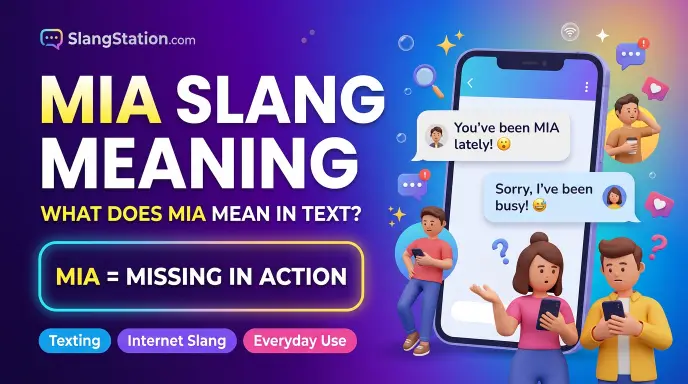
MIA slang means “Missing in Action.” In texting, it describes someone who has been absent, stopped replying, or disappeared from social activities for a while.
For example, if your friend has not answered your messages all day, you might say, “You’ve been MIA lately!”
People use MIA in text messages, group chats, and on platforms like TikTok, Snapchat, Instagram, and WhatsApp. It is a quick way to describe someone who is not around or has gone quiet.
You might also see people use MIA to explain their own absence. For example, “Sorry, I’ve been MIA because work has been busy.” This means the person has not been very active or available.
However, MIA does not always mean that someone is ignoring you. They could be busy, taking a break, or dealing with personal matters. Understanding the context helps you know what the sender really means.
MIA Slang Meaning in Text
MIA stands for “Missing in Action.” In everyday texting, it usually means that someone is missing from a conversation, social gathering, online platform, or regular activity.
The term started as a military abbreviation. Today, people also use it informally when a friend stops replying, a person disappears from social media, or someone has not joined the group for a while.
For example:
“Where have you been? You’ve been MIA all week!”
This message means the person has not been around or in contact as usual. It does not mean they are literally missing.
MIA is an abbreviation that is also widely used as slang in casual conversations. The letters come from the first letters of “Missing in Action.”
What Does MIA Mean in Everyday Conversations?
The meaning often depends on the situation. Here are some common ways people use it:
- In texting: Someone has not answered messages or calls.
- In friendships: A friend has not met up with the group recently.
- On social media: Someone has stopped posting or interacting.
- At school: A student has missed classes or group activities.
- At work: A person is absent or hard to reach.
- In dating: Someone has become quiet or stopped communicating for a while.
For example, if your friend usually sends you messages every day but suddenly goes quiet, you might text, “You’ve been MIA lately. Everything okay?”
This message can show concern rather than anger.
On the other hand, “You went MIA after I asked you for help” may suggest that the sender feels disappointed. The same term can sound friendly or serious depending on the words around it.
Does MIA Always Mean Someone Is Ignoring You?
No. MIA does not automatically mean that someone is ignoring you.
A person may be absent because they have schoolwork, a busy job, family duties, or other things to handle. They might also need time away from their phone.
For example:
“I’ve been MIA because I had exams.”
Here, the person explains why they have not been available. They are not saying they deliberately ignored anyone.
MIA describes the absence. It does not tell you the reason for it.
Where People Use MIA Slang
MIA appears in many types of online conversations. Its basic meaning stays the same, but the situation can change how people understand it.
MIA on TikTok
On TikTok, MIA often describes someone who has stopped posting videos or interacting with followers.
For example:
“I’ve been MIA on TikTok because I needed a break.”
This means the person has not been active on the platform recently.
You may also see comments such as “Bro went MIA” when a creator disappears from the feed or stops uploading videos. Friends might use the phrase when someone has not been seen in their usual online spaces.
Sometimes, people use MIA in captions to explain a long gap between posts. It is a simple way to let followers know that they have been away.
MIA on Snapchat
On Snapchat, MIA usually means someone has stopped sending Snaps, replying to chats, or talking with friends.
For example:
A: Why haven’t you opened my Snaps?
B: Sorry, I’ve been MIA on Snap lately.
B means they have not been active or responsive on Snapchat.
The phrase can also describe someone who has stopped keeping up with their usual streaks or group conversations. However, being MIA does not necessarily mean a person has lost interest in their friends.
MIA on Instagram
On Instagram, people may use MIA when someone has stopped sharing Stories, posting photos, or responding to direct messages.
For example:
“I’ve been MIA from Instagram for a few weeks.”
This means the person has not been active on the platform for some time.
A friend might also say, “You’ve been MIA on here!” after noticing that someone has not posted in a while.
The term is common in casual online language because it explains an absence without requiring a long explanation.
MIA on WhatsApp
On WhatsApp, MIA often refers to someone who has stopped replying in private chats or group conversations.
For example:
“You’ve been MIA in the family group. Is everything okay?”
This means the person has not been participating in the group chat as usual.
Friends may also use it when someone reads messages but does not respond for a long time. Still, MIA alone does not prove that the person is deliberately avoiding the group.
MIA in SMS Text Messages
In regular SMS messages, MIA has the same meaning as it does on social media.
For example:
“Hey, you’ve been MIA all weekend. Want to catch up?”
The sender is saying that the other person has not been around or in touch.
SMS conversations do not need special internet slang to use MIA. The abbreviation works in ordinary messages between friends, relatives, classmates, and coworkers.
Real Chat Examples of MIA Slang
These examples show how people might use MIA in everyday conversations. The meaning can change slightly depending on the situation and tone.
Example One: A Friend Has Gone Quiet
A: Hey, haven’t heard from you in days.
B: Sorry, I’ve been busy with school.
A: You’ve been MIA lately 😂
Meaning: A is joking that B has not been around or replying much.
Example Two: Taking a Social Media Break
A: You haven’t posted anything lately.
B: Yeah, I’ve been MIA from Instagram.
A: Everything good?
Meaning: B has not been active on Instagram recently.
Example Three: Missing From a Group Chat
A: Is Jake coming to the game tonight?
B: Not sure. He’s been MIA in the group chat.
A: I’ll message him.
Meaning: Jake has not been joining the group conversation.
Example Four: Being Busy at Work
A: Why didn’t you answer my call?
B: Meetings all afternoon. Sorry!
A: No worries. You were MIA today.
Meaning: The person was busy and unavailable for most of the day.
Example Five: Dating and Communication
A: You disappeared after our date.
B: Sorry, work got really busy.
A: I thought you went MIA on me.
Meaning: A thought B had stopped communicating after their date.
Example Six: Missing a Party
A: We looked for you at the party!
B: I couldn’t make it.
A: You were MIA 😂
Meaning: The person was absent from the party.
Example Seven: Returning to TikTok
A: Finally, a new video!
B: Haha, I’ve been MIA for a month.
A: Welcome back!
Meaning: B had not posted videos for a month.
Example Eight: Checking on a Friend
A: You’ve been MIA lately. Are you okay?
B: Yeah, just dealing with some things.
A: Okay. I’m here if you need me.
Meaning: A has noticed B’s absence and wants to make sure they are okay.
Example Nine: Online Gaming
A: Are you joining the game tonight?
B: Maybe tomorrow.
A: Bro, you’ve been MIA from the server all week.
Meaning: B has not been joining the online gaming group.
Example Ten: Explaining Your Absence
A: Where have you been? We miss you!
B: Sorry! I’ve been MIA because I moved to a new place.
A: That makes sense. Hope everything went well!
Meaning: B explains that moving kept them busy and unavailable.
These examples show that MIA can describe many kinds of absence. It can be a playful comment, a simple explanation, or a caring way to check on someone.
How to Reply When Someone Says MIA
Your response depends on what the other person means. They might be teasing you, asking where you have been, or showing concern.
You do not need a complicated reply. A short, natural message is usually enough.
Funny Replies
Use these when a friend is joking about your absence.
- “I went into hiding 😂”
- “I had to disappear for a little while.”
- “MIA mode: activated!”
- “I was on a secret mission.”
- “I’m back from the dead!”
These replies work best when you and the other person have a relaxed relationship.
Casual Replies
If you want to explain why you have not been around, try one of these:
- “I’ve been busy lately.”
- “Sorry, I haven’t checked my messages.”
- “Life has been hectic.”
- “I needed a little break.”
- “I’m back now!”
These responses are useful when you want to explain your absence without sharing personal details.
Friendly Replies
If someone seems worried about you, respond warmly.
- “Thanks for checking on me. I’m okay!”
- “Sorry I went quiet. How have you been?”
- “I’ve had a lot going on, but I’m doing fine.”
- “I appreciate you reaching out.”
- “Everything’s good. I just needed some time offline.”
A kind reply can reassure the other person without making the conversation awkward.
Neutral Replies
Sometimes, you may want to keep your response simple and polite.
- “I’ve been away for a while.”
- “I’ve had a busy week.”
- “I wasn’t available earlier.”
- “I’ve been taking care of a few things.”
- “I’ll catch up with everyone soon.”
These options can work with classmates, coworkers, acquaintances, or people you do not know very well.
What If Someone Else Has Been MIA?
You can also use the term to start a conversation with someone who has been absent.
For example:
- “Hey, you’ve been MIA lately. Everything okay?”
- “Haven’t heard from you in a while!”
- “We miss you in the group chat.”
- “Hope you’re doing well. Just checking in.”
- “No pressure to reply quickly. Just wanted to say hi.”
If you are concerned, avoid making the person feel guilty. They may have a good reason for being quiet.
Is MIA Slang Rude or Offensive?
MIA is generally not rude or offensive. It is a common abbreviation that people use to describe someone who is absent or unavailable.
However, the tone can change depending on the situation. A friendly joke between close friends may sound different from a complaint about a coworker who missed an important meeting.
Is MIA Safe to Use With Friends?
Yes, MIA is usually fine in casual conversations with friends.
For example, “You’ve been MIA all week 😂” may simply mean that you miss someone or have noticed they are not around.
Still, be thoughtful if the person is dealing with a difficult situation. A caring message is often better than teasing them about their absence.
Is MIA Appropriate at School?
In casual conversations with classmates, MIA is generally fine.
For example, you might say, “I was MIA from the group chat last night because I had homework.”
In a formal message to a teacher, however, use clearer wording such as “I was absent from class” or “I was unavailable yesterday.”
Is MIA Appropriate at Work?
It depends on your workplace and the context.
Among coworkers who speak casually, saying someone has been MIA may be understood without any problem.
However, telling a manager or colleague, “You’ve been MIA all week,” may sound like a criticism.
In professional emails, phrases such as “I couldn’t reach you” or “Were you available yesterday?” are often more polite.
Can MIA Sound Negative in Dating?
Yes, it can.
In a dating conversation, saying “You went MIA on me” may mean that someone stopped replying or became less available. It can suggest frustration or disappointment.
If you want to avoid a misunderstanding, explain what you noticed instead of assuming the other person ignored you on purpose.
Who Uses MIA Slang?
MIA is used by people who text, chat online, and talk about someone being absent. It is not limited to one age group.
Do Gen Z and Younger Users Say MIA?
Yes, younger internet users may use MIA in messages, captions, and group chats. However, the expression is not exclusive to Gen Z. Adults and older users also use it because the abbreviation has been part of English for a long time.
You might see someone write, “I’ve been MIA because of finals,” or “Why have you been MIA from the server?” Both examples use the same basic meaning.
Which Platforms Use MIA Most?
The abbreviation can appear on TikTok, Instagram, Snapchat, WhatsApp, SMS, Discord, and other online spaces.
Its use depends on the conversation. Someone who has stopped posting might be described as MIA on Instagram, while a friend who no longer joins gaming sessions might be called MIA from the server.
How Common Is MIA Online?
MIA is a familiar abbreviation in casual English, but its use varies by community and situation. There is no need to assume that everyone uses it or understands every meaning.
Most importantly, it is not a new term created only for TikTok. It has an older history and has carried over into modern online conversations.
Origin of MIA Slang
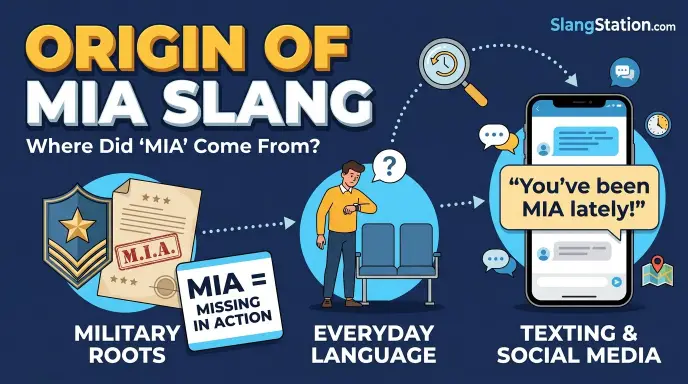
MIA comes from the phrase “Missing in Action,” which is associated with military service. In that setting, it refers to someone whose status or location is unknown after taking part in an operation.
The abbreviation later became part of everyday English. People began using it informally for anyone who was absent, unavailable, or hard to find.
Online conversations made the short form useful because it can express a familiar idea in just three letters. Instead of saying, “You haven’t been around lately,” a person can simply write, “You’ve been MIA.”
The military phrase has a clear origin, although it is difficult to identify one exact moment when its casual slang use became popular in everyday texting.
Today, MIA can have a light, playful meaning. In a serious military or news context, however, it may retain its original meaning. Always look at the surrounding words to understand how someone is using it.
MIA vs. IDK, IDC, IMO, and BRB
MIA is one of many abbreviations used in text messages. However, it serves a different purpose from terms such as IDK and BRB.
| Term | Meaning | Type | Usage | Popularity |
| MIA | Missing in Action | Abbreviation used as slang | Describes someone who is absent or unavailable | Familiar in casual English |
| IDK | I Don’t Know | Text abbreviation | Shows that someone does not know an answer | Widely recognized |
| IDC | I Don’t Care | Text abbreviation | Expresses a lack of concern or interest | Widely recognized |
| IMO | In My Opinion | Text abbreviation | Introduces a personal view | Widely recognized |
| BRB | Be Right Back | Text abbreviation | Tells someone that you will return soon | Widely recognized |
These terms are useful for different reasons.
For example, if a friend asks a question and you do not know the answer, you might write “IDK.” If you need to step away from a conversation briefly, you might write “BRB.”
MIA is different because it describes absence. Someone can be MIA without using any other abbreviation.
The popularity labels above are general descriptions, not measured rankings. Usage can vary by age group, platform, and community.
Real-World Example of MIA
Imagine that a group of friends usually meets for lunch every Friday. One friend, Daniel, has attended almost every week for months. Recently, however, he has missed three meetups and has not replied much in the group chat.
One friend might message the group:
“Has anyone heard from Daniel? He’s been MIA lately.”
The message means Daniel has not been around as usual. It does not automatically mean that he is avoiding his friends.
Another friend might contact Daniel directly:
“Hey, you’ve been MIA for a while. Hope everything is okay!”
Daniel could reply:
“Sorry, I’ve had a lot of work and family stuff to handle. I’ll try to join you next Friday.”
This is a normal example of how MIA works in everyday life. It helps people describe an absence without giving a long explanation.
It can also be used in the first person. Daniel might say, “I’ve been MIA lately because work has been hectic.” In that case, he is explaining his own absence.
Frequently Asked Questions
What does MIA mean in text messages?
MIA means “Missing in Action.” In text messages, it usually describes someone who has been absent, stopped replying, or has not been around lately.
What does MIA mean on TikTok?
On TikTok, MIA usually means someone has not posted videos or interacted with followers for a while. For example, “I’ve been MIA” means the person has been inactive recently.
Is MIA slang?
Yes, MIA is commonly used as informal slang in texts and online conversations. It comes from the abbreviation for “Missing in Action.”
Is MIA rude or offensive?
MIA is not usually offensive. However, it may sound critical if you use it to complain about someone’s absence or lack of communication.
How should you reply to MIA?
You can reply with “Sorry, I’ve been busy,” “I needed a break,” or “I’m back now!” If the person seems worried, reassure them that you are okay.
What does “I’ve been MIA” mean?
It means “I’ve been absent” or “I haven’t been around lately.” The person may have been busy, offline, or less active in conversations.
What does “going MIA” mean?
“Going MIA” means becoming unavailable or stepping away from usual activities. For example, someone might say they are going MIA for the weekend to take a break from social media.
Does MIA mean ghosting?
Not necessarily. MIA means someone is absent or hard to reach. Ghosting usually means suddenly stopping communication without an explanation. The two terms can overlap, but they are not identical.
Conclusion
MIA slang means “Missing in Action.” In everyday texting, it usually describes someone who has been absent, stopped replying, or has not been active on social media.
People use it on TikTok, Snapchat, Instagram, WhatsApp, SMS, and in group chats. It can be playful, casual, or caring, depending on the situation.
You can safely use MIA in most informal conversations. At school or work, choose more formal wording when the situation calls for it.
Also, remember that being MIA does not always mean someone is ignoring you. They may simply be busy or need some time away.
Discover More Articles!
Torta Meaning Slang: What Does Torta Mean?(2026)
What Does Snow Bunny Slang Mean in Text? Real Meaning & Examples
Sus Meaning Slang: What Does Sus Mean in Text?In 30 Seconds

Hi, I’m Sophia Bennett, a novelist passionate about creating heartfelt stories filled with romance, emotion, and unforgettable characters. Through my books, I hope to inspire readers and take them on journeys they’ll always remember.