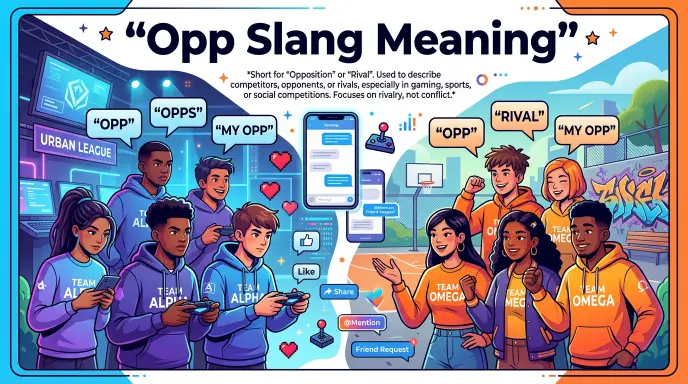
Opp in slang usually means an opponent, enemy, rival, or someone who is against you. It is commonly understood as a shortened form related to “opposition” or “opponent.”
You may see opp or opps in rap lyrics, social media posts, texting, gaming, and online conversations.
For example, if someone says, “He’s an opp,” they usually mean, “He is my enemy or rival.” The plural form opps means multiple enemies or rivals.
However, context matters. Someone can use opp seriously to describe a real rival, or casually to describe a person they disagree with. On social media, people sometimes use it more loosely than the word “enemy” suggests.
What Does Opp Mean in Slang?
Opp is slang for an opponent, enemy, or rival. It is commonly associated with “opposition” or “opponent” and became especially widespread through hip hop and street influenced language.
Today, opp and opps are also common online, including on TikTok, Instagram, gaming platforms, and in text messages.
Quick Answer: Opp Slang Meaning
| Term | Meaning | Example |
| Opp | Enemy, opponent, or rival | “He’s an opp.” |
| Opps | Enemies or rivals | “Watch out for the opps.” |
| My opp | Someone I consider an enemy | “That guy is my opp.” |
| Opp behavior | Behavior seen as disloyal or hostile | “That was opp behavior.” |
| Opps online | Online rivals or people against someone | “My opps keep commenting.” |
What Does Opp Mean?
Opp generally refers to someone who is on the opposing side.
In casual slang, however, it often carries a stronger meaning than simply “opponent.” An opp may be someone viewed as an enemy, rival, adversary, or person who has a conflict with you.
For example:
“Don’t trust him. He’s an opp.”
This means:
“Don’t trust him. He’s someone who is against me.”
The exact level of hostility depends on the situation. In one conversation, opp might mean a serious rival. In another, it might be used jokingly for someone who disagrees with you.
What Is the Plural of Opp?
The plural of opp is usually opps.
For example:
- One opp = one rival or enemy
- Two opps = two rivals or enemies
- My opps = my enemies or rivals
- Those are the opps = those people are the opposing group
Example:
“He’s an opp, but they’re my opps.”
The first sentence refers to one person. The second refers to several people.
Where Did Opp Come From?
The slang term opp is generally understood as a shortening connected to opponent or opposition. Dictionary.com notes that the slang use predates TikTok and was popularized through hip hop.
The broader words opponent and oppose have much older histories. An opponent is someone who is on the opposing side of a contest, disagreement, or conflict, while oppose means to act against something or someone.
Therefore, opp is best understood as modern slang built around the basic idea of being “on the other side.”
It is difficult to assign one exact date to when every community first began using opp because slang develops through speech, music, local communities, and cultural movements rather than appearing on a single documented date.
Why Do People Say Opp Instead of Enemy?
People use opp because it is shorter, more casual, and strongly associated with modern slang culture.
Compare these sentences:
“He’s my enemy.”
“He’s my opp.”
The first sounds direct and formal. The second sounds more like casual slang.
The word can also communicate a sense of group identity. Someone may describe another person as an opp because they see that person as belonging to an opposing group.
That is one reason the plural opps is so common.
Opp Meaning in Text
In texting, opp usually means enemy, rival, or opposing person.
For example:
“Don’t tell him. He’s an opp.”
This means:
“Don’t tell him because he’s against us.”
Another example:
“Why are you talking to the opp?”
This could mean:
“Why are you talking to our rival?”
Texting often removes context, so you should look at the surrounding conversation before deciding exactly how serious the word is.
Opp Meaning on TikTok
On TikTok and other social platforms, opp can refer to someone who is considered an enemy, rival, hater, or person working against you.
Dictionary.com specifically notes that opp is used online to refer to enemies or rivals and that the term became popular in hip hop before spreading into newer social media spaces.
For example:
“My opps are watching this video.”
Depending on context, this could mean:
“People who dislike or oppose me are watching this video.”
Online users can also use the term jokingly. Someone might call a friend an opp because the friend chose a different team, disagreed with them, or made a playful betrayal.
Opp Meaning in Rap and Hip Hop
Opp has a strong connection to rap and hip hop culture.
In this setting, an opp can mean a rival, opposing person, or member of a competing group. The word often appears alongside themes of loyalty, rivalry, conflict, and neighborhood identity.
Because of that background, opp can sometimes carry a much more serious meaning than it does in casual social media conversations.
You should therefore avoid assuming that every use of opp is harmless joking. Context, speaker, and situation matter.
Opp Meaning in Gaming
Gamers may also use opp to describe an opposing player or rival.
For example:
“The opp is hiding behind the building.”
Here, opp may simply mean:
“The opposing player.”
A gamer might also say:
“We need to beat the opps.”
In this context, the term does not necessarily mean personal enemies. It can simply refer to the opposing team or players.
This is an important difference.
Opp in Gaming vs. Everyday Slang
| Context | Meaning |
| Competitive game | Opposing player or team |
| Sports | Opposing player/team |
| Social media | Rival, hater, or person against someone |
| Texting | Enemy or person in conflict |
| Hip hop/street slang | Rival or opposing person/group |
Opp Meaning in Sports
In sports, opp can be used informally to mean an opponent.
For example:
“We have a tough opp tonight.”
Here, the speaker is probably talking about the opposing player or team.
This use is less about personal hatred and more about competition.
A basketball player, gamer, or sports fan could call a competitor an opp without suggesting a serious personal conflict.
What Does Opps Mean?
Opps means enemies, rivals, or opposing people.
For example:
“The opps are here.”
This usually means:
“The rival group is here.”
Another example:
“I don’t mess with the opps.”
This means:
“I don’t associate with people who are against me.”
The plural form is especially common in rap lyrics, social media captions, and casual speech.
What Does “My Opp” Mean?
My opp means my rival, enemy, or someone who is against me.
Example:
“He used to be my friend, but now he’s my opp.”
This suggests that the relationship has changed from friendship to conflict.
The phrase can also be exaggerated for humor:
“You ate my fries? You’re my opp now.”
Here, the speaker probably does not mean a real enemy. They are joking about a small disagreement.
What Does “Opp Behavior” Mean?
Opp behavior describes an action that someone considers disloyal, hostile, or supportive of an opposing side.
Example:
“You told them our secret? That’s opp behavior.”
The speaker is accusing the other person of acting like a rival.
On social media, the phrase can be used humorously:
“You picked pineapple pizza? Opp behavior.”
The meaning depends heavily on tone.
What Does “Opps” Mean on Social Media?
On social media, opps can refer to:
- Enemies
- Rivals
- Haters
- People who disagree with someone
- People from an opposing group
- Sometimes, jokingly, friends who have done something annoying
For instance:
“The opps are mad in the comments.”
This could mean that people who dislike the creator are criticizing the post.
Because social media slang changes quickly, the word can be used more loosely online than in its original cultural contexts.
Is Opp a Bad Word?
Opp is not automatically a swear word, but it can have a hostile meaning.
Calling someone an opp usually suggests that you see that person as a rival or someone who is against you.
However, the seriousness varies.
Serious Use
“He’s an opp. Stay away from him.”
This sounds like a genuine warning.
Playful Use
“You took the last slice? You’re an opp 😂”
This is probably a joke.
Therefore, opp is better described as informal slang with potentially hostile meaning, rather than a profanity.
Is Opp Offensive?
Opp is not inherently offensive, but it can be confrontational.
If you call someone an opp, you are labeling them as an enemy or rival. In a serious situation, that label can increase tension.
It is also important to understand the term’s connection to particular music and street language contexts. Using it casually online is not necessarily equivalent to using it in a real world conflict.
When you are unsure, neutral words such as rival, opponent, competitor, or person I disagree with are safer.
Opp vs. Hater
Although opp and hater can overlap, they are not exactly the same.
A hater is generally someone who dislikes, criticizes, or shows negativity toward another person.
An opp is more directly connected to opposition or rivalry.
| Word | Main Meaning |
| Opp | Rival, enemy, or opposing person |
| Hater | Person who dislikes or criticizes someone |
| Rival | Person competing against someone |
| Opponent | Person on the opposing side |
| Enemy | Person viewed as hostile |
Someone can be both an opp and a hater, but the words are not perfect synonyms.
Opp vs. Opponent
Opponent is the standard English word, while opp is slang.
For example:
“The opposing team is our opponent.”
Informally, someone might say:
“They’re our opps.”
The standard word works in formal situations. Opp is much more casual.
Opp vs. Opposition
Opposition refers to the act or state of being against someone or something, or to the opposing side.
Opp is an informal shortened slang form that can refer to a person or group seen as being on that opposing side.
For example:
“The opposition is strong.”
is different from:
“That guy is an opp.”
The first refers broadly to an opposing side. The second labels a person as a rival or enemy.
Common Examples of Opp in a Sentence
Here are natural examples showing different levels of meaning:
Serious:
“He’s considered an opp, so don’t share the information.”
Competitive:
“Our opps are much better this round.”
Gaming:
“The opp is coming from the left.”
Social media:
“My opps are going to go out of control in the comments.”
Playful:
“You stole my seat. You’re an opp now.”
Sports:
“We have a strong opp tonight.”
Texting:
“Why are you hanging with the opp?”
These examples show why context is essential.
Common Mistakes When Understanding Opp
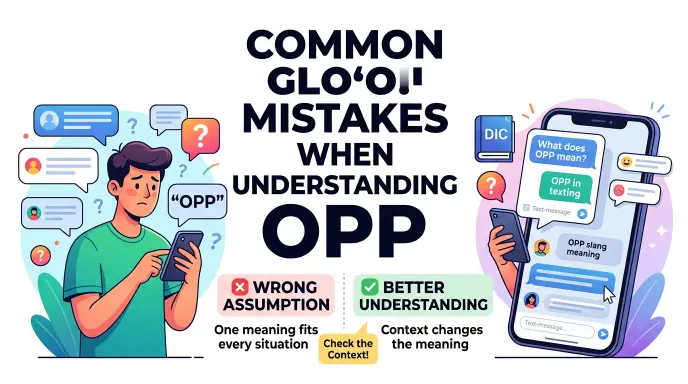
Mistake: Thinking Opp Always Means a Dangerous Enemy
Not necessarily.
In gaming, sports, and joking conversations, opp can simply mean an opponent or rival.
Mistake: Thinking Opp Always Means Hater
A hater dislikes or criticizes someone. An opp generally suggests opposition or rivalry.
Mistake: Confusing Opp With OP
OP can have completely different meanings online.
For example, OP commonly means original poster on internet forums. In gaming, OP can also mean overpowered.
By contrast, opp usually means an opponent, rival, or enemy in slang.
Mistake: Assuming the Meaning Is Always Serious
Someone can use opp as a joke.
For example:
“You picked the wrong team? You’re an opp.”
That does not necessarily indicate a real conflict.
Mistake: Assuming Every Use Has the Same Cultural Meaning
Slang changes across communities. A word used in rap, gaming, TikTok, or everyday texting may carry different levels of seriousness.
When Should You Avoid Using Opp?
Avoid using opp in formal or professional writing.
For example, do not write:
“Our biggest opp is another company.”
in a formal business report.
Instead, write:
“Our main competitor is another company.”
You should also avoid casually labeling real people as enemies when the situation could become confrontational.
In professional settings, opponent, competitor, rival, or critic is usually clearer.
Why Is Opp So Popular Online?
Several factors have helped opp spread online.
First, slang tends to favor short words that are easy to type. Second, hip hop has a major influence on modern internet vocabulary. Third, social platforms allow expressions from different communities to spread rapidly.
As a result, a word that once had a more specific cultural use can become familiar to a much wider audience.
However, wider use does not erase the word’s original cultural context.
Opp in Different Online Communities
| Platform/Context | Typical Meaning |
| TikTok | Rival, enemy, hater |
| Rival or person against someone | |
| Texting | Enemy or opponent |
| Gaming | Opposing player/team |
| Sports | Competitor or opposing team |
| Rap/Hip hop | Rival or opposing person/group |
| Memes | Often exaggerated or humorous rival |
The same sentence can therefore have different levels of seriousness depending on where you see it.
How Do You Pronounce Opp?
Opp is usually pronounced like “op”:
/ɑp/ in many American English contexts.
It is a short, one syllable word.
The plural opps is pronounced like “ops.”
Is Opp the Same as OPP?
Usually, when people write opp in lowercase in slang, they mean opponent, rival, or enemy.
However, OPP in uppercase can have other meanings. Dictionary.com notes that OPP can also refer to a different acronym associated with a 1991 Naughty by Nature song, while the slang opp is separately used for opposition or an enemy.
Therefore, capitalization and context can matter.
What Does “No Opps” Mean?
“No opps” can mean there are no enemies, rivals, or opposing people present.
For example:
“We’re all good here. No opps.”
Depending on the context, it may be serious or playful.
On social media, someone might also use no opps as a caption or joke without referring to an actual conflict.
What Does “Fewer Opps” Mean?
Fewer opps means having fewer rivals or people considered to be against you.
Example:
“I cut the drama out of my life, so now I have fewer opps.”
The expression is informal and can refer to social conflict rather than literal enemies.
What Does “Opps Watching” Mean?
“Opps watching” usually means that people who dislike, compete with, or oppose someone are watching what they do.
Example:
“Keep posting. The opps are watching.”
This is often used humorously online.
It can mean:
“People who don’t like you are paying attention to you.”
Is Opp Still Used Today?
Yes. Opp and opps remain recognizable slang terms, especially in online conversations, music culture, social media, and informal speech. Dictionary.com specifically identifies the term as older than TikTok and notes its connection to hip hop.
Its meaning has also become broader online. A person does not necessarily need to be a serious enemy to be jokingly called an opp.
Key Takeaways
- Opp usually means enemy, rival, opponent, or opposing person.
- It is commonly understood as a shortening related to opponent or opposition.
- Opps is the plural form.
- The word has strong connections to hip hop and street influenced slang.
- It is now widely seen on TikTok, Instagram, gaming platforms, and in text messages.
- In sports and gaming, opp may simply mean an opposing player or team.
- Online, people may use opp jokingly for someone who disagrees with them.
- Opp is not automatically a swear word, but it can sound hostile.
- Opp is different from OP, which can mean “original poster” or “overpowered.”
- In formal writing, use opponent, rival, competitor, or enemy instead.
Frequently Asked Questions
What does opp mean in Gen Z?
In Gen Z slang, “opp” means an opponent, rival, or enemy. It usually describes someone who is against you, causes problems, or is seen as a rival.
For example, “He’s an opp” means “He’s someone I’m against or someone who is against me.” The term is common in texting, social media, gaming, and hip hop influenced slang.
What is an opp in UK slang?
In UK slang, an “opp” generally means an opposition, rival, or enemy. It is especially associated with street and music culture, where “opps” can refer to people from a rival group or people involved in an ongoing conflict. The exact seriousness depends on the context.
Why does Gen Z say “OOP”?
“Oop” is different from “opp.” Gen Z and other internet users use “oop” as an interjection when something surprising, awkward, embarrassing, or unexpected happens.
It can be similar to saying “Oops!”, “Oh!”, or “Well, that happened.” For example, “Oop, I sent that message to the wrong person” shows surprise or embarrassment.
What does “opp” stand for?
“Opp” usually stands for “opponent” or “opposition.” In slang, it commonly means a rival or enemy.
The plural form is “opps,” as in “Watch out for the opps.” The exact meaning can vary by community and context, but it generally refers to someone considered to be on the opposing side.
What does “opp” mean in chat?
In chat, “opp” usually means an opponent, rival, or enemy. It is often used for someone who is against you or causes conflict. For example, “He’s my opp” means “He’s my rival” or “He’s someone who is against me.”
What does “opp” mean in English slang?
In English slang, “opp” is a shortened form of “opponent” or “opposition.” It commonly refers to a rival or enemy, especially in conversations influenced by hip hop, street culture, gaming, and social media. The meaning can be serious or playful depending on the context.
What does “opp” mean on TikTok?
On TikTok, “opp” usually means a rival, enemy, or someone you have an issue with. People may also use it casually or jokingly for someone who disagrees with them. For example, “My opp saw this” can mean “The person who is against me saw this.”
What does “opp” mean on Urban Dictionary?
On Urban Dictionary, “opp” is commonly explained as slang for an opponent, rival, or enemy.
The term is often connected with “opps,” the plural form, which can refer to people viewed as being on the opposing side.
Because Urban Dictionary contains user-submitted definitions, individual explanations can vary.
Conclusion
Opp slang meaning is usually enemy, rival, opponent, or someone who is against you. The word is a shortened slang form associated with ideas of opposition and opponent, and it became widely known through hip hop before spreading into social media and online communication.
Today, opp can have different levels of seriousness. In rap or street influenced language, it may refer to a genuine rival or opposing person. In gaming and sports, it can simply mean an opposing player or team.
On TikTok, Instagram, and in texting, it may even be used jokingly for someone who disagrees with you.
The key is context. If someone says “he’s my opp,” they probably mean that person is a rival or enemy. If someone jokingly says “you’re an opp because you took my fries,” the meaning is clearly less serious.
Discover More Articles!
Ion Meaning Slang: What Does “Ion” Mean in Texting and Slang?(2026)
70s Slang Words: 50+ Popular 1970s Slang Terms & Meanings.
Moose Knuckles Meaning in Text, TikTok & Social Media.(2026)

Hi, I’m Sophia Bennett, a novelist passionate about creating heartfelt stories filled with romance, emotion, and unforgettable characters. Through my books, I hope to inspire readers and take them on journeys they’ll always remember.