NPW usually means “No Problem Whatsoever” in text messages. People use it to reassure someone that something is completely fine or that they do not mind helping. It is an informal abbreviation used in casual online communication.
You may see NPW after someone says “thank you,” apologizes for a mistake, or asks for a favor.
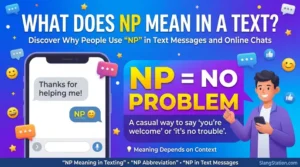
For example, if a friend says, “Thanks for helping me,” you could reply, “NPW!” to mean “No problem whatsoever!”
The abbreviation can look confusing if you have never seen it before. It is also less familiar than common texting shortcuts such as IDK, BTW, and BRB.
In this guide, you will learn what NPW means, how to use it naturally, what it might mean on social media, and how to reply when someone sends it to you.
What Does NPW Mean in Text?
NPW stands for “No Problem Whatsoever.” It is a short way to tell someone that something is not a problem at all.
The phrase is often used to sound relaxed, helpful, or reassuring. For example, someone may use NPW when a friend apologizes for being late or thanks them for doing something.
Here is a simple example:
A: Thanks for helping me with my homework!
B: NPW 😊
Meaning: B is saying, “No problem whatsoever!” They are letting their friend know that helping was not a bother.
NPW is an initialism because each letter represents part of a longer phrase. It belongs to informal digital communication rather than formal writing.
What Does Each Letter in NPW Stand For?
The abbreviation comes from the first letters of the phrase:
- N = No
- P = Problem
- W = Whatsoever
Put together, they form “No Problem Whatsoever.”
The word “whatsoever” adds emphasis. It means “at all” in this phrase.
For example, “No problem” is a simple way to reassure someone. “No problem whatsoever” makes that reassurance stronger.
Compare these replies:
- “No problem.” : A simple, friendly response.
- “No problem whatsoever.” : A more emphatic response.
- “NPW!” : A short, informal version of the same phrase.
The exact tone depends on the conversation. A friendly emoji or warm message can make the reply feel even more welcoming.
Is NPW Slang or an Abbreviation?
NPW is an informal abbreviation, often treated as texting slang. It shortens a common phrase so people can respond quickly in a chat.
It is not as widely recognized as abbreviations such as LOL, IDK, or BRB. Some people may understand it right away, while others may need to ask what it means.
That does not make the abbreviation incorrect. It simply means that context and shared understanding matter when using less familiar texting shortcuts.
When Do People Use NPW?
The easiest way to understand NPW is to look at the situation in which it appears. Most casual uses involve reassuring someone that a request, favor, or small mistake is not a problem.
When Someone Says Thank You
One possible use is to respond to gratitude.
Friend: Thanks for picking up my bag!
You: NPW!
Here, NPW means “No problem whatsoever.” You are telling your friend that helping them was no trouble.
When Someone Apologizes
NPW can also be used after an apology.
Friend: Sorry I replied so late.
You: NPW, don’t worry about it.
The reply shows that you are not upset about the delay.
When Someone Asks for a Favor
You may use NPW when agreeing to help with something simple.
Friend: Can you send me the notes later?
You: NPW, I’ll send them tonight.
In this example, the abbreviation helps keep the conversation casual. The rest of the message makes your response clear.
When Plans Change
NPW may also work when someone needs to change a plan.
Friend: Can we meet tomorrow instead?
You: NPW, tomorrow works for me.
Here, the sender is saying that the change is fine.
The common idea is reassurance: NPW communicates that the other person does not need to worry about the issue. Still, not every person will recognize the abbreviation, so a full phrase may be clearer.
Real Chat Examples of NPW
These ten conversations show how NPW can fit into everyday messages. They are illustrative examples of the phrase “No Problem Whatsoever,” not claims that every user writes the abbreviation in exactly this way.
Example One: Helping With Homework
A: Thank you for explaining that math question.
B: NPW! Glad you understand it now.
Meaning: B is saying “No problem whatsoever.” They are happy to help.
Example Two: Replying to a Late Message
A: Sorry, I just saw your message.
B: NPW 😊
Meaning: B is letting the other person know that the late reply is not an issue.
Example Three: Asking for Notes
A: Could you send me today’s class notes?
B: NPW, I’ll send them after class.
Meaning: B is agreeing to help and saying that the request is fine.
Example Four: Changing Plans
A: Sorry, can we move our movie night to Saturday?
B: NPW! Saturday is even better for me.
Meaning: B is happy with the change and does not mind adjusting the plan.
Example Five: Thanking a Friend
A: Thanks for waiting for me outside.
B: NPW, we’re friends!
Meaning: B is saying that waiting was no trouble.
Example Six: Borrowing Something
A: Thanks for lending me your charger.
B: NPW. Just give it back tomorrow.
Meaning: B is saying that lending the charger was fine while also explaining when they want it returned.
Example Seven: A Small Mistake
A: Sorry, I spilled a little water on the table.
B: NPW, I’ll wipe it up.
Meaning: B is reassuring the other person that the small accident is not a big deal.
Example Eight: Getting Help With a Phone
A: Thanks for fixing my phone settings!
B: NPW! Happy to help.
Meaning: B is saying that helping did not bother them.
Example Nine: A Group Project
A: Can you check my slides before we present?
B: NPW, send them over.
Meaning: B is willing to help and is comfortable with the request.
Example Ten: Saying Sorry for a Small Delay
A: Sorry I kept you waiting for five minutes.
B: NPW, it’s all good.
Meaning: B is reassuring the other person that the short wait was not a problem.
What do these examples have in common? In each one, NPW is used to express reassurance or willingness to help.
The abbreviation is most useful when the conversation is friendly and the other person understands it.
How to Reply When Someone Says NPW
If someone sends you NPW, the best response depends on what happened before it. They may be reassuring you after an apology or replying to your thanks.
You do not need to repeat NPW in your own message. A natural response is usually enough.
Casual Replies
Use these when chatting with friends:
- “Thanks!”
- “Appreciate it.”
- “Cool, thank you!”
- “You’re the best!”
These replies are simple and work well in everyday conversations.
Friendly Replies
If someone has helped you, you can make your appreciation clear:
- “That’s really kind of you.”
- “Thanks for being so helpful.”
- “I owe you one!”
- “Really appreciate it 😊”
These are useful when the person has taken time to help you with something.
Funny Replies
If you and the other person often joke around, try a playful response:
- “You’re a lifesaver 😂”
- “I’ll remember this when you need help!”
- “Legend behavior 😭”
- “Okay, officially promoting you to best friend.”
Use these only when they fit your relationship and the situation.
Neutral Replies
If you want to keep the exchange polite and simple, use:
- “Thank you for understanding.”
- “I appreciate that.”
- “Okay, thanks for letting me know.”
- “Glad that’s fine.”
A short “Thanks!” is usually enough when someone uses NPW to reassure you.
Is NPW Rude or Offensive?
NPW is not generally considered rude or offensive when it means “No Problem Whatsoever.” It is usually intended as a reassuring or helpful response.
For example:
A: Sorry for bothering you.
B: NPW 😊
This sounds friendly because B is telling A not to worry.
However, tone depends on context. A very short reply may sometimes feel distant, especially if the conversation is already tense. That does not mean NPW itself is offensive.
Is NPW Safe to Use With Friends?
Yes, it can be suitable for casual chats with friends who understand the abbreviation.
You might use it after someone thanks you for sharing notes, helping with a task, or agreeing to a change in plans.
If your friends are unfamiliar with NPW, writing “No problem at all!” will be easier to understand.
Can You Use NPW at School or Work?
It is generally better to use the full phrase in formal emails, school assignments, or professional messages.
For example, instead of replying:
“NPW.”
You could write:
“No problem at all. I’m happy to help.”
The full response sounds clear and professional. It also avoids making the reader guess what the abbreviation means.
Who Uses NPW?
NPW may be used by people who enjoy short forms in digital communication. However, there is not enough reliable evidence to say exactly which age group uses it most or how often it appears across social media.
Do Teenagers and Gen Z Use NPW?
Teenagers and Gen Z users often encounter abbreviations through texting, gaming, and social media. But not every abbreviation becomes a common Gen Z expression.
NPW is less recognizable than many well known shortcuts, so some younger users may understand it while others may not.
Do not assume that someone knows NPW just because they use TikTok or Snapchat. People have different texting habits.
Do Adults Use NPW?
Adults also use abbreviations in messages, especially when chatting with friends, family, or coworkers they know well.
Some may recognize NPW as “No Problem Whatsoever,” while others may prefer the more familiar phrase “No problem.”
The difference is often about personal communication style, not age alone.
Is NPW Popular on Social Media?
NPW has documented use in texting abbreviation references, but it is not as widely recognized as IDK, LOL, or BRB.
Without dependable usage statistics, it would be misleading to claim that it is trending on a specific platform or used by a particular percentage of users.
What Is the Origin of NPW?
NPW is formed from the phrase “No Problem Whatsoever.” Its construction is easy to understand: each letter comes from one of the three words.
However, there is no well established origin story that identifies the exact person, date, or platform where the texting abbreviation first appeared.
Like many short forms, NPW fits into the wider habit of shortening phrases in digital communication.
People often use initialisms because they are quick to type and can make a familiar response shorter.
How Texting Abbreviations Became Common
Text messages and online chats encouraged people to use short forms for everyday phrases. Some abbreviations became widely recognized, while others remained less common.
Examples include:
- IDK: I don’t know
- BRB: Be right back
- IMO: In my opinion
- BTW: By the way
NPW follows the same basic pattern, but it is less widely recognized than these examples.
Why Its History Is Unclear
Abbreviations do not always come from a single inventor. Different people may independently shorten the same phrase, and a form may appear in online discussions long before it becomes documented in a dictionary.
For that reason, it is better to explain NPW’s structure than to invent a story about where it began.
NPW vs. IDK, IDC, IMO, and BRB
These abbreviations may all appear in casual chats, but they serve different purposes. Knowing the difference helps you understand a message without confusing one shortcut with another.
| Term | Meaning | Type | Usage | Popularity |
| NPW | No Problem Whatsoever | Initialism | Reassuring someone | Less widely recognized |
| IDK | I don’t know | Initialism | Showing uncertainty | Very common |
| IDC | I don’t care | Initialism | Expressing indifference | Common |
| IMO | In my opinion | Initialism | Sharing a personal view | Common |
| BRB | Be right back | Initialism | Saying you will return soon | Common |
The popularity labels are broad descriptions, not measured rankings.
NPW vs. IDK
IDK means “I don’t know.” It is used when someone is unsure about an answer.
Example: “IDK what time the shop closes.”
NPW, by contrast, is used to reassure someone that something is not a problem.
NPW vs. IDC
IDC means “I don’t care.” Depending on the situation, it can express indifference or a lack of concern.
NPW is generally more reassuring. It communicates that something is not a problem, rather than saying that the sender does not care.
NPW vs. IMO
IMO means “In my opinion.” It introduces a personal view.
NPW is used to express reassurance or acceptance, so the two abbreviations have different purposes.
NPW vs. BRB
BRB means “Be right back.” People use it when they need to leave a conversation briefly.
NPW does not mean that the sender is leaving. It is a response that indicates something is fine or not a problem.
A Real World Example of NPW
Imagine your classmate asks you to share notes from a lesson they missed. You send the notes, and they reply, “Thanks so much!”
You could respond with:
“NPW! Hope they help.”
In this situation, NPW means “No Problem Whatsoever.” You are letting your classmate know that sharing the notes was not a burden.
Now imagine that the classmate has never seen the abbreviation. They might not understand your reply. In that case, “No problem at all!” would be clearer.
This illustrates the main rule for using informal shorthand: it works best when both people understand it.
Common Mistakes People Make About NPW
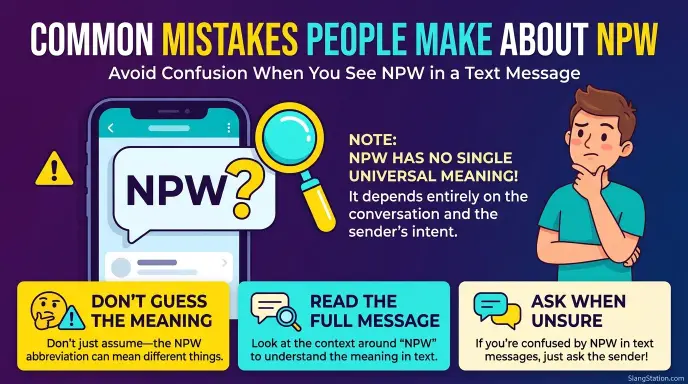
Even a simple abbreviation can cause confusion if people assume too much about it.
Thinking NPW Means Only “No Problem”
The standard expansion described in texting abbreviation references is “No Problem Whatsoever.” People may also use NP or simply write “No problem” to express a similar idea.
Assuming Everyone Knows It
NPW is not as familiar as many common texting shortcuts. A person may need the meaning explained, even if they use other abbreviations every day.
Using It in Every Situation
Abbreviations are useful in casual conversations, but they may look unclear or unprofessional in formal communication.
Misreading the Tone
NPW is generally reassuring, but a short message can still be interpreted differently depending on the conversation. Do not assume that punctuation alone proves someone is annoyed or happy.
Confusing It With Another Abbreviation
If the letters appear in a technical document or a specialized community, NPW may have a meaning unrelated to texting. Always consider the topic.
Frequently Asked Questions
What does NPW mean in text messages?
NPW usually stands for “No Problem Whatsoever.” It is an informal way to reassure someone that a request, favor, or small mistake is not a problem.
What does NPW mean on TikTok?
NPW can be used as “No Problem Whatsoever” in a casual message or comment. However, its meaning depends on the context, and not every TikTok user will recognize it.
Is NPW slang?
NPW is an informal initialism that can be treated as texting slang. It shortens the phrase “No Problem Whatsoever.”
Is NPW rude or offensive?
No, NPW is generally not rude or offensive. It usually communicates reassurance, although the tone depends on the situation and the rest of the message.
How should you reply to NPW?
You can reply with “Thanks!”, “I appreciate it,” or “You’re the best!” If the meaning is unclear, ask the sender what they mean.
Conclusion
NPW means “No Problem Whatsoever” in texting. People may use it to respond to thanks, accept a request, or reassure someone after a small mistake.
You might encounter it in casual chats or online conversations, but it is less widely recognized than abbreviations such as IDK and BRB. That is why context matters.
Use NPW with people who understand your texting style. For school, work, or messages where clarity is important, writing “No problem at all” is usually the better choice.
The main thing to remember is simple: NPW is a short, informal way to say that something is not a problem at all.
Discover More Articles!
What Does Mean in Text? Meaning, Uses & Examples(2026)
What Does “OBG” Mean in Text? Common Uses Explained
What Does NTR Mean in Text? Meaning & Examples

Hi, I’m Sophia Bennett, a novelist passionate about creating heartfelt stories filled with romance, emotion, and unforgettable characters. Through my books, I hope to inspire readers and take them on journeys they’ll always remember.