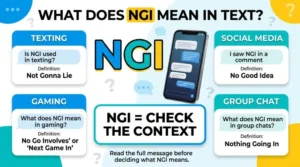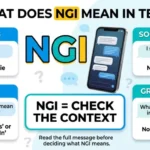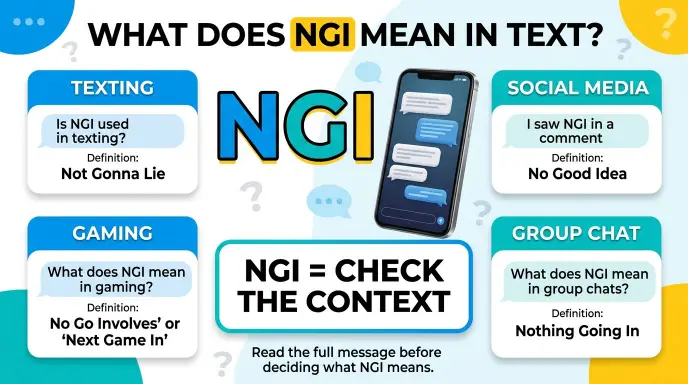
NGI in text does not have one widely recognized meaning across all texting and social media platforms. Its meaning may depend on the conversation, the people using it, or a specific online community. If someone sends you “NGI,” the surrounding message can help you understand what they mean.
You might see NGI in a text message, TikTok comment, Snapchat chat, Instagram DM, or WhatsApp conversation.
However, it is not as widely established as common texting abbreviations like IDK, IDC, and BRB.
People search for this abbreviation because they want to understand a message without guessing.
A short combination of letters can have a special meaning in one group but mean something different to another person.
In this guide, you will learn how to interpret NGI, where it may appear, how to reply, and how it compares with familiar texting shortcuts. You will also learn why context matters when an abbreviation has no single confirmed meaning.
What Does NGI Mean in Text?
NGI does not have one standard meaning in everyday texting. It may be a personal abbreviation, a term used by a particular online community, or shorthand for a phrase understood by the people in a conversation.
Unlike many popular internet abbreviations, NGI does not have one meaning that you can safely apply to every message. The sender’s words, the topic, and the situation all matter.
For example, imagine that a friend sends you “NGI” after you share a funny video. You might understand the message from the surrounding conversation, but the three letters alone may not explain what your friend means.
In that situation, it is better to ask than to assume.
Is NGI an Acronym or an Abbreviation?
NGI can be described as an abbreviation when someone uses it to shorten a longer expression. If its letters represent the first letters of several words, it may also function as an initialism or acronym, depending on how it is formed and pronounced.
However, the letters alone do not tell us which phrase the sender intends. There is not enough reliable evidence to assign NGI one universal expansion in casual texting.
This is an important difference between NGI and abbreviations such as IDK, which commonly means “I don’t know.”
What Does NGI Mean in Everyday Conversations?
In everyday chat, the intended meaning depends on the message. Some people create their own shortcuts with friends, while others use abbreviations they have learned from gaming communities, social media, or private group chats.
Consider these examples:
- Your friend sends “NGI” in a conversation about a video.
- Someone comments “NGI” beneath a post.
- A person uses the letters in a gaming chat.
- A classmate sends NGI without explaining what it stands for.
In each case, the conversation may provide clues, but the letters alone do not confirm the intended meaning.
If you received NGI in a real message, look at the words before and after it. If that still does not help, ask the sender what they mean.
Where Do People Use NGI?
People can type abbreviations anywhere they send messages or post comments. However, seeing an abbreviation on a platform does not mean it has a special, widely accepted meaning there.
Here is how to interpret NGI in different online spaces.
NGI on TikTok
TikTok users often use short expressions in comments, captions, and direct messages. A few letters can be part of a joke, a reaction, or a conversation that makes sense to a particular group.
If you see NGI under a TikTok video, check the video topic and nearby comments. Other users may provide clues about the intended meaning.
Still, do not assume that NGI has one official TikTok meaning. A creator or community may use it differently from other users.
NGI on Snapchat
Snapchat conversations are often casual and brief. Friends may use personal shortcuts, inside jokes, and abbreviations that outsiders do not immediately understand.
If someone sends NGI in a Snap or chat, read the earlier messages. The abbreviation may relate to something you were discussing.
For example, if you were talking about a school event, the message may have a different meaning from one sent during a gaming conversation. The topic is an important clue, but it does not prove what the letters stand for.
NGI on Instagram
On Instagram, you might come across NGI in a comment, a caption, a Story reply, or a direct message.
Before interpreting it, consider the context. Is the person responding to a photo, reacting to a joke, or discussing a specific subject?
If the letters appear in a public comment, other replies may help you understand them. However, a single comment is not enough to establish a universal slang meaning.
NGI on WhatsApp
WhatsApp is commonly used for private chats, family groups, class groups, and work conversations. These groups can develop their own abbreviations over time.
Someone may use NGI because their friends already understand it. Another person in the same group might not know what it means.
If the message appears in a family or school group, avoid guessing based on social media trends. Ask the sender for clarification if the meaning affects your response.
NGI in SMS Text Messages
Traditional SMS messages also contain shortened words and letter combinations. People may use them to save typing time or because they are familiar with a particular expression.
NGI can appear in an SMS, but that does not establish one standard definition. The sender’s habits and the message’s subject can help you interpret it.
If you are unsure, a simple reply such as “What does NGI mean?” is clear and polite.
Real Chat Examples Using NGI
The following conversations show realistic situations in which someone might encounter an unfamiliar abbreviation.
Because NGI has no single confirmed meaning in general texting, these examples focus on how to handle it rather than assigning it an invented definition.
Example One: Asking a Friend
A: Did you understand the last message?
B: Not really. It just said NGI.
A: Did you ask what it meant?
B: Not yet. I’ll ask now.
Example Two: A TikTok Comment
A: Someone commented NGI on my video.
B: Did anyone explain it?
A: No, that’s why I’m confused.
B: Check the replies or ask them what they mean.
Example Three: A Snapchat Chat
A: You sent NGI. What does that mean?
B: I meant something specific to our conversation.
A: Oh, I didn’t know that.
B: No worries. I should have explained it.
Example Four: A WhatsApp Group
A: What does NGI stand for?
B: I’m not sure either.
A: Then we shouldn’t guess.
B: Agreed. Let’s ask the person who sent it.
Example Five: Talking About a Game
A: Someone typed NGI in the game chat.
B: Was it during the match?
A: Yes, right after the round ended.
B: It could be community-specific. Check the game context.
Example Six: An Instagram DM
A: What did you mean by NGI?
B: Why, was it confusing?
A: A little. I’ve never seen it before.
B: Fair enough. I’ll explain what I meant.
Example Seven: A Classmate’s Message
A: Did you finish the assignment?
B: Yes, but I don’t understand your last text.
A: Which part?
B: The NGI part.
A: Let me explain it more clearly.
Example Eight: A Conversation With a New Friend
A: NGI 😂
B: I’m lost. What does that mean?
A: It’s a shortcut I use with my friends.
B: Got it. I hadn’t come across it before.
Example Nine: A Public Comment
A: Why are people writing NGI in the comments?
B: It might be an abbreviation used by that group.
A: So it doesn’t have one meaning everywhere?
B: Right. The context matters.
Example Ten: Clearing Up a Misunderstanding
A: I thought your message meant something else.
B: Sorry, I didn’t mean to confuse you.
A: It’s okay. What did NGI mean here?
B: I was using it in a way my friends understand.
A: Thanks for explaining.
These examples show an important point: the best response depends on what the sender intended. Do not treat a guess as a confirmed definition.
How to Reply When Someone Says NGI
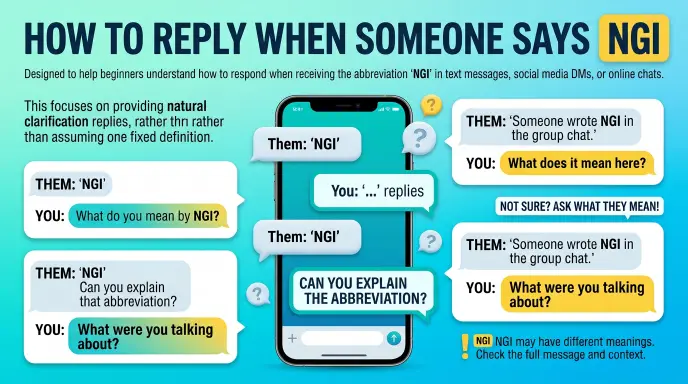
If someone sends NGI and you do not understand it, you can reply in several ways. Choose a response that fits your relationship with the sender and the tone of the conversation.
Funny Replies
Use a playful response if you are chatting with a friend and the conversation is relaxed.
- “My slang dictionary needs an update 😂”
- “You can’t just drop three letters and disappear!”
- “Wait, did I miss a new internet trend?”
- “Please translate that for me 😭”
These replies keep things light without pretending you know the meaning.
Casual Replies
Casual replies work well in everyday conversations.
- “What does NGI mean?”
- “What do you mean by NGI?”
- “I’ve never seen that abbreviation before.”
- “Can you explain that one?”
They are simple, direct, and easy to understand.
Friendly Replies
If you want to sound warm and interested, try one of these:
- “Hey, what does NGI stand for?”
- “I haven’t heard that one before. Can you explain?”
- “Teach me that abbreviation!”
- “I want to make sure I understand you correctly.”
These responses show that you want to understand the person rather than judge their wording.
Neutral Replies
For a conversation with a classmate, coworker, or someone you do not know well, keep your response clear and polite.
- “Could you clarify what NGI means?”
- “I’m not familiar with that abbreviation.”
- “Can you write that out in full?”
- “I’m unsure what you mean. Could you explain?”
A neutral question is often the best choice when the conversation is serious or professional.
Is NGI Rude or Offensive?
NGI is not inherently rude or offensive based on the letters alone. Since it has no single, widely established meaning in casual texting, you cannot judge the tone without knowing how the sender is using it.
The surrounding message matters. A harmless abbreviation can appear in a friendly conversation, while a message containing almost any set of letters can sound rude if the person uses it to insult someone.
Is NGI Safe to Use With Friends?
You can use an abbreviation when you and your friends understand what it means. However, if the other person does not recognize NGI, your message may confuse them.
If you are introducing a new shortcut, explain it first. Clear communication is usually better than expecting everyone to know the same internet slang.
Can You Use NGI at School or Work?
It is better to avoid unexplained abbreviations in school assignments, formal emails, workplace messages, and other professional communication.
Teachers, coworkers, and managers may not recognize NGI. In those settings, write your meaning in full unless the abbreviation is clearly established in your group.
This advice is not specific to NGI. It applies to unfamiliar internet slang in general.
Who Uses NGI?
There is not enough reliable public evidence to identify one age group that uses NGI most often. It would be misleading to claim that it belongs mainly to teenagers, Gen Z, or any other particular group.
People of different ages use abbreviations in digital conversations. Their habits often depend on the platforms they use, their interests, and the people they communicate with.
Do Gen Z Users Say NGI?
Gen Z users often communicate through messaging apps, social media, and online communities. These spaces encourage short messages and informal language.
However, that general trend does not prove that NGI is a common Gen Z expression. Without reliable evidence, it is more accurate to treat its popularity as uncertain.
Is NGI Common on Social Media?
NGI may appear in individual posts, comments, and chats, but there is no reliable basis here to describe it as a widely used abbreviation across major platforms.
This is different from familiar shortcuts such as IDK and BRB, which have well-established meanings in everyday digital communication.
If you saw NGI repeatedly in one group, it may be popular within that community without being common across the internet.
Origin of NGI
The exact origin of NGI as a general texting expression is unclear. There is no single established origin that can confidently explain how it entered everyday internet slang or what it originally stood for.
People have used abbreviations in digital communication for decades. Text messages, online forums, multiplayer games, chat rooms, and social media have all encouraged shorter ways to communicate.
Some abbreviations become widely understood because many people use them in the same way. Others remain limited to a particular group or conversation.
NGI may be encountered as a local or community-specific abbreviation, but that possibility does not establish its origin.
Without reliable historical evidence, it would be misleading to name a specific creator, date, or platform as its source.
The safest conclusion is that the origin and intended expansion of NGI in general texting remain uncertain.
NGI vs. Other Texting Abbreviations
NGI differs from common texting shortcuts because its meaning is not clearly established across everyday digital communication. The table below compares it with four familiar abbreviations.
| Abbreviation | Meaning | Type | Usage | Popularity |
| NGI | No single widely established texting meaning | Context-dependent abbreviation | May appear in specific chats or communities | Uncertain |
| IDK | I don’t know | Initialism | Used when someone does not know an answer | Common |
| IDC | I don’t care | Initialism | Used to express a lack of concern or interest | Common |
| IMO | In my opinion | Initialism | Used to introduce a personal view | Common |
| BRB | Be right back | Initialism | Used when someone will leave briefly and return | Common |
The key difference is that IDK, IDC, IMO, and BRB have familiar meanings that many people recognize. NGI does not have the same level of established meaning in general texting.
Remember that tone still matters. For example, IDC can sound dismissive in some conversations, even though its meaning is well known. Likewise, the tone of a message containing NGI depends on how the sender uses it.
A Real-World Situation Where NGI Might Appear
Imagine that you are in a WhatsApp group with classmates. One person sends a short message containing NGI while everyone is discussing an upcoming school event.
You have never seen the abbreviation before. One classmate guesses what it means, while another says it could mean something different.
Instead of repeating the guess, you ask the person who sent the message to explain. They clarify what they intended, and the conversation continues without confusion.
This is a useful way to handle unfamiliar slang in real life. It prevents misunderstandings and reminds everyone that not all abbreviations have universal meanings.
The same approach works on TikTok, Instagram, Snapchat, Discord, and SMS. Check the surrounding conversation first, then ask for clarification if needed.
Frequently Asked Questions
What does NGI mean in text messages?
NGI does not have one widely recognized meaning in everyday texting. Its intended meaning may depend on the sender, the conversation, or a specific online community.
What does NGI mean on TikTok?
There is no single confirmed meaning for NGI across TikTok. Check the video’s topic, caption, and replies for clues about how the abbreviation is being used.
Is NGI slang?
NGI may be used as slang or as a context-specific abbreviation, but it is not a widely established texting term with one confirmed definition.
Is NGI rude or offensive?
Not necessarily. The letters alone do not establish if a message is rude. Read the full conversation and consider the sender’s intended meaning.
How should you reply to NGI?
If you do not understand it, ask, “What does NGI mean?” You can also say, “Can you explain that abbreviation?” This avoids guessing and keeps the conversation clear.
Conclusion
NGI does not have one widely accepted meaning in text messages, so context is essential. You may encounter it in TikTok comments, Snapchat chats, Instagram DMs, WhatsApp groups, or SMS conversations, but the platform alone will not tell you what it means.
Unlike common abbreviations such as IDK, IDC, IMO, and BRB, NGI has no single established meaning that you can confidently apply to every message.
If someone sends you NGI, check the surrounding conversation and ask for clarification if needed.
Avoid using it in formal or professional communication unless everyone understands it. When in doubt, clear words are always better than a confusing abbreviation.
Discover More Articles!
What Does Mean in Text? Emoji Meaning & Uses(2026)
What Does Mean in Text? Emoji Meaning & Uses
What Does NDS Mean in Text? Meaning & Examples.2026

Hi, I’m Sophia Bennett, a novelist passionate about creating heartfelt stories filled with romance, emotion, and unforgettable characters. Through my books, I hope to inspire readers and take them on journeys they’ll always remember.