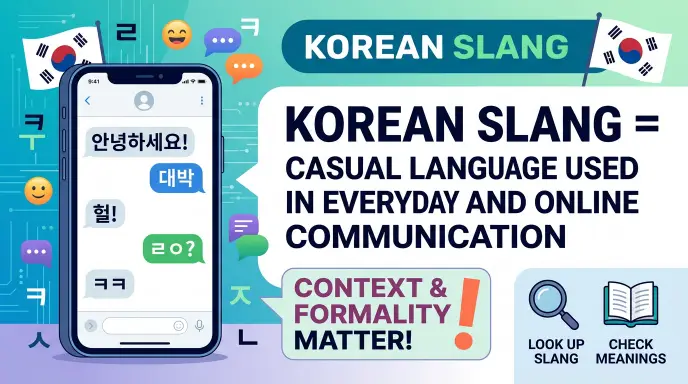
Korean slang is informal Korean language used by friends, younger speakers, online communities, gamers, and social media users.
Common examples include 대박 (daebak), 헐 (heol), 짱 (jjang), 노잼 (nojaem), 꿀잼 (kkuljaem), 인정 (injeong), and 현타 (hyeonta).
You may hear Korean slang in K dramas, K pop content, YouTube videos, gaming chats, KakaoTalk messages, TikTok comments, and everyday conversations. Some terms are playful, while others can sound rude or too casual for formal situations.
Korean slang also changes quickly. Internet communities create new expressions, shorten existing words, and combine Korean and English words.
As a result, a phrase that sounds natural among friends may not be suitable when speaking to a teacher, boss, stranger, or older person.
This guide explains common Korean slang, what the words mean, how people use them, and which expressions you should use carefully.
What Is Korean Slang? Quick Answer
| Korean slang | Romanization | Common meaning |
| 대박 | daebak | Amazing, awesome, unbelievable |
| 헐 | heol | OMG, no way |
| 짱 | jjang | The best, awesome |
| 노잼 | nojaem | Not fun, boring |
| 꿀잼 | kkuljaem | Very fun, entertaining |
| 인정 | injeong | Agreed, true, I agree |
| 현타 | hyeonta | Reality check, sudden disappointment |
| 갑분싸 | gapbunssa | Suddenly awkward atmosphere |
| 웃프다 | utpeuda | Funny but sad |
| 열받다 | yeolbatda | To be angry, annoyed |
| 빡치다 | ppakchida | To be very angry |
| 존맛 | jonmat | Extremely delicious |
| 핵꿀잼 | haekkkuljaem | Extremely fun |
| 셀카 | selka | Selfie |
| 먹방 | meokbang | Eating broadcast/video |
| 덕질 | deokjil | Being deeply involved in a fandom |
These expressions are common examples, but Korean slang varies by age, community, platform, and context.
대박 (Daebak) Meaning
대박 (daebak) is one of the best known Korean slang expressions. It can mean amazing, awesome, incredible, or unbelievable.
For example:
대박!
Daebak!
This can mean:
“Wow!” or “That’s amazing!”
People may use daebak when something surprising, impressive, exciting, or unexpected happens.
Although many learners first encounter it through K dramas and K pop, Korean speakers also use it in casual everyday speech.
헐 (Heol) Meaning
헐 (heol) is a casual reaction similar to “OMG,” “no way,” or “what?”
For example:
헐, 진짜?
Heol, jinjja?
This can mean:
“OMG, really?”
The expression can show surprise, disbelief, shock, or disappointment.
It is very informal, so it is mainly used in casual speech, texting, and online conversations.
짱 (Jjang) Meaning
짱 (jjang) means something like the best, awesome, or excellent.
For example:
너 짱이야!
Neo jjangiya!
This can mean:
“You’re the best!”
You may also see 짱 combined with other words or used in online slang.
It is casual and expressive rather than formal Korean.
노잼 (Nojaem) Meaning
노잼 (nojaem) means not fun, boring, or uninteresting.
It combines 노 (no) with 잼 (jaem), which comes from 재미 (jaemi), meaning fun or enjoyment.
For example:
이 영화 노잼이야.
I yeonghwa nojaemiya.
This means:
“This movie is boring.”
The word is especially common in casual online language.
꿀잼 (Kkuljaem) Meaning
꿀잼 (kkuljaem) means very fun, highly entertaining, or extremely enjoyable.
The word combines 꿀 (kkul), meaning honey, with 잼, from 재미.
The idea is that something is “sweet” or especially enjoyable.
For example:
이 게임 꿀잼이야.
This means:
“This game is so much fun.”
It is a playful internet expression.
인정 (Injeong) Meaning
인정 (injeong) literally relates to acknowledgment or recognition, but in casual slang it can mean “I agree,” “true,” or “you’re right.”
For example:
인정.
This can simply mean:
“True.”
or:
“I agree.”
You may see it often in online comments and casual conversations.
현타 (Hyeonta) Meaning
현타 (hyeonta) is short for 현실 자각 타임, which roughly means “reality realization time.”
In casual use, it describes the feeling of suddenly returning to reality, often after excitement, fantasy, overthinking, or an intense experience.
For example, someone may spend hours watching videos and then suddenly think:
“Why did I spend my whole night doing this?”
That sudden feeling can be described as 현타.
It is common in Korean internet culture.
갑분싸 (Gapbunssa) Meaning
갑분싸 (gapbunssa) is short for 갑자기 분위기 싸해짐, meaning the atmosphere suddenly became awkward or cold.
It is used when a conversation or social situation suddenly becomes uncomfortable.
For example, someone makes a joke, nobody laughs, and the room becomes quiet.
Someone might describe that moment as:
갑분싸
It is an internet style abbreviation and is mainly casual.
웃프다 (Utpeuda) Meaning
웃프다 (utpeuda) describes something that is funny and sad at the same time.
It combines ideas from:
- 웃다 : to laugh
- 슬프다 : to be sad
For example, a situation may be so unfortunate that you cannot help laughing.
That can be described as 웃프다.
English does not have one perfect everyday equivalent, although “funny but sad” gives the basic idea.
열받다 (Yeolbatda) Meaning
열받다 (yeolbatda) means to get angry, annoyed, or irritated.
For example:
나 진짜 열받아.
This means:
“I’m really angry.”
It is casual and emotional.
You may hear it in conversations, dramas, online comments, and entertainment content.
빡치다 (Ppakchida) Meaning
빡치다 (ppakchida) is a stronger and more vulgar sounding way to say that someone is very angry or pissed off.
For example:
진짜 빡쳐.
This means something like:
“I’m really pissed off.”
Because it is more aggressive than neutral expressions for being annoyed, learners should use it carefully.
존맛 (Jonmat) Meaning
존맛 (jonmat) is slang used to say that food is extremely delicious.
It comes from 존나 and 맛있다, with the first part functioning as an intensifier that can be vulgar.
Because of that, it is not appropriate for every situation.
Friends may use it casually online, but learners should avoid using it in formal settings.
핵꿀잼 (Haekkkuljaem) Meaning
핵꿀잼 (haekkkuljaem) is an intensified form of 꿀잼.
It means something is extremely fun or entertaining.
The prefix 핵 is used in slang as an intensifier, giving the word a stronger feeling.
For example:
이 드라마 핵꿀잼!
This means:
“This drama is wildly fun!”
It is highly casual.
셀카 (Selka) Meaning
셀카 (selka) is a common shortened word for selfie.
It comes from 셀프 카메라, meaning “self camera.”
For example:
셀카 찍었어?
This means:
“Did you take a selfie?”
Unlike some stronger slang terms, 셀카 is widely understood and commonly used in casual Korean.
먹방 (Meokbang) Meaning
먹방 (meokbang) means a video or broadcast centered around someone eating food.
The word comes from:
- 먹다 : to eat
- 방송 : broadcast
The concept became internationally known through Korean online culture and platforms such as YouTube.
You may see 먹방 used in discussions about food creators, livestreams, restaurants, and Korean internet culture.
덕질 (Deokjil) Meaning
덕질 (deokjil) describes actively enjoying or supporting something as a dedicated fan.
It can involve:
- K pop groups
- Korean actors
- anime
- games
- movies
- books
- other fandoms
For example:
나 요즘 BTS 덕질해.
This means roughly:
“I’ve been really into BTS lately.”
The word comes from 덕후, a Korean term connected with being an enthusiastic fan or enthusiast.
Korean Slang in Texting
Korean texting uses many shortened expressions.
People often shorten phrases to make messages faster, funnier, or more expressive.
Some common examples include:
- ㅋㅋㅋ : laughter, similar to “lol”
- ㅎㅎ : a soft laugh or chuckle
- ㄷㄷ : expressing shock or amazement
- ㅇㅇ : yes / yeah
- ㄴㄴ : no / nope
- ㅂㅂ : bye
- ㄱㄱ : go, let’s go, or “go for it”
These expressions are highly informal.
The exact tone can change depending on how many repeated characters someone uses and the situation.
What Does ㅋㅋ Mean in Korean Slang?
ㅋㅋ represents laughter in Korean online communication.
It is similar to “lol” or “haha.”
For example:
진짜 웃겨 ㅋㅋ
This means:
“That’s really funny lol.”
More repeated ㅋ characters can make the laughter look stronger or more playful.
For example:
ㅋㅋㅋㅋㅋㅋ
is a stronger written laugh than simply:
ㅋ
What Does ㅎㅎ Mean?
ㅎㅎ is another way to represent laughter or a soft chuckle.
It can sound gentler than a long string of ㅋㅋㅋ.
For example:
알겠어 ㅎㅎ
can have a friendly tone similar to:
“Okay, haha.”
The exact feeling depends on the conversation.
Korean Slang on TikTok
Korean slang appears frequently in TikTok captions, comments, videos, and fan communities.
You may encounter:
- 대박
- 헐
- ㅋㅋ
- ㅎㅎ
- 꿀잼
- 노잼
- 인정
- 현타
- 먹방
- 덕질
Korean entertainment has also introduced many Korean expressions to international audiences.
However, seeing a Korean slang word in a K pop video does not mean every Korean speaker uses it in exactly the same way.
Korean Slang on Instagram
Instagram users may use Korean slang in captions, comments, stories, and direct messages.
For example:
대박 ㅋㅋ
could express something like:
“Wow, that’s amazing lol.”
Fans may also mix Korean slang with English words, emojis, and shortened expressions.
This type of mixed language is especially common in online communities.
Korean Slang on KakaoTalk
KakaoTalk is widely used for messaging in South Korea, so casual Korean texting expressions are common there.
You may see:
- ㅋㅋ
- ㅎㅎ
- ㅇㅇ
- ㄴㄴ
- ㄱㄱ
- ㅂㅂ
- 헐
- 대박
These expressions make messages short and conversational.
Still, Korean speakers normally adjust their language depending on who they are talking to.
Korean Slang in K Dramas
K dramas often use casual Korean expressions because characters speak differently with friends, family members, coworkers, strangers, and romantic partners.
Words such as 대박, 헐, 짱, 열받다, and ㅋㅋ may appear in casual situations.
However, subtitles do not always translate slang word for word.
A Korean expression may be translated into natural English rather than its exact literal meaning.
Korean Slang in K Pop
K pop fans encounter Korean slang through songs, livestreams, fan chats, interviews, and social media.
Expressions such as 대박, 헐, ㅋㅋ, 덕질, and 인정 can appear in fan communities.
Some terms become popular internationally because fans repeat them online.
Still, fans should understand the level of formality before using Korean slang with native speakers.
Is Korean Slang Rude?
Some Korean slang is harmless, while other expressions can be rude or vulgar.
For example:
- ㅋㅋ : generally casual laughter
- 대박 : casual and widely understood
- 헐 : informal reaction
- 인정 : casual agreement
- 빡치다 : stronger and more vulgar
- 존맛 : contains vulgar slang
- 욕설 : Korean swear words can be much stronger and should be used carefully
If you are learning Korean, start with expressions that are easy to understand and less offensive.
Korean Slang vs. Formal Korean
Korean has important levels of politeness.
This means the same basic idea can be expressed differently depending on the person you are talking to.
A close friend may accept very casual slang.
A teacher, boss, customer, stranger, or older person may expect more respectful language.
For beginners, this distinction is especially important.
Knowing what a slang word means does not automatically mean you should use it with everyone.
Common Mistakes When Using Korean Slang
Using Slang With Everyone
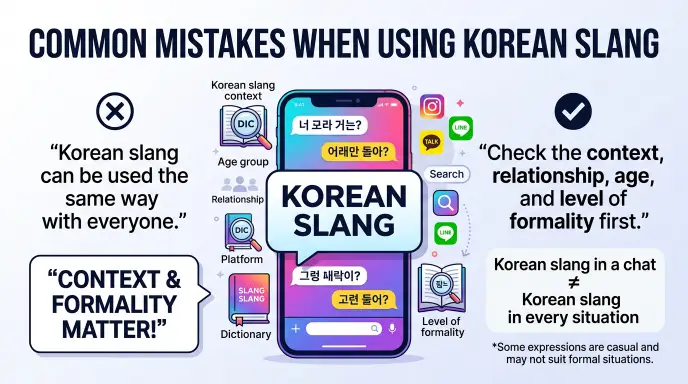
Korean speakers change their language based on age, status, relationship, and situation.
Do not assume slang works in every conversation.
Copying K Drama Dialogue
Drama dialogue is written for entertainment. Real conversations can be different.
A phrase that sounds natural in a drama may sound strange if copied without understanding the situation.
Translating Every Word Literally
Korean slang often does not have a perfect word for word English translation.
Focus on the meaning and tone instead.
Ignoring Formality
Some slang is extremely casual.
Using it with a teacher, boss, or stranger can sound disrespectful.
Assuming Every Korean Person Uses Internet Slang
Slang varies by age, region, profession, platform, and social group.
Not everyone uses the same expressions.
How to Learn Korean Slang Safely
Start by learning the meaning and level of formality together.
For every slang word, ask:
- What does it mean?
- Is it casual or formal?
- Is it rude or vulgar?
- Who normally uses it?
- Where is it commonly seen?
- Does it have another meaning?
This approach helps you understand Korean conversations without accidentally using a phrase in the wrong situation.
Key Takeaways About korean slang
- Korean slang is informal Korean used in casual speech and online communication.
- 대박 (daebak) means amazing or unbelievable.
- 헐 (heol) expresses surprise or disbelief.
- 짱 (jjang) means awesome or the best.
- 노잼 (nojaem) means boring or not fun.
- 꿀잼 (kkuljaem) means very fun or entertaining.
- 인정 (injeong) can mean “true” or “I agree.”
- 현타 (hyeonta) describes a sudden reality check.
- ㅋㅋ represents laughter in Korean texting.
- 먹방 (meokbang) means an eating broadcast or video.
- Some Korean slang is vulgar, so context and formality matter.
- Korean slang changes quickly, especially online.
Frequently Asked Questions
What does “gaja gaja gaja” mean in Korean?
“Gaja gaja gaja” (가자 가자 가자) means “Let’s go, let’s go, let’s go!” in Korean. 가자 (gaja) is a casual form of 가다 (gada), meaning “to go.” Repeating it adds excitement, encouragement, or urgency.
What is Gen Z in Korean?
Gen Z in Korean is commonly called Z세대 (Z sedae), which literally means “Generation Z.” 세대 (sedae) means “generation.”
You may also see 젠지 (jenji), a Korean transliteration of “Gen Z,” especially in casual or online contexts.
What does ~~~ mean in Korean?
In Korean texting, ~~~ usually adds a soft, playful, cute, or drawn-out feeling to a sentence. It can make a message sound more relaxed or friendly. For example, 고마워~~~ means “Thank you~~~” with a warmer or more playful tone.
What does kiyo mean in Korean?
“Kiyo” is often a romanized spelling of 귀여워 (gwiyeowo), which means “cute” or “you’re cute.” However, “kiyo” is not the standard romanization.
Korean speakers may also write 귀여워 in English letters as “gwiyeowo,” “gwiyeowo,” or similar informal spellings.
What are Korean slang text words?
Common Korean slang used in texts and online chats includes ㅋㅋㅋ (ㅋㅋㅋ) for laughter, ㅎㅎ (ㅎㅎ) for a soft laugh, ㅇㅇ for “yes/yeah,” ㄴㄴ for “no/nope,” ㄱㄱ for “go/go for it,” and 대박 (daebak) for “awesome” or “wow.” Korean texting slang often uses shortened words, initials, and consonants.
What are Korean slang curse words?
Common Korean slang curse words include 씨발 (ssibal), a strong swear word similar to “fuck,” and 존나 (jonna), a vulgar intensifier meaning “really” or “extremely.” 개새끼 (gaesaekki) is a strong insult roughly meaning “son of a bitch” or “bastard.”
These expressions can be offensive, so they should not be used casually with strangers or in formal settings.
What are common Korean slang words?
Common Korean slang words include 대박 (daebak) for “awesome” or “amazing,” 헐 (heol) for “OMG” or “wow,” 짱 (jjang) for “the best,” 노잼 (nojaem) for “not fun,” 꿀잼 (kkuljaem) for “really fun,” and 현타 (hyeonta) for a sudden feeling of disappointment or reality hitting you. Meanings can change with context and online trends.
What are Korean slang words in English?
Korean slang words can be written in English letters through romanization. Examples include daebak (“awesome”), aigo (“oh dear”), heol (“OMG/wow”), jjang (“the best”), nojaem (“not fun”), and kkuljaem (“very fun”).
Korean speakers may use different English spellings because informal romanization is not always standardized.
What is Korean slang on Reddit?
On Reddit, Korean slang may appear in Korean characters, English romanization, or both. Common examples include ㅋㅋㅋ (ㅋㅋㅋ) for laughter, 대박 (daebak) for “awesome,” 헐 (heol) for “wow,” and ㅇㅇ for “yeah.”
The meaning can depend on the subreddit, conversation, and if the speaker is Korean or a learner of Korean.
Conclusion
Korean slang is a large and changing part of casual Korean communication, especially in texting, social media, K pop communities, K dramas, gaming, and online culture. Expressions such as 대박, 헐, 짱, 노잼, 꿀잼, 인정, and 현타 each have their own tone and use.
The most important thing for learners is context. Korean speakers do not use the same language with everyone. Age, relationship, social setting, and politeness all affect which words sound natural.
If you are learning Korean through K dramas, K pop, TikTok, or KakaoTalk, understanding slang can make conversations much easier to follow.
Just remember that knowing a slang word is different from knowing when it is appropriate to use it.
Discover More Articles!
Huzz Slang Meaning: What Does Huzz Mean in Slang?(2026)
Weed Slang: Common Slang Words for Weed and Cannabis.
Dip Meaning Slang: What Does Dip Mean in Slang?(2026)

Hi, I’m Sophia Bennett, a novelist passionate about creating heartfelt stories filled with romance, emotion, and unforgettable characters. Through my books, I hope to inspire readers and take them on journeys they’ll always remember.