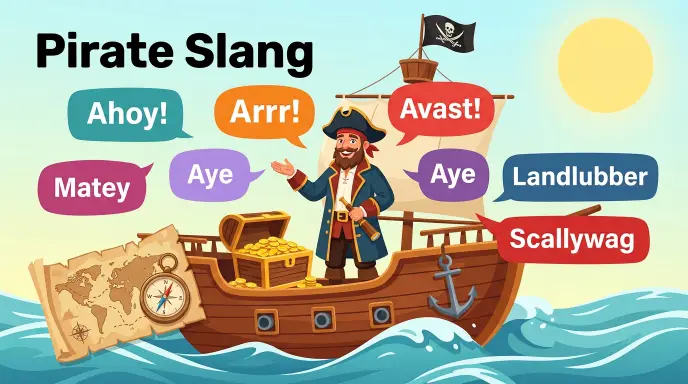
Pirate slang is a group of words, expressions, and nautical terms linked with pirates, sailors, ships, treasure, and life at sea.
Pirate slang is popular because movies, books, games, and Halloween costumes have created a fun and dramatic way to talk like a pirate.
Words such as “ahoy,” “matey,” “avast,” “landlubber,” and “scallywag” are now widely recognized, even by people who have never been at sea.
What Does Pirate Slang Mean? Quick Answer
Pirate slang refers to words and phrases associated with pirates and sailors. Common examples include “Ahoy!” for a greeting, “matey” for a friend, “avast!” for “stop” or “pay attention,” and “landlubber” for someone inexperienced at sea. Many popular pirate expressions come from nautical language and later pop culture.
Quick Answer Table
| Pirate Slang | Meaning |
| Ahoy! | Hello or a call for attention |
| Arrr! | A pirate style expression of emotion or agreement |
| Matey | Friend or companion |
| Avast! | Stop, wait, or pay attention |
| Aye | Yes |
| Landlubber | A person who is not used to life at sea |
| Scallywag | A rascal or mischievous person |
| Buccaneer | A pirate or sea raider |
| Booty | Stolen treasure or valuables |
| Plunder | Loot taken by force |
| Grog | A sailor’s alcoholic drink |
| Bilge rat | A pirate style insult |
| Hornswoggle | To trick or deceive |
| Shiver me timbers! | An expression of surprise |
| Jolly Roger | The pirate flag with a skull and crossbones |
Popular Pirate Slang Words
Pirate language can sound strange at first. However, many terms have simple meanings.
Ahoy
Ahoy is a traditional nautical greeting or call used to attract someone’s attention.
A pirate might say:
“Ahoy, matey!”
In modern speech, people often use “ahoy” in a playful pirate voice.
Arrr
Arrr is one of the most famous sounds connected with pirates.
It can show agreement, excitement, frustration, or confidence. However, there is an important detail: the strong association between “arrr” and pirates comes largely from popular culture rather than evidence that every historical pirate regularly spoke this way.
You may hear:
“Arrr, we found the treasure!”
Today, “arrr” is mostly a fun way to imitate a fictional pirate.
Matey
Matey means a friend, companion, or fellow sailor.
It comes from mate, a word used for a companion or shipmate.
Example:
“Come aboard, matey!”
The word is still common in pirate themed jokes and costumes.
Avast
Avast is a nautical command meaning to stop or hold on. It can also mean to pay attention.
Example:
“Avast! There’s a ship ahead!”
This word has a stronger historical connection to nautical speech than many modern pirate catchphrases.
Aye
Aye means yes.
Sailors used nautical commands such as “aye, aye” to show that they understood and would follow an order.
Example:
“Aye, captain!”
This phrase remains popular in pirate movies and sailor themed entertainment.
Landlubber
A landlubber is someone who is not accustomed to the sea.
The word can also be used humorously for someone who prefers staying on land.
Example:
“That landlubber gets seasick every time!”
Scallywag
A scallywag is a rascal, troublemaker, or mischievous person.
It is often used as a light insult.
Example:
“You little scallywag!”
The word sounds pirate like today, although its historical use is broader than pirate speech.
Buccaneer
A buccaneer was historically a type of sea raider, especially one associated with the Caribbean.
Today, the word can simply mean a pirate or adventurous sea raider.
It also appears in fictional stories, sports names, games, and other forms of popular culture.
Booty
In pirate stories, booty means treasure or valuable goods taken during a raid.
Example:
“The crew carried the booty back to the ship.”
In modern English, “booty” also has other meanings, including an informal reference to a person’s buttocks. Context matters.
Plunder
Plunder means goods or valuables taken by force, especially during a raid or attack.
Example:
“The pirates divided the plunder.”
Unlike some playful pirate terms, plunder remains a normal English word today.
Pirate Phrases You Hear in Movies
Movies and television have shaped how many people imagine pirate speech.
Shiver Me Timbers!
“Shiver me timbers!” is a famous pirate style expression of surprise or shock.
It sounds old fashioned and dramatic.
Example:
“Shiver me timbers! That’s a huge treasure chest!”
The phrase is strongly associated with fictional pirate speech today.
Yo Ho Ho!
“Yo ho ho” is a traditional sounding sailor or pirate cry.
It is especially famous because of pirate songs and stories.
You might hear:
“Yo ho ho, and off we go!”
Modern speakers usually use it for fun rather than ordinary conversation.
Walk the Plank
To walk the plank means to be forced to walk along a wooden plank and fall into the sea.
It is one of the best known pirate story ideas.
Example:
“The pirate captain threatened the prisoner with the plank.”
There is a major historical caution here: the idea is much more common in pirate fiction than many people assume.
Davy Jones’ Locker
Davy Jones’ Locker is a nautical expression for the bottom of the sea or a watery grave.
In stories, it is often linked to sailors who die at sea.
Example:
“The ship disappeared beneath the waves and sank to Davy Jones’ Locker.”
Bilge Rat
A bilge rat is a humorous pirate style insult.
The bilge is the lowest part of a ship where water and waste can collect. Calling someone a “bilge rat” compares them to a rat living in this dirty area.
Example:
“Get off my ship, you bilge rat!”
Hornswoggle
Hornswoggle means to trick, cheat, or deceive someone.
Example:
“That merchant tried to hornswoggle the pirate crew.”
The word is old informal English and is now often used in a humorous way.
Pirate Slang for Treasure
Treasure is one of the biggest themes in pirate stories. As a result, several pirate related words describe valuable goods.
Treasure
Treasure means valuable objects, money, jewels, or other precious items.
Example:
“The crew searched the island for buried treasure.”
Booty
As mentioned above, booty refers to valuable goods taken during a raid.
Example:
“The captain hid the booty in a secret cave.”
Plunder
Plunder refers to valuables taken through force or during a raid.
Example:
“The pirates returned to their ship with their plunder.”
Doubloons
Doubloons are historical gold coins strongly associated with Spanish treasure and pirate stories.
Today, the word often appears in fictional pirate settings.
Example:
“The treasure chest was filled with gold doubloons.”
Pirate Slang for People
Pirate stories use colorful names for different people.
Mate
A mate is a companion or fellow sailor.
Example:
“My mate is waiting on the deck.”
Matey
Matey is a playful pirate style form of “mate.”
Example:
“Good work, matey!”
Landlubber
A landlubber is someone who is unfamiliar with the sea.
Example:
“That landlubber has never sailed before.”
Scallywag
A scallywag is a rascal or troublemaker.
Example:
“That scallywag stole my hat!”
Bilge Rat
A bilge rat is a humorous insult that fits the fictional pirate style.
Example:
“You sneaky bilge rat!”
Pirate Slang for Ships and the Sea
Pirate speech also includes many real nautical terms.
Deck
The deck is the floor or surface of a ship.
Example:
“Meet me on the deck.”
Crew
The crew is the group of people who work on a ship.
Example:
“The captain called the crew together.”
Captain
The captain is the person in command of a ship.
Example:
“The captain gave the crew an order.”
Port
Port refers to the left side of a ship when facing forward.
Example:
“Move toward the port side.”
Starboard
Starboard refers to the right side of a ship when facing forward.
Example:
“The island is on the starboard side.”
Bow
The bow is the front of a ship.
Stern
The stern is the back of a ship.
These are nautical terms rather than pirate slang alone, but they help create authentic sea themed language.
Pirate Slang for Food and Drinks
Grog
Grog is a drink historically associated with sailors. It traditionally involved rum mixed with water, although recipes and historical details varied.
Today, “grog” often appears in pirate themed stories and jokes.
Example:
“The sailors gathered for a cup of grog.”
Galley
A ship’s galley is the area used for cooking.
Example:
“The cook is working in the galley.”
Pirate Slang Insults
Pirate stories often use playful insults instead of serious modern insults.
Common examples include:
- Landlubber : inexperienced person at sea
- Scallywag : rascal or troublemaker
- Bilge rat : dirty or unpleasant person
- Barnacle : a humorous name for someone who will not leave
- Sea dog : an experienced sailor
- Rapscallion : mischievous person
These words are usually playful in modern pirate themed speech.
How to Talk Like a Pirate
If you want to sound like a fictional pirate, you do not need to use difficult words.
Try combining a few familiar expressions:
“Ahoy, matey! Avast! There’s treasure ahead!”
Or:
“Aye, captain! We’ll bring the booty aboard.”
Another example:
“Shiver me timbers! That landlubber found the treasure!”
The key is the tone. Pirate speech in modern entertainment often sounds exaggerated, dramatic, and playful.
Is Pirate Slang Historically Accurate?
Not always.
This is one of the most important things to understand about pirate slang.
Many expressions that people now consider classic pirate language became popular through literature, theater, movies, television, cartoons, games, and themed entertainment.
Historical pirates did use nautical language. However, they did not necessarily speak exactly like the pirates in modern movies.
For example, “arrr” is strongly linked to pirate speech today, but its famous pirate image is largely a product of later popular culture.
Likewise, “walk the plank” is a famous pirate story idea, but it should not be treated as a routine practice used by all historical pirates.
Therefore, it is better to separate historical nautical vocabulary from fictional pirate speech.
Pirate Slang vs. Sailor Slang
Pirate slang and sailor slang overlap because pirates spent their lives at sea.
However, they are not exactly the same.
Sailor slang can include practical words used for navigation, ships, weather, commands, and daily life at sea.
Pirate slang often adds dramatic expressions about treasure, raids, captains, enemies, and adventure.
For example:
- “Port” is nautical terminology.
- “Starboard” is nautical terminology.
- “Ahoy” is a nautical greeting.
- “Scallywag” has a broader historical meaning.
- “Walk the plank” is strongly associated with fictional pirates.
So, a pirate character may use real nautical terms alongside exaggerated fictional expressions.
Pirate Slang in Modern Social Media
People still use pirate slang online, but usually as a joke or character voice.
You may see words such as “ahoy,” “matey,” “arrr,” and “scallywag” in:
- Memes
- TikTok captions
- Gaming chats
- Discord communities
- Halloween posts
- Pirate themed games
- Role playing communities
- Funny comments
- Social media usernames
For example:
“Ahoy, matey! Who’s ready for the weekend?”
This does not mean the speaker is actually talking like a historical pirate. It simply creates a playful tone.
Pirate Slang in Gaming
Pirate language is especially common in video games.
Games with ships, exploration, treasure hunting, or fantasy worlds often use nautical words to make the setting feel more immersive.
A player might write:
“Avast! Enemy ship on the starboard side!”
Or:
“Let’s find the booty!”
In gaming communities, these phrases can become part of role play and friendly jokes.
Common Mistakes When Using Pirate Slang
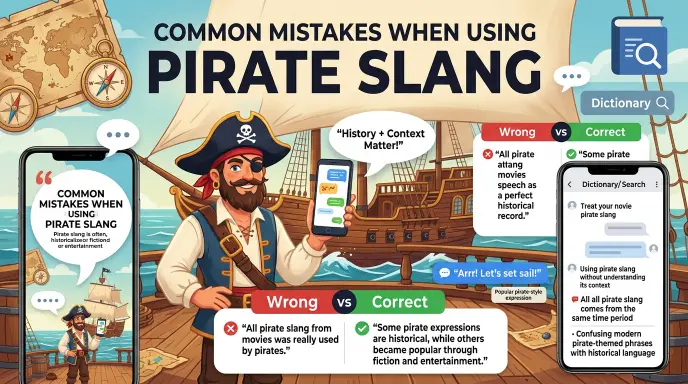
Assuming Every Pirate Phrase Was Historical
Not every famous pirate phrase comes directly from historical pirates.
Some expressions became popular much later through entertainment.
Using Too Many Expressions at Once
A sentence filled with “ahoy,” “arrr,” “matey,” “scallywag,” “avast,” and “shiver me timbers” can sound forced.
Use one or two expressions for a more natural joke.
Confusing Nautical Terms With Pirate Slang
Words such as port, starboard, bow, stern, deck, and galley are nautical terms. They are not exclusively pirate slang.
Forgetting That Some Words Have Modern Meanings
Words such as booty can have meanings unrelated to pirates.
Always consider the context.
When Should You Use Pirate Slang?
Pirate slang works well in casual and playful situations.
You can use it for:
- Halloween
- Pirate themed parties
- Games
- Memes
- Social media jokes
- Creative writing
- Role playing
- Funny messages
- Children’s stories
For example:
“Ahoy, matey! Happy Halloween!”
It is usually not suitable for formal business writing, academic work, or serious professional communication unless you are discussing pirate language itself.
Pirate Slang Examples in Texting
Here are some simple examples you can use in messages:
Friend: “Where are you?”
You: “Ahoy! I’m on my way, matey.”
Friend: “Did you find the hidden prize?”
You: “Aye! We found the treasure!”
Friend: “Who took my snacks?”
You: “Arrr, I know nothing!”
Friend: “Let’s play the pirate game.”
You: “Avast! I’m ready!”
These examples show how pirate slang can make an ordinary conversation sound playful.
Pirate Slang vs. Modern Slang
Pirate slang and modern internet slang serve different purposes.
Modern slang changes quickly. Terms can spread through TikTok, Instagram, gaming communities, memes, and texting.
Pirate slang is usually more theatrical. People use it to create a character, joke, or theme.
For example:
Modern slang: “That game was fire.”
Pirate style speech: “Arrr, that game was mighty good!”
The first sounds like current casual internet language. The second creates a pirate character.
Why Is Pirate Slang Still Popular?
Pirate language remains popular because pirates have a strong place in popular culture.
Stories about treasure maps, mysterious islands, ships, sea battles, and hidden gold continue to attract audiences. Movies and games also make pirate vocabulary easy to recognize.
Another reason is humor. Words such as “scallywag” and “landlubber” sound unusual in everyday conversation. That makes them useful when someone wants to be funny.
Pirate slang also works well for costumes, memes, role playing, and themed events.
Key Takeaways
- Pirate slang refers to words and expressions associated with pirates and sailors.
- Ahoy can be used as a greeting or call for attention.
- Matey means a friend or companion.
- Avast means stop, wait, or pay attention.
- Aye means yes or indicates understanding.
- Landlubber describes someone inexperienced with the sea.
- Scallywag means a rascal or mischievous person.
- Booty can mean treasure or valuable goods taken during a raid.
- Plunder means goods taken by force.
- Grog is a drink historically linked with sailors.
- Many famous pirate phrases come from popular culture, not necessarily from everyday speech among historical pirates.
- Pirate slang is mainly used today for humor, entertainment, gaming, costumes, memes, and role play.
Frequently Asked Questions
What are some pirate slang words?
Some common pirate slang words include matey for a friend or companion, landlubber for someone inexperienced with the sea, scallywag for a mischievous person, buccaneer for a pirate or seafarer, swashbuckler for a bold fighter, plunder for stolen treasure, and booty for treasure or loot.
How do you say “I love you” in pirate?
A playful pirate style way to say “I love you” is “I love ye, matey!” Pirate speech is mostly a fictionalized style rather than a single real dialect, so there is no official pirate translation. The classic pirate style often uses words such as ye, matey, and me to create the effect.
What are some slurs for pirates?
There is no standard set of true “pirate slurs.” Insults associated with pirate themed speech include scallywag, landlubber, bilge rat, swine, and coward. These are generally playful fictional insults rather than protected group slurs.
What are some cool pirate phrases?
Some cool pirate style phrases include “Ahoy, matey!”, “Shiver me timbers!”, “Walk the plank!”, “Avast, ye scallywag!”, “Where be the treasure?”, “Yo ho ho!”, and “Dead men tell no tales.” These phrases are strongly associated with popular fictional portrayals of pirates.
Pirate slang insults
Common pirate style insults include scallywag, landlubber, bilge rat, scurvy dog, swab, and coward.
These are mostly playful terms used in fictional pirate speech, costumes, games, and movies rather than a formal set of historical pirate insults.
Pirate slang for woman
In pirate-style speech, lass, wench, and lady may be used for a woman. “Lass” is generally friendly, while “wench” can sound old fashioned, rough, or insulting depending on context. There was no single official pirate slang word that all pirates used for women.
Pirate slang meaning
“Pirate slang” refers to words, phrases, and expressions associated with pirates and sailors. Famous examples include ahoy for a greeting or call, matey for a companion, landlubber for someone inexperienced at sea, booty for treasure, and avast as a command to stop or pay attention. Much of the pirate speech heard today comes from fictional and popular portrayals.
Pirate translator
A pirate translator changes normal English into playful pirate style speech. For example, “Hello, my friend” can become “Ahoy, matey!” and “Where is the treasure?” can become “Where be the treasure?”
Pirate translators are for fun and do not translate into one historically accurate pirate language.
Conclusion
Pirate slang combines real nautical language with expressions made famous by stories and popular culture. Words such as ahoy, matey, avast, aye, landlubber, scallywag, booty, and plunder can instantly create a pirate themed voice.
However, not every phrase associated with pirates has a strong historical connection to real pirates. Modern pirate speech is often a fun mix of maritime vocabulary, old expressions, and fictional storytelling.
If you are writing a pirate character, creating a social media joke, playing a game, or preparing for Halloween, a few well chosen pirate words can make your message sound more adventurous.
Discover More Articles!
Delulu Meaning: What Does Delulu Mean in Slang?(2026)
Cocaine in Spanish Slang: Common Words and Meanings Explained.
STFU Full Form in Chat: What Does STFU Mean?In 30 Seconds.

Hi, I’m Sophia Bennett, a novelist passionate about creating heartfelt stories filled with romance, emotion, and unforgettable characters. Through my books, I hope to inspire readers and take them on journeys they’ll always remember.