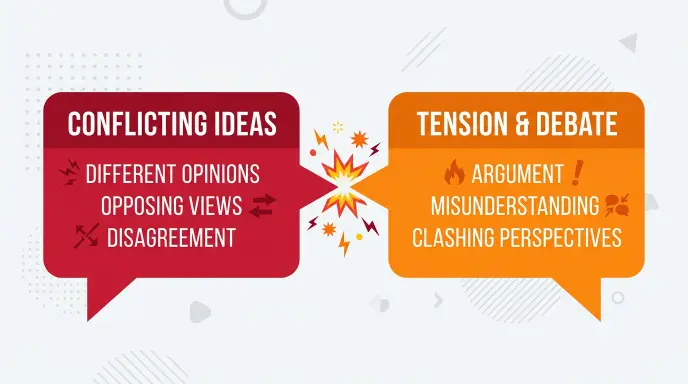
Beefing slang means arguing, fighting, or having a conflict with someone, often because of an ongoing disagreement.
You see “they’re beefing” under a celebrity post or in a group chat. No food is involved. No one’s cooking anything. The word points somewhere else entirely.
Here’s the short version: beefing means arguing, feuding, or holding a grudge against someone.
It comes from the noun “beef,” meaning a conflict or grudge. This guide covers where it comes from, how people use it today, and a few related phrases that sound similar but mean something different.
What Does Beefing Mean in Slang? (Quick Answer)
Beefing means actively arguing, feuding, or holding a grudge against someone. It’s the verb form of “beef,” a noun meaning a conflict, grudge, or unresolved tension.
You’ll hear it about anything from a small disagreement between friends to a long running celebrity rivalry. It has nothing to do with food the word shifted meaning over a century ago.
Quick Answer Table
| Question | Answer |
| What does beefing mean? | Arguing, feuding, or holding a grudge |
| What does “beef” mean as a noun? | A conflict, grudge, or grievance |
| Is it rude? | Not on its own it’s neutral, descriptive slang |
| Where is it most common? | TikTok, Instagram, celebrity gossip, group chats |
| Is it OK at work? | No avoid it in professional writing |
| Is it dated or still used? | Still very common, especially online |
| Any other meanings? | Yes “beefy” means muscular; “where’s the beef” means “where’s the substance” |
| Language origin | American English slang |
What Does Beefing Mean? (Primary Meaning)
Beefing is the verb form of the noun “beef,” and it means to actively argue, feud, or hold a grudge against someone. You can say two people “are beefing,” or that someone “has beef” with another person.
Example:
- Those two rappers have been beefing for months.
- She’s beefing with her old roommate over unpaid rent.
The conflict can be small, like a disagreement between coworkers, or serious, like a long running public rivalry. The word itself doesn’t say how big the conflict is context does that.
Origin of Beefing
“Beef” has a long, well documented history in American English, and it didn’t start out meaning “conflict” at all.
- 1888: “Beef” first appears as a verb meaning “to complain.” A quote from the New York World that year uses it this way.
- 1899: “Beef” appears as a noun meaning “complaint” or “grievance” as in “What’s your beef?”
- 1930s: “Beef” as a noun grows to mean “argument,” beyond just a complaint.
- 1980s: The phrases “having beef” and “starting beef” become popular, especially in African American Vernacular English and hip hop culture. Run DMC’s 1986 song “Proud to Be Black” uses the line “Got the strength to go the length if you wanna start beef.”
- 1980s–90s: “Beef” becomes tied to real rivalries in rap music, where artists feud publicly through diss tracks.
- 2010s–2020s: Texting and social media give the word new life. “Beefing” becomes shorthand for celebrity drama, online arguments, and friend group conflicts, spreading fast on platforms like TikTok and X.
No single person invented the shift from “complaint” to “conflict.” It built up gradually over decades, and the word still carries that layered history today.
“Where’s the Beef?” A Different, Unrelated Meaning
You might also hear “where’s the beef?” This phrase means something different: it asks where the substance or content is in something, like an argument or a plan.
It comes from a famous 1984 Wendy’s commercial, where a customer complained about the lack of meat in a competitor’s burger.
The phrase later spread to mean “where’s the real substance here?” completely separate from beefing as in arguing.
Example:
- His speech sounded good, but where’s the beef? He didn’t actually answer the question.
“Beefy” and “Beefcake” Another Unrelated Meaning
“Beefy” and “beefcake” describe someone muscular or physically strong. This meaning has nothing to do with conflict it’s a compliment, or sometimes a lighthearted tease, about someone’s build.
Example:
- He’s gotten so beefy since he started lifting weights.
How Beefing Is Used Across Platforms
| Platform | Typical Use |
| TikTok comments | Describing drama between creators or celebrities |
| Instagram captions | Referencing tension between public figures |
| Group chats | Describing a disagreement between friends |
| Gossip and entertainment news | Reporting on public feuds between artists or influencers |
Real Life Examples
Example 1 Friend group
- Did you hear Jake and Mia are beefing? They haven’t talked in weeks.
Example 2 Celebrity drama
- The two singers have been beefing since last year’s award show.
3 Workplace, said casually outside of work
- My coworker and I had beef for a bit, but we sorted it out.
4 Online
- These two accounts have been beefing in the comments all week.
When to Avoid Using Beefing
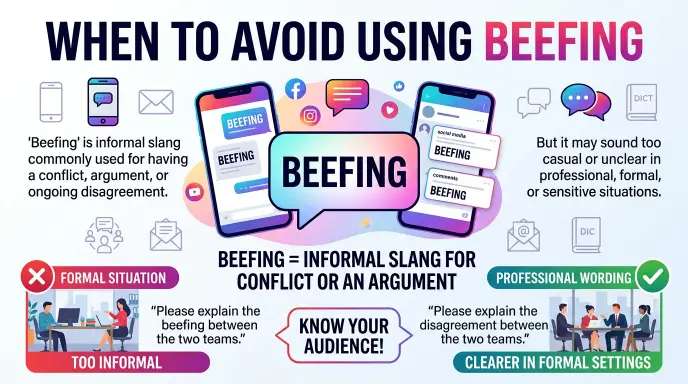
- Professional emails or work messages use “conflict,” “disagreement,” or “tension” instead.
- Formal writing of any kind it doesn’t belong in reports, essays, or official documents.
- Serious or sensitive conflicts for situations involving real harm or safety concerns, “beefing” can sound too casual for what’s actually happening.
Verdict on workplace use: Not appropriate for professional writing. Fine for casual conversations about drama, friend groups, or public figures.
Common Mistakes
- Confusing “beefing” with “where’s the beef?” They sound related but mean completely different things one is about conflict, the other about substance or content.
- Assuming it’s always serious.
- Beefing can describe anything from a minor tiff to a major rivalry the word alone doesn’t tell you the size of the conflict.
- Using it in professional writing. Stick with “conflict,” “dispute,” or “disagreement” in formal contexts.
- Missing the unrelated “beefy” meaning. “He’s beefy” is about muscles, not conflict.
Key Takeaways About Beefing Meaning Slang
- Beefing means arguing, feuding, or holding a grudge against someone
- It comes from “beef,” which first meant “complaint” in the late 1800s
- “Having beef” and “starting beef” became popular through 1980s hip hop culture
- Texting and social media revived the word in the 2010s and 2020s
- “Where’s the beef?” and “beefy” are unrelated phrases with different meanings
- Still widely used today, especially to describe online and celebrity drama
Frequently Asked Questions
What does it mean if someone is beefing?
If someone is “beefing,” it means they are having a conflict, argument, or ongoing problem with another person.
For example, “They’re beefing” means “They are fighting or having an issue with each other.” It can describe serious conflict or a playful argument, depending on the context.
What is beef in Gen Z slang?
In Gen Z slang, “beef” means a disagreement, conflict, or personal problem between people. Saying “They have beef” means they are not getting along. The term is common on TikTok, social media, gaming platforms, and in casual conversations.
What does beefing mean for a man?
When someone says a man is “beefing,” it usually means he is arguing or having a conflict with another person.
For example, “He’s beefing with his friend” means he has an ongoing disagreement or problem with his friend. The term does not have a special male-only meaning.
What does “beef up” mean in slang?
“Beef up” means to make something stronger, bigger, or more substantial. For example, “Beef up your resume” means to add more strong details or experience to it.
When talking about a person, “beef up” can also mean to become more muscular or physically stronger.
Beefing meaning slang Urban Dictionary
On Urban Dictionary, “beefing” has several user-submitted meanings, but a common slang meaning is having a conflict, argument, or ongoing problem with someone.
For example, “They’re beefing” means “They are having an issue with each other.” Exact definitions can vary between entries.
Beefing meaning slang in English
In informal English, “beefing” means arguing, fighting, or having a disagreement with someone.
For example, “Why are you beefing with him?” means “Why are you having a problem with him?” It can describe a serious conflict or a minor argument.
Beefing up meaning
“Beefing up” means making something stronger, bigger, or more substantial. For example, “I need to beef up my resume” means “I need to add stronger details to my resume.”
When describing a person, “beefing up” can also mean gaining muscle or becoming physically bigger.
What does beefing mean for a male dancer?
For a male dancer, “beefing” does not have a special dance related meaning by itself. It normally means having a conflict, argument, or rivalry with another person.
If the term appears in a specific dance community or video, the surrounding context may give it a different meaning.
Beef meaning in fight
In the context of a fight, “beef” means a conflict, disagreement, or ongoing problem between people.
Saying “They have beef” means they have an issue with each other. It does not necessarily mean they are physically fighting; the conflict can also be verbal or personal.
Beef meaning in rap
In rap and hip hop, “beef” usually means a public or ongoing conflict between rappers, artists, or groups.
A rap beef may involve insults, diss tracks, interviews, or social-media exchanges. The term can describe a rivalry without necessarily meaning a physical fight.
Conclusion
Beefing means arguing or feuding with someone, and it comes from over a century of American slang history from “complaint” in the 1880s to hip hop culture in the 1980s to today’s group chats and TikTok comments.
Just remember: “where’s the beef?” and “beefy” are different phrases entirely, so don’t mix them up.
Discover More Articles!
Dip Meaning Slang: What Does Dip Mean in Slang?(2026)
Korean Slang: Common Korean Slang Words and Their Meanings
YT Meaning in Text: What Does YT Stand For?(2026)

Hi, I’m Sophia Bennett, a novelist passionate about creating heartfelt stories filled with romance, emotion, and unforgettable characters. Through my books, I hope to inspire readers and take them on journeys they’ll always remember.