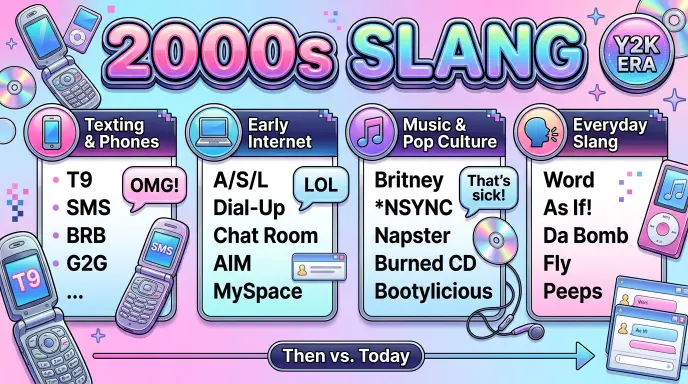
2000s slang refers to informal words and phrases that became popular in the United States during the 2000–2009 period.
Popular examples include bling, crunk, tight, phat, noob, baller, fo’ shizzle, pwned, my bad, and da bomb. Texting, AIM, gaming, music, television, and early social media all helped shape the slang of the decade.
Key TakeawaysAbout 2000s Slang
- 2000s slang mixed spoken youth language with growing internet and texting culture.
- Words such as bling, crunk, tight, phat, and noob are strongly linked with the era.
- Not every “2000s” term started in the 2000s; some became popular during that decade after appearing earlier.
- AIM, MySpace, gaming, music, MTV, and reality TV helped spread new expressions.
- Some 2000s slang is still common, while other terms now sound nostalgic.
What Does 2000s Slang Mean?
2000s slang means the informal vocabulary people used during the first decade of the 21st century, especially from 2000 to 2009.
There was no single set of words that everyone used. Slang changed based on age, location, music taste, online community, and social group.
The decade was also a major transition period. People still talked face to face and watched television, but cell phones, instant messaging, internet forums, gaming, and early social networks were becoming a bigger part of everyday life.
Because of this, 2000s slang came from many places. Hip hop and pop culture helped spread words such as bling and crunk, while online communities popularized terms such as noob and pwned.
Texting and instant messaging also made abbreviations such as LOL, BRB, TTYL, and OMG familiar to millions of users.
Popular 2000s Slang Words and Meanings
Here are some well known examples of 2000s slang and what they meant.
| Slang | Meaning | Example |
| Bling | Flashy jewelry or accessories | “Check out her new bling.” |
| Crunk | Very energetic or wild | “The party was crunk.” |
| Tight | Cool, impressive, or attractive | “Those shoes are tight.” |
| Phat | Cool, excellent, or stylish | “That car is phat.” |
| Noob | An inexperienced person, especially online | “He’s still a noob at the game.” |
| Baller | Someone successful, wealthy, or impressive | “He thinks he’s a baller.” |
| Fo’ shizzle | For sure | “Are you coming?” “Fo’ shizzle.” |
| Pwned | Completely defeated or outplayed | “You just got pwned.” |
Bling
Bling described flashy jewelry, especially large or expensive looking pieces. The word became strongly associated with hip hop and luxury style around the late 1990s and early 2000s.
Example:
“He showed off his new bling.”
Today, the word is still understood, but it often creates a deliberate throwback feeling.
Crunk
Crunk described a highly energetic, wild, or excited atmosphere. It was closely connected with hip hop and party culture and became widely recognizable during the 2000s.
Example:
“The concert was getting crunk.”
Tight
Tight could mean cool, excellent, attractive, or impressive.
Example:
“Those new sneakers are tight.”
The slang meaning depended on context. Linguistic records also document tight as early 2000s college slang with positive meanings such as cool and attractive.
Phat
Phat was an informal spelling used to describe something cool, excellent, or stylish.
Example:
“That new car is phat.”
The term was already established before 2000 but remained recognizable during the early 2000s.
This is an important point when discussing historical slang: a word can be strongly associated with a decade without actually originating in that decade.
Noob
Noob means an inexperienced or new person, especially in an online game or community.
Example:
“I was a noob when I first started playing.”
It could be playful, but it could also be used as an insult. The related spelling n00b also appeared in early online culture.
Baller
Baller described someone who appeared successful, wealthy, stylish, or impressive. The word was strongly connected with hip hop culture and ideas of money and status.
Example:
“He pulled up in a new car like a baller.”
Fo’ Shizzle
Fo’ shizzle is a playful way of saying “for sure.” It became closely associated with Snoop Dogg and the “ izzle” style of wordplay.
Example:
“You coming to the party?”
“Fo’ shizzle.”
Pwned
Pwned means being completely defeated or outplayed. It became especially common in gaming and online communities.
Example:
“You got pwned in that match.”
The unusual spelling came from online culture and became a recognizable part of early internet and gaming language.
Popular 2000s Slang Phrases
The decade also produced many memorable phrases.
That’s Hot
“That’s hot” became strongly associated with Paris Hilton and 2000s pop culture. It was used to describe something attractive, fashionable, or appealing.
Example:
“Those sunglasses are hot.”
My Bad
My bad is a casual way to admit a mistake or apologize.
Example:
“My bad, I forgot to call you.”
Unlike some 2000s expressions, this one remains common today.
Wassup
Wassup? is a casual version of “What’s up?” and was especially recognizable during the late 1990s and 2000s because of pop culture and advertising.
Example:
“Wassup, dude?”
The phrase itself is older, but its exaggerated pronunciation became a major cultural reference around the start of the decade.
Talk to the Hand
Talk to the hand was a humorous way to tell someone that you did not want to listen to them.
Example:
“You never listen!”
“Talk to the hand!”
The phrase is now mostly associated with retro 1990s and 2000s culture.
Da Bomb
Da bomb meant something was extremely good, exciting, or impressive.
Example:
“That movie was da bomb.”
Although the expression became strongly associated with 1990s and early 2000s pop culture, it is not strictly a word that began in the 2000s.
2000s Texting and Internet Slang
One of the biggest differences between 2000s slang and earlier slang was the growth of digital communication.
People used AIM, MSN, forums, chat rooms, gaming communities, and text messages to communicate quickly. Short abbreviations saved time and space.
| Term | Meaning | Example |
| LOL | Laughing out loud | “LOL, that was funny.” |
| BRB | Be right back | “BRB, getting food.” |
| TTYL | Talk to you later | “I have to go. TTYL.” |
| OMG | Oh my God | “OMG, did you see that?” |
| IDK | I don’t know | “IDK what happened.” |
| ROFL | Rolling on the floor laughing | “ROFL, that joke was inexplicable.” |
These abbreviations were not all invented during the 2000s. However, the decade helped move many of them from online communities into everyday communication.
How 2000s Slang Was Shaped by Pop Culture
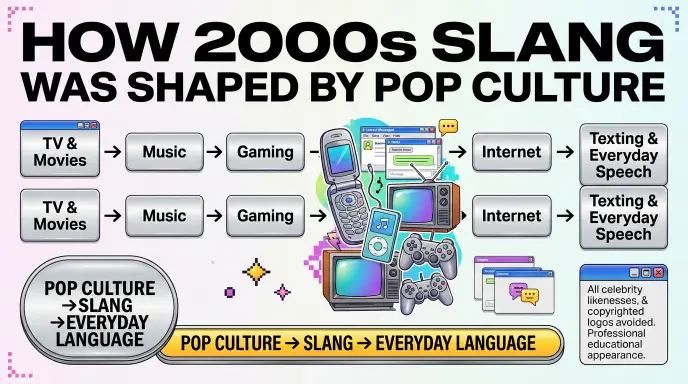
Music, television, movies, gaming, and the growing internet all played a role.
Music helped spread words connected with hip hop, fashion, money, and party culture. MTV and reality television gave viewers repeated exposure to new catchphrases and styles of speech.
At the same time, AIM, MySpace, forums, and online gaming created new communities where people could invent, shorten, and remix language.
This made the 2000s different from earlier decades. Slang could move from a song or TV show to the internet and then into everyday conversation very quickly.
What 2000s Slang Is Still Used Today?
Some expressions survived because they remained useful or easy to understand.
LOL, OMG, my bad, chill, noob, and bling are still recognizable today, although their frequency varies by age and context.
Other terms are more strongly tied to nostalgia. Fo’ shizzle, crunk, phat, da bomb, and talk to the hand may sound intentionally retro when used today.
It is also worth remembering that slang does not have a strict expiration date. A word can disappear from everyday speech and later return through memes, movies, TikTok, gaming, or other forms of online culture.
Frequently Asked Questions
What are some 2000s slang words?
Some recognizable 2000s slang words include bling, crunk, tight, phat, noob, baller, pwned, and fresh. Texting also made abbreviations such as LOL, BRB, TTYL, OMG, and IDK widely recognizable.
Not every term originated in the 2000s, so it is more accurate to describe some as expressions that were popular or strongly associated with the decade.
What was the slang word for cool in the 2000s?
There was no single slang word for “cool.” People used terms such as tight, phat, fresh, sweet, sick, and da bomb, depending on their community and the situation.
Tight and phat are particularly associated with early 2000s slang, while some of the other expressions were also common before or after the decade.
What were popular 2000s texting terms?
Popular 2000s texting and instant messaging terms included LOL for “laughing out loud,” BRB for “be right back,” TTYL for “talk to you later,” OMG for “oh my God,” and IDK for “I don’t know.” These shortcuts became part of everyday digital communication as texting and instant messaging grew.
What 2000s slang is still used today?
Some 2000s expressions remain familiar, including LOL, OMG, chill, my bad, noob, and bling.
Their use depends on the speaker and context. Other expressions are now mainly used for humor, nostalgia, or references to 2000s pop culture.
Was all 2000s slang invented in the 2000s?
No. Many words associated with the decade were older. For example, some expressions became popular in the 1990s and continued into the 2000s.
The decade also introduced genuinely new internet and cultural vocabulary. A historical slang list should therefore distinguish between origin, popularity, and later nostalgic use.
Conclusion
2000s slang reflects a decade when traditional pop culture and digital communication began to overlap.
Words such as bling, crunk, tight, phat, noob, and fo’ shizzle captured different parts of youth and pop culture, while LOL, BRB, TTYL, and OMG showed how texting and the internet were changing everyday communication.
Some of these expressions have faded, while others remain familiar. Either way, they provide a useful look at how Americans talked, texted, played games, and shared pop culture during the 2000s.
Disccover More Articles!
Tool Meaning Slang: Definition, Texting & Social Media Uses.
What Does TSS Mean in Text? Meaning, Uses & Examples
What Does TTYL Mean in a Text? Meaning, Uses & Examples

Hi, I’m Sophia Bennett, a novelist passionate about creating heartfelt stories filled with romance, emotion, and unforgettable characters. Through my books, I hope to inspire readers and take them on journeys they’ll always remember.