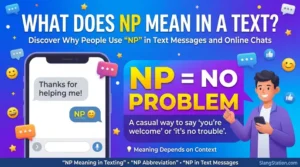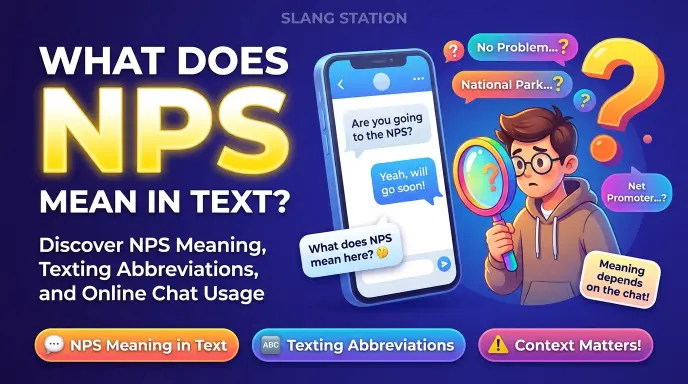
In texting, NPS means “No Problems” : a relaxed way to say “You’re welcome,” “It’s okay,” or “Sure, I can do that” after a thank-you, a small apology, or a request. You’ll see it on TikTok, Snapchat, Instagram, WhatsApp, and in quick phone texts.
Here is the twist that confuses almost everyone. NPS is also a famous business term. Outside chatting, it usually means Net Promoter Score.
So a person can read the same three letters in two places and get two completely different meanings.
That is why people search for it. They get a short “nps” from a friend and wonder : is this good? Is it rude? Did I do something wrong? Relax. In a chat, it is almost always friendly.
In this guide, you will not just get the meaning. You will learn the 3 jobs NPS does in a conversation, when it sounds warm, when it sounds dry, and how to reply without overthinking a 3-letter message.
NPS Meaning in Text
⚡ Quick Answer: NPS = No Problems
Use it when: someone thanks you, someone says sorry for something small, or someone asks you for a small favour.
It means: “All good. Don’t stress about it.”
That last line is the real feeling behind it. The words are “no problems,” but the message is reassurance.
You are telling the other person the help was easy, the mistake was small, and there is nothing to feel guilty about.
Compare it with a full sentence. “Thank you for sending the notes” : “You are welcome, it was no problem at all” sounds polite but long. In a fast chat, “nps” does the same job in one second.
Is NPS Slang, an Acronym, or an Abbreviation?
NPS is a texting abbreviation, also called an initialism, and it works as slang.
Each letter stands for a word or part of the phrase:
N = No
P = Problem
S = the plural “s” that turns it into “Problems”
People say the letters when they read it : en-pee-ess : instead of saying it like a normal word. That makes it an initialism, not a true acronym like NASA.
And it is slang because of where it lives. It belongs in informal chats, not in formal English. You will write it to a friend at midnight. You will not write it in a job application.
The 3 Jobs NPS Does in a Chat
Most slang guides only give you the meaning. What actually helps you is knowing why the person sent it. NPS normally does one of these three jobs:
1. It replies to a thank you.
Someone says thanks. You say “nps.” Meaning: You’re welcome.
This is the most common use, by far.
2. It closes a small apology.
Someone says, “Sorry I replied late.” You say “nps.” Meaning: It’s fine, forget it.
It stops a small mistake from becoming a big, awkward discussion.
3. It says yes to a request.
Someone asks, “Can you pick me up at 7?” You say “nps.” Meaning: Sure, I can do that.
Here it is not about the past help. It is a quick, positive yes for something coming up.
Once you spot which job it is doing, the chat suddenly makes sense. The surrounding messages are your biggest clue.
NPS vs NP : The One Difference Worth Knowing
This is where many readers get stuck, so let’s clear it now.
NP means “No Problem” : singular. NPS means “No Problems” : plural.
In real chats, people use them for the exact same feeling. NP is more common and more famous.
NPS is its close cousin. Some people type the extra S because they naturally say “no problems” when they speak. Others just learned it that way from their friend group.
Do not overthink the grammar. Nobody is counting problems. Both mean the sender is chill about it.
⚠️ Don’t Confuse This NPS
In a text: NPS = No Problems
In a business survey: NPS = Net Promoter Score : the “How likely are you to recommend us?” score, from 0 to 10
In the US, in travel or official contexts: NPS can also mean National Park Service
If your friend texts it after a thank-you, it is never about a business score or a national park. Context decides everything.
Where People Use NPS
NPS works best in short, friendly, fast-moving conversations. Here is how it actually looks on each platform : because the same word feels slightly different everywhere.
On TikTok
On TikTok, you will mostly see NPS in comments and replies between creators and followers.
A fan thanks a creator for a tutorial, a link, or a part two. The creator replies, “nps, glad it helped.” It is quick, warm, and keeps the comment section moving.
You will also spot it in live chats, where messages fly past too fast for full sentences. Short replies win on TikTok Live, and NPS fits that speed perfectly.
On Snapchat
Snapchat chats are private, fast, and full of shortcuts. That makes NPS feel at home there.
A friend apologises for missing your Snap, and you reply “nps.” No drama, no long explanation. The chat stays light, which is exactly how Snapchat is meant to feel.
Because Snap conversations disappear, people rarely write formally there. Three letters are enough when the friendship already has context.
On Instagram
On Instagram, NPS lives mainly in DMs and story replies.
Someone thanks you for sharing a post, sending a reel, or tagging them. A short “nps 👍” in the DM says you are happy to help without starting a whole new conversation.
You will see it less in public comments. In public, people usually write “no problem” fully, because strangers reading the comment may not know the shortcut.
On WhatsApp
WhatsApp is a mix of friends, family, and work groups, so NPS shows up there in the casual chats, not the formal ones.
In a friend group, it is perfect. Someone thanks you for adding them to the plan or sending the location, and “nps” closes the chat neatly.
In a family group, younger members use it more. In an office group, most people avoid it. Same app, different audience, different choice : that judgment is what makes you a good texter.
In SMS and Normal Texting
Texting is the original home of this kind of shortcut. Long before apps, people shortened everyday phrases to save time and space.
In SMS or iMessage today, NPS still does that old job. It is a one-tap reply when your hands are busy : you are walking, working, or in the middle of something and cannot type a full sentence.
If the person knows chat slang, it lands perfectly. If they do not, one extra second to write “no problem” saves a confused reply later.
Real Chat Examples
Definitions tell you the meaning. These chats show you the feeling. Read the bold line under each one : that is the part worth remembering.
Example 1 : After a thank-you
A: Thanks for sending me the class notes.
B: nps, I had them open anyway.
A: You saved my day, honestly.
Main point: NPS after “thanks” = You’re welcome.
Example 2 : A small favour
A: Can you hold my seat? I’ll be 5 minutes late.
B: nps, I’ll keep your bag here too.
A: Perfect, running now.
Main point: NPS before a task = Sure, I can do it.
Example 3 : A late reply apology
A: Sorry, I saw your message late last night.
B: nps at all, I was asleep early too.
A: Okay good, I felt bad.
Main point: NPS after a small sorry = Don’t worry about it.
Example 4 : Helping a friend move a plan
A: Thanks for changing the time for me.
B: nps, 8 works better for me anyway.
A: Great, see you at 8 then.
Main point: NPS can show the change was easy, not a burden.
Example 5 : In a gaming chat
A: Thanks for reviving me, I thought I was done.
B: nps, stay close next round.
A: Got it, following you.
Main point: In games, NPS is a fast, team-friendly reply.
Example 6 : Sending a file
A: You sent the video so fast, thank you!
B: nps, it was already on my phone.
A: Still, I appreciate it.
Main point: NPS makes your help sound effortless and kind.
Example 7 : Borrowing something small
A: Can I borrow your charger for 10 minutes?
B: nps, it’s on the table.
A: Thanks, I’ll return it right after.
Main point: As an answer to a request, NPS is a relaxed yes.
Example 8 : A friend who feels guilty
A: Sorry I talked so much about my problem today.
B: nps, that’s what friends are for.
A: That means a lot, really.
Main point: NPS can be emotional reassurance, not just a shortcut.
Example 9 : In a group chat
A: Thanks for adding me to the group, everyone.
B: nps, we needed one more person for the plan.
A: Happy to be here!
Main point: In groups, NPS keeps the welcome short and friendly.
Example 10 : Covering for someone
A: Thanks for covering my shift on Saturday.
B: nps, but you owe me coffee.
A: Deal. Big coffee.
Main point: NPS can be friendly and playful when you add a small joke after it.
Look at the pattern across all ten. Nobody uses NPS to start a cold conversation. It is almost always a response : to thanks, to sorry, or to a request. Remember that, and you will read it correctly every time.
How to Reply When Someone Says “NPS”
Here is the good news most people miss: when someone says NPS, the conversation is usually already complete.
They have basically said, “All good.” You do not need a clever comeback. A short reaction, an emoji, or even just moving on is completely normal.
Still, if you want to reply, match your reply to the mood.
Funny Replies
Best for close friends, after a light favour.
- “You say nps now, I’ll remind you when I need help.”
- “No problems? I create problems professionally.”
- “Cool, I’m adding this favour to my VIP list.”
- “nps accepted. Coffee tax still applies.”
- “Legend. Officially my emergency contact now.”
Keep the joke short. If you write a long comedy speech after a 3-letter reply, the balance of the chat feels weird.
Casual Replies
These work in almost any friend chat.
- “ok cool 👍”
- “got it, thanks again”
- “perfect, appreciate it”
- “aight, see you later then”
- “👍👍”
Casual replies match casual energy. That mirroring is a big part of natural texting : short gets short, warm gets warm.
Friendly Replies
Use these when you genuinely want to show gratitude.
- “Thank you, that really helped me.”
- “I appreciate it more than you know.”
- “You’re kind, let me know if you ever need anything.”
- “Thanks again, I owe you one.”
- “That was sweet of you, truly.”
A friendly reply is the best choice when the favour was bigger than “small.” NPS may sound light, but the help itself might have mattered a lot to you.
Neutral Replies
For classmates, teammates, or people you do not know that well.
- “Okay, thank you.”
- “Got it.”
- “Noted, thanks.”
- “Alright, see you then.”
- “Thanks, I’ll let you know if I need anything else.”
Neutral replies are safe because they are polite without being overly familiar. When you are unsure which style to pick, pick neutral. You can almost never go wrong there.
Is NPS Rude or Offensive?
Short answer: No. NPS is not rude, not offensive, and not a bad word.
It has no insult hidden inside it. In fact, its whole purpose is the opposite : it removes tension from a chat. It tells someone not to feel bad, not to over-apologise, and not to stress.
So why do some people feel it is rude? Tone.
A bare “nps.” with a full stop can look dry to some readers. “NPS” in all caps can look louder than the person meant.
And if someone wrote you a long, heartfelt thank-you, a cold 3-letter reply can feel too small for the moment.
The word is fine. The match matters.
At school, NPS is fine with friends and classmates in casual chats. Do not use it with a teacher in an email or a formal message. Write “No problem, I will submit it tomorrow” in full. It shows effort and respect.
At work, be more careful. A teammate in a casual internal chat? Probably fine. A manager, a client, or anyone outside your company? Write the full phrase. “No problem at all, happy to help” costs you four extra seconds and sounds professional every time.
Who Uses This Term?
Teenagers and Gen Z users are the most natural users of NPS. They grew up replying in shortcuts across Snapchat, TikTok, Discord, and gaming chats, where speed is normal and full sentences can actually feel strangely formal.
Young adults and millennials use it too, especially people who spent years in chat rooms and group chats.
Many of them switch styles without thinking : full sentences at work, shortcuts with friends at night. That switching is normal now.
Older adults use it much less. For them, NP itself may already be unfamiliar, so NPS can look like a code, a company name, or a survey score. That gap is exactly why slang searches keep growing every year.
How common is it, honestly? NPS is less common than NP. NP is the star. NPS is the backup that some groups love and others never touch.
You will not see it in every chat, every day. But in the right friend group, you may see it ten times in one evening. Slang is local like that : popular in one circle, invisible in another.
Origin of the Term
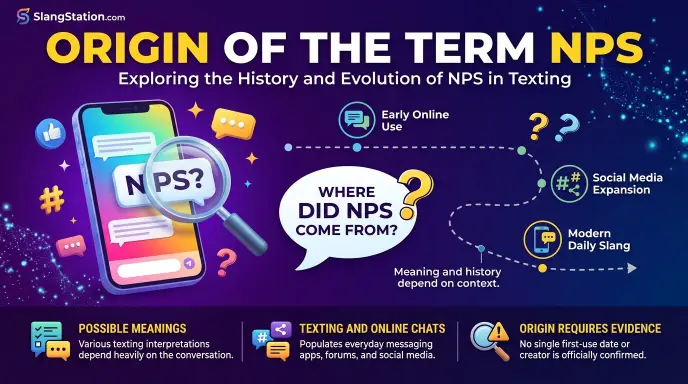
The slang origin of NPS is uncertain, and there is no single creator to credit. Nobody went viral one day and invented “no problems.”
What likely happened is much more ordinary, and more interesting. People already had NP for “No Problem.”
In normal speech, many people naturally say “no problems” with an S, especially in British and casual English. When they typed the phrase the way they said it, NP simply grew an extra letter and became NPS.
That happened inside a bigger culture. Early texting had character limits. Chat rooms and games rewarded the fastest reply.
Everyday phrases got cut down first, because people used them the most. “You’re welcome” was long. “NP” and “NPS” were instant.
The business NPS has a completely different, well documented history as a customer score created in the early 2000s.
The two meanings were born in two different worlds : one in offices and surveys, one in phones and chats : and then collided when people started Googling the letters.
That collision is why the origin feels messy. It is not one story. It is two stories sharing the same three letters.
Comparison Table
Placed next to its neighbours, NPS becomes impossible to confuse.
| Term | Meaning | Type | Usage | Popularity |
| NPS | No Problems | Abbreviation / texting slang | To say “you’re welcome,” “it’s fine,” or “sure” after thanks, sorry, or a request | Medium-low |
| IDK | I Don’t Know | Abbreviation / texting slang | When you do not have an answer | Very high |
| IDC | I Don’t Care | Abbreviation / texting slang | To show you have no strong feeling about something | High |
| IMO | In My Opinion | Abbreviation / texting slang | Before giving a personal view | High |
| BRB | Be Right Back | Abbreviation / texting slang | When you are stepping away from a chat for a short time | Very high |
Notice the emotional difference. IDC can sound cold. NPS sounds kind. IDK admits you do not know something. BRB pauses a chat.
NPS does something none of the others do: it comforts the other person. That is its special job, and it is why it has survived alongside the much more famous NP.
Real-World Usage Example
It is 4:12 pm on a busy Tuesday. Zara is stuck in traffic, and she was supposed to send her friend Daniyal the presentation file before his meeting.
At 4:14, she finally sends it, with a rushed message: “SO sorry, traffic is impulsive, here it is, thank you for waiting.”
Daniyal downloads it in one tap. He can feel she is stressed.He does not make her apologise again.
He replies: “nps, got it, meeting saved 👍”
Zara reads it and relaxes instantly. The delay is forgiven. The apology is closed. Daniyal walks into his meeting with the file, and the whole problem disappears in under a minute.
That is NPS in real life. Not exciting, not dramatic : just a tiny message that removes stress at exactly the right moment.
Most good slang works like that. You barely notice it, but the conversation feels smoother because of it.
Frequently Asked Questions
What does NPS mean in text messages?
NPS means “No Problems” in text messages. People use it to say “you’re welcome,” “it’s okay,” or “sure” after a thank-you, a small apology, or a request. It is friendly and informal.
What does NPS mean on TikTok?
On TikTok, NPS means the same thing: No Problems. Creators and followers use it in comments and live chats as a quick, friendly reply when someone thanks them or apologises for something small.
Is NPS slang?
Yes, NPS is texting slang. It is also an abbreviation, because the letters stand for “No Problems.” It belongs in casual chats with friends, not in formal emails, school work, or job messages.
Is NPS rude or offensive?
No, NPS is not rude or offensive. It is meant to make the other person feel relaxed. It can only look dry if the chat was very formal or emotional, so in those moments, writing “no problem at all” in full feels warmer.
How should you reply to NPS?
Keep it short. Reply with “thanks again,” “got it 👍,” or “appreciate it” : or simply continue the conversation. NPS usually closes that part of the chat, so no long reply is needed.
Conclusion
NPS means “No Problems,” and in a chat, it carries a friendly little promise: you helped easily, you forgive quickly, and nobody needs to stress.
Use it where it belongs : with friends, in fast chats, on TikTok, Snapchat, Instagram, WhatsApp, and in texts : after a thank-you, a small sorry, or a simple request. That is where it sounds natural and kind.
Avoid it where clarity and respect matter more : with teachers, managers, clients, and strangers, and in any message about a business score, where NPS means something completely different.
Next time a friend sends you those three letters, you will not pause or Google it. You will smile, reply “thanks again,” and move on : exactly as the chat was meant to flow.
Discover More Articles!
What Does Mean in Text? Meaning, Uses & Examples(2026)
What Does “OBG” Mean in Text? Common Uses Explained
What Does NTR Mean in Text? Meaning & Examples

Hi, I’m Sophia Bennett, a novelist passionate about creating heartfelt stories filled with romance, emotion, and unforgettable characters. Through my books, I hope to inspire readers and take them on journeys they’ll always remember.