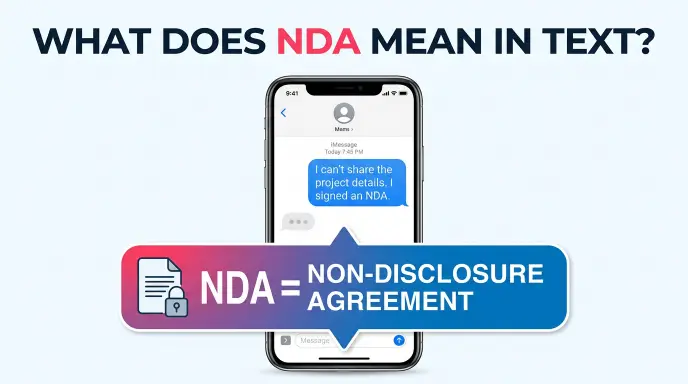
NDA usually means “Non Disclosure Agreement” in text messages. It is a legal agreement that asks someone to keep certain private or confidential information secret.
In casual chat, people may also use “NDA” when talking about a confidentiality agreement, private information, or something they cannot reveal.
You may see NDA in texting, WhatsApp messages, emails, work chats, social media posts, or conversations about jobs and business.
Unlike many texting abbreviations, NDA is not mainly internet slang. It is a common business and legal abbreviation.
The meaning can depend on the context. If someone says, “I signed an NDA,” they usually mean they agreed not to share certain information.
If someone says, “Sorry, I can’t tell you because of an NDA,” they are saying that a confidentiality agreement prevents them from discussing the information.
This guide explains what NDA means in text, how people use it, what it means on social media, and how to reply when someone mentions an NDA.
What Does NDA Mean in Text?
In text messages, NDA most commonly means “Non Disclosure Agreement.” It is a legal contract between people or organizations that limits the sharing of confidential information.
An NDA may cover information such as:
- Business plans
- Product ideas
- Trade secrets
- Client information
- Financial information
- Software or technology
- Marketing plans
- Private documents
- Unreleased projects
- Other confidential information
For example:
Person A: What are you working on?
Person B: I can’t say. I signed an NDA.
Here, NDA means Non Disclosure Agreement.
In simple words, an NDA is an agreement about keeping certain information private.
What Does NDA Stand For?
NDA stands for “Non Disclosure Agreement.”
“Non disclosure” means not revealing or sharing certain information. An agreement is a formal arrangement between parties.
You may also hear an NDA called a confidentiality agreement. The exact terms of an agreement can vary, so the two phrases are not always legally identical in every situation, but they are often used in similar contexts.
Is NDA Slang or an Abbreviation?
NDA is an abbreviation or initialism, not typical texting slang.
People use it in professional and everyday conversations because the full phrase, “Non Disclosure Agreement,” is longer.
For example:
“I can’t discuss the project because I signed an NDA.”
Using “NDA” makes the sentence shorter and is common in workplace communication.
What Does NDA Mean in a Text Message?
When someone uses NDA in a text message, they are usually talking about confidential information that they cannot legally or contractually disclose.
For example:
“I’d tell you, but I’m under an NDA.”
This means:
“I’d tell you, but I have agreed not to share this information.”
Another example:
“The company made us sign an NDA.”
This means the company required the people involved to agree to confidentiality terms.
The abbreviation can appear in casual conversations too, especially when someone wants to explain why they cannot reveal details about a project, job, product, event, or business matter.
Why Do People Use NDA in Texting?
People use NDA because it is much shorter than writing Non Disclosure Agreement every time.
It is especially common when discussing:
- Work
- Freelance projects
- Startups
- Business deals
- Technology
- Entertainment
- Product development
- Employment
- Private information
For example:
“Can’t share the details yet. NDA.”
This is a very short way of saying that confidentiality restrictions apply.
NDA Can Explain Why Someone Is Being Secretive
Sometimes people mention an NDA when someone asks them for information they cannot share.
For example:
Friend: What is your company launching next month?
You: I can’t tell you. NDA.
The person is explaining why they are keeping the information private.
NDA Can Refer to the Document Itself
People can use NDA to talk about the agreement:
“Did you sign the NDA?”
Here, NDA means the actual legal document.
They can also use it to describe the confidentiality obligation:
“I’m under an NDA.”
This means they have agreed to keep certain information confidential.
What Does NDA Mean on WhatsApp?
On WhatsApp, NDA usually means Non Disclosure Agreement when the conversation involves work, business, employment, or confidential information.
For example:
A: What was the meeting about?
B: Can’t say. NDA.
Or:
A: Can you show me the new product?
B: Not yet. I signed an NDA.
The abbreviation works the same way in WhatsApp as it does in regular texting.
However, if the conversation is unrelated to work or confidentiality, you should look at the surrounding messages before deciding what NDA means.
What Does NDA Mean on Instagram?
On Instagram, NDA can appear in DMs, captions, comments, or discussions about businesses and collaborations.
For example:
“I can’t post the project yet because of an NDA.”
This could mean the person has agreed not to publicly share information about the project.
People working with brands, production companies, agencies, startups, or other businesses may use NDA when discussing confidential collaborations.
In casual Instagram comments, however, the abbreviation may have a different meaning depending on the community or context.
What Does NDA Mean on Snapchat?
On Snapchat, NDA can mean Non Disclosure Agreement when someone is talking about private work or a secret project.
For example:
You: What was that thing you were working on?
Friend: NDA 😭
The friend may be jokingly saying they cannot reveal the details because they have a confidentiality agreement.
The emoji or surrounding conversation can make the message feel more casual, but the basic meaning of NDA remains the same.
What Does NDA Mean in Business Texting?
NDA is especially common in business conversations.
A company may ask employees, contractors, freelancers, consultants, or business partners to sign an NDA before sharing confidential information.
For example:
“Please review and sign the NDA before we send the project files.”
In this sentence, NDA clearly means Non Disclosure Agreement.
The agreement may define what information must remain confidential and how that information can be used or shared.
What Does “Under NDA” Mean?
If someone says they are “under NDA,” they usually mean they have a confidentiality obligation that prevents them from sharing certain information.
For example:
“I know what the company is planning, but I’m under NDA.”
In simple English:
“I know, but I am not allowed to tell you.”
This phrase is common when people work on unreleased products, confidential business projects, movies, games, software, or other private projects.
Example of “Under NDA”
Friend: Have you seen the new game yet?
Developer: Yes, but I’m under NDA.
The developer is saying they may have access to information that they cannot publicly discuss.
What Does “Signed an NDA” Mean?
When someone says “I signed an NDA,” they mean they agreed to confidentiality terms.
For example:
“I signed an NDA, so I can’t show you the files.”
The person is explaining that they have a formal agreement limiting what they can disclose.
The exact restrictions depend on the agreement.
Real Chat Examples of NDA
Here are realistic examples showing how people may use NDA in conversations.
Example One: Work Project
A: What project are you working on?
B: Can’t tell you. I signed an NDA.
Here, NDA means Non Disclosure Agreement.
Example Two: New Product
A: Have you seen the new product?
B: Yeah, but I’m under NDA.
The person cannot share confidential details.
Example Three: Freelance Work
A: Can you show me the design?
B: Not yet. NDA.
The designer may be restricted from showing the work before its official release.
Example Four: Startup
A: What is your startup building?
B: I’d tell you, but I’m under NDA.
The person is saying the project is confidential.
Example Five: Movie Project
A: Are you working on that movie?
B: Maybe 👀 NDA.
The person is avoiding confirming or revealing details.
Example Six: Game Development
A: Have you played the new version?
B: Yes, but NDA.
The person cannot discuss what they saw or played.
Example Seven: Business Meeting
A: What did they offer you?
B: Can’t discuss it. NDA.
The agreement may restrict disclosure of business information.
Example Eight: Client Work
A: Can you put that project in your portfolio?
B: No, there’s an NDA.
The person is saying the agreement prevents them from publicly sharing the work.
Example Nine: Private Information
A: Tell me what happened in the meeting.
B: Sorry, NDA.
The person is using NDA as a short explanation for why they cannot provide details.
Example Ten: Casual Joke
Friend A: So what is the surprise?
Friend B: NDA 😂
Here, the person may be jokingly using the idea of confidentiality to avoid giving away the surprise.
How to Reply When Someone Says NDA
Your reply depends on the situation.
If someone says they cannot share information because of an NDA, it is usually better to respect that boundary rather than keep asking for confidential details.
Casual Replies
You can say:
- “Fair enough.”
- “Got it.”
- “No worries.”
- “Makes sense.”
- “Okay, I’ll wait.”
Friendly Replies
If you are talking with a friend:
- “Haha, fair enough 😂”
- “Okay, secret agent.”
- “I won’t ask again 😄”
- “Guess I’ll have to wait.”
- “Fine, keep your secrets 😂”
Professional Replies
In a work conversation, you can respond with:
- “Understood.”
- “Thanks for clarifying.”
- “No problem.”
- “I understand.”
- “We’ll wait until you can share it.”
Funny Replies
With close friends, you might say:
- “NDA? You’re so mysterious 😂”
- “Okay, Mr. Secret Project.”
- “I’ll pretend I never asked.”
- “Top secret, apparently 😂”
Keep humorous replies appropriate for the relationship and situation.
Is NDA Rude or Offensive?
NDA is not a rude or offensive term.
It is a standard abbreviation used in legal, business, workplace, and casual conversations.
For example:
“I can’t discuss that because I’m under NDA.”
This is normally a straightforward explanation.
However, saying only “NDA” in response to a question can sometimes sound dismissive because it gives very little information.
For example:
A: What happened?
B: NDA.
If the topic is not obviously related to confidentiality, the other person may not understand what B means.
Is NDA Safe to Use at Work?
Yes. NDA is a normal professional abbreviation.
You may see it in:
- Emails
- Contracts
- Workplace chats
- Project documents
- Business discussions
- Freelancer communication
- Client conversations
When discussing a real agreement, however, the actual contract terms matter more than the abbreviation.
Who Uses NDA?
NDA is not limited to a particular age group.
You may see it used by:
- Employees
- Employers
- Freelancers
- Contractors
- Developers
- Designers
- Entrepreneurs
- Consultants
- Business owners
- Lawyers
- Creators
- Actors
- Producers
- Researchers
It can appear in both formal and casual conversations.
Unlike many Gen Z slang terms, NDA is not specifically associated with one generation.
Origin of NDA
NDA comes from the phrase “Non Disclosure Agreement.”
The abbreviation became common because legal and business documents often use shortened forms for frequently repeated terms.
There is no need to treat NDA as a modern social media slang term. Its main use comes from professional and legal communication.
People later brought the abbreviation into everyday online conversations. Today, someone may casually say “NDA” in a text message simply to explain why they cannot reveal information.
NDA vs Confidentiality Agreement
NDA and confidentiality agreement are closely related terms, but their exact legal meaning can depend on the document and jurisdiction.
| Term | Common Meaning | Typical Context |
| NDA | Non Disclosure Agreement | Business and legal |
| Confidentiality agreement | Agreement to protect private information | Work and business |
| Confidential information | Information that should remain private | Contracts and workplaces |
| Under NDA | Bound by confidentiality terms | Casual and professional speech |
The important point is that an NDA generally deals with keeping specified information confidential.
Common Mistakes When Using NDA
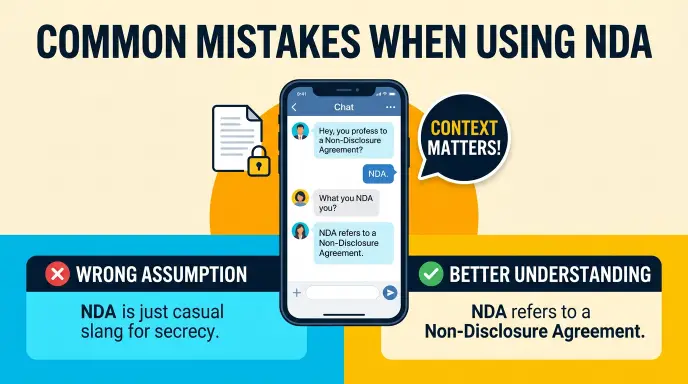
One common mistake is assuming that NDA always means the same thing in every conversation.
The most common meaning in professional and texting contexts is Non Disclosure Agreement, but abbreviations can have multiple meanings in different communities.
Another mistake is assuming that an NDA means someone can never talk about anything related to a project. The actual restrictions depend on the agreement.
People also sometimes use “NDA” casually as a joke:
“NDA 😂”
That does not necessarily mean there is a real legal contract.
Do Not Assume Every “NDA” Is a Legal Agreement
Context matters.
If someone says:
“I signed an NDA with my employer.”
That strongly suggests a real agreement.
But if someone says:
“What’s the surprise?”
“NDA 😂”
they may simply be joking.
What Does NDA Mean in Social Media?
On social media, NDA generally keeps its standard meaning: Non Disclosure Agreement.
Creators and professionals may mention NDAs when discussing:
- Brand partnerships
- Unreleased products
- Movies
- Television projects
- Video games
- Technology
- Private events
- Business deals
- Confidential collaborations
For example:
“I can’t show you the new feature yet. NDA.”
The person is saying they cannot share the information at that time.
What Does NDA Mean in a Job?
In a job or employment context, NDA almost always refers to a Non Disclosure Agreement.
An employer may use an NDA to protect confidential business information.
For example:
“You’ll need to sign an NDA before starting the project.”
This means the employer wants the employee or contractor to agree to confidentiality terms.
The exact legal effect depends on the agreement itself and applicable law.
Frequently Asked Questions
What does NDA mean in text?
NDA usually means Non Disclosure Agreement in text messages. It refers to an agreement that requires certain information to remain confidential.
What does NDA stand for?
NDA stands for Non Disclosure Agreement.
Is NDA texting slang?
Not usually. NDA is an abbreviation or initialism that comes from legal and business language. People also use it casually in texts and social media.
What does “I’m under NDA” mean?
It usually means the person has agreed to keep certain information confidential and cannot share it freely.
What does “signed an NDA” mean?
It means someone agreed to the confidentiality terms in a Non Disclosure Agreement.
What does NDA mean on WhatsApp?
On WhatsApp, NDA usually means Non Disclosure Agreement, especially when people are discussing work, business, private projects, or confidential information.
What does NDA mean on Instagram?
NDA usually means Non Disclosure Agreement when it appears in discussions about work, brands, collaborations, products, or private projects.
What does NDA mean on Snapchat?
NDA can mean Non Disclosure Agreement on Snapchat. Someone may use it casually to say they cannot reveal information.
Is NDA a rude word?
No. NDA is not inherently rude or offensive. It is a common abbreviation used in professional and casual communication.
Can NDA be used as a joke?
Yes. People sometimes say “NDA” jokingly when they do not want to reveal a surprise or secret. The context shows if a real agreement exists.
Does NDA always mean Non Disclosure Agreement?
No abbreviation has one meaning in every possible context. However, Non Disclosure Agreement is the standard meaning of NDA in business, legal, employment, and most texting contexts involving confidentiality.
What should I say when someone says “NDA”?
You can reply with something simple such as “Got it,” “No worries,” “Fair enough,” or “I understand.” If the information is confidential, respect the person’s decision not to share it.
Conclusion
NDA in text usually means “Non Disclosure Agreement.” It refers to an agreement that requires people to keep certain information confidential.
You may see NDA in texts, WhatsApp messages, Instagram DMs, workplace chats, emails, and conversations about jobs, businesses, technology, entertainment, and private projects.
When someone says “I’m under NDA,” they usually mean, “I can’t share that information because I agreed to keep it confidential.”
NDA is not typical slang. It is a professional abbreviation that people also use casually online. In some conversations, especially among friends, someone may use “NDA” as a joke to avoid revealing a secret.
When you see NDA in a message, check the surrounding conversation. If the topic involves work, business, a private project, or unreleased information, Non Disclosure Agreement is almost certainly the intended meaning.
Discover More Articles!
What Does MHM Mean in Text? Meaning & Examples.(2026)
What Does MK Mean in Text? Meaning & Examples
What Does ML Mean in Text? Meaning & Examples(2026)

Hi, I’m Sophia Bennett, a novelist passionate about creating heartfelt stories filled with romance, emotion, and unforgettable characters. Through my books, I hope to inspire readers and take them on journeys they’ll always remember.