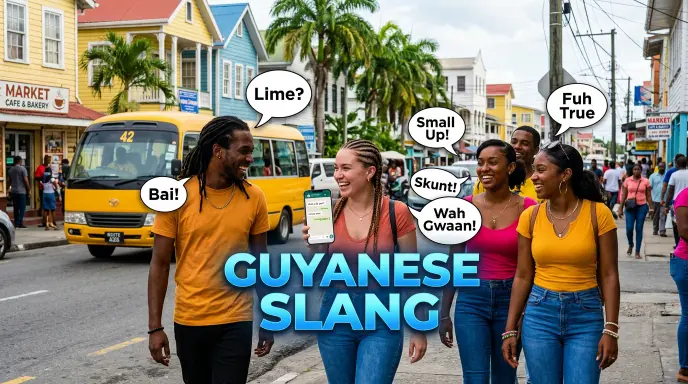
Guyanese slang is a collection of informal words and expressions that people in Guyana use in everyday conversations. Many of these phrases come from Guyanese Creole, while others reflect the country’s African, Indian, Indigenous, European, and Caribbean influences.
As a result, Guyanese slang is colorful, expressive, and full of local culture. If you’re visiting Guyana, talking with Guyanese friends, or watching Caribbean content online, learning these expressions can help you understand conversations more naturally.
Today, you’ll hear Guyanese slang in homes, schools, workplaces, markets, music, comedy shows, and social media.
It frequently appears on TikTok, Facebook, Instagram, WhatsApp, and YouTube because many Guyanese creators enjoy sharing their culture with a global audience.
Although some slang words are friendly and easy to use, others depend on the speaker, situation, and tone. Therefore, understanding the context is just as important as learning the words themselves.
In this guide, you’ll discover popular Guyanese slang terms, their meanings, where people use them, and when it’s appropriate to say them.
What Is Guyanese Slang? (Quick Answer)
Guyanese slang refers to the informal words, phrases, and expressions commonly used by people in Guyana. Most slang comes from Guyanese Creole and reflects the country’s unique cultural background.
People use these expressions in everyday conversations, text messages, music, social media, and community events to communicate in a relaxed and natural way.
Quick Answer Table
| Question | Answer |
| Meaning | Informal words and phrases used in Guyana |
| Language | Mainly Guyanese Creole and English |
| Common Users | People in Guyana and the Guyanese diaspora |
| Tone | Friendly, casual, and expressive |
| Popular Platforms | TikTok, Facebook, Instagram, WhatsApp, YouTube |
| Offensive? | Some expressions can be offensive depending on context |
| Formal or Informal? | Mostly informal |
| Still Popular? | Yes, across all age groups |
What Is Guyanese Slang?
Guyanese slang includes the informal expressions people use instead of standard English in daily conversations.
Although English is the official language of Guyana, many locals naturally switch between English and Guyanese Creole. Because of this, conversations often sound different from what you’ll hear in other English-speaking countries.
Unlike dictionary English, Guyanese slang is full of personality. People use it to greet friends, tell stories, make jokes, describe emotions, or react to everyday situations.
In addition, many expressions have meanings that become clear only when you understand the local culture.
For example, a simple greeting between friends may sound very different from formal English, yet every local understands it immediately.
Therefore, learning Guyanese slang is not only about vocabulary. It also helps you understand how people in Guyana communicate, build friendships, and express themselves.
Why Is Guyanese Slang So Popular?
Guyanese slang remains popular because it reflects the country’s history, identity, and everyday life. Instead of using formal language all the time, people often choose slang because it sounds warmer and more natural.
Several factors have helped Guyanese slang stay popular.
- It reflects local culture.
- It creates a sense of community.
- It makes conversations feel relaxed.
- It appears in music and entertainment.
- It is widely shared on social media.
- Families pass many expressions from one generation to the next.
As a result, many young people continue using these expressions while also introducing them to global audiences through online videos and social media posts.
The Origins of Guyanese Slang
The history of Guyanese slang is closely connected to the country’s diverse population. Over hundreds of years, people from different backgrounds brought their languages and traditions to Guyana.
Eventually, many of these influences blended together and helped shape Guyanese Creole, which remains the main source of local slang today.
Although experts continue to study the development of Guyanese Creole, it is generally accepted that its vocabulary reflects influences from several languages and cultures.
These include:
- English
- West African languages
- Indian languages
- Dutch
- Portuguese
- Indigenous languages
- Other Caribbean Creoles
Because languages naturally evolve over time, some slang words have changed in meaning, while others have remained popular for generations.
Where Do People Use Guyanese Slang?
People use Guyanese slang almost everywhere in daily life. While formal English is common in schools, government offices, and official documents, slang dominates many casual conversations.
You’ll commonly hear it in:
Family Conversations
Parents, grandparents, brothers, sisters, and cousins often speak using local expressions at home. As a result, children usually learn slang naturally while growing up.
Schools
Students regularly use slang when talking with classmates during breaks or after school. However, teachers generally expect standard English during lessons.
Markets
Local vendors and shoppers frequently use slang while buying and selling goods. These conversations often sound lively and friendly.
Sports
If people are playing cricket, football, or basketball, slang naturally appears during games and friendly competitions.
Community Events
Festivals, celebrations, and neighborhood gatherings are excellent places to hear authentic Guyanese expressions.
Because slang is part of everyday communication, visitors often hear it within minutes of arriving in Guyana.
Common Guyanese Slang Words and Their Meanings
Learning a few common expressions is one of the easiest ways to understand everyday conversations.
| Slang Word | Meaning | Example |
| Bai | Friend, buddy, or guy | Morning, bai! |
| Lime | Hang out or spend time together | We’re going to lime later. |
| Bruk | Broken or out of money | I’m bruk until Friday. |
| Chupid | Silly or foolish | Don’t be chupid. |
| Pickney | Child | The pickney is playing outside. |
| Small up yuhself | Move over or make room | Small up yuhself so everyone can sit. |
| Wah Gwaan? | What’s going on? | Wah gwaan, bai? |
| Big Up | Show respect or appreciation | Big up everyone who helped today! |
Although these expressions are common, pronunciation may vary slightly from one region to another.
Understanding “Lime”
One of the most famous Guyanese slang words is lime.
In Guyanese slang, lime means to spend time with friends in a relaxed and enjoyable way. It doesn’t necessarily involve a specific activity. Instead, it simply means getting together to talk, eat, laugh, or enjoy each other’s company.
Example Conversation
Ryan: We liming after work?
Kevin: Yeah, let’s meet around six.
Context: Ryan asks If they are getting together after work. Kevin agrees, confirming the plan.
Because lime is such a common expression, you’ll hear it in conversations between friends of all ages.
Understanding “Bai”
Another popular Guyanese slang word is bai.
People commonly use bai to address a friend, neighbor, or someone they know casually. Although it originally referred to a boy, today’s usage is much broader.
Example
A: Morning, bai!
B: Morning! How things?
Context: Both speakers greet each other in a friendly and informal way.
Because bai creates a warm and familiar tone, it’s one of the first Guyanese expressions many visitors learn.
More Popular Guyanese Slang Words
While words like lime and bai are widely recognized, Guyanese conversations include many other expressions that make everyday speech more colorful.
Some describe people or situations, while others express emotions or reactions. Therefore, learning these words can help you understand both casual conversations and local humor.
| Slang Word | Meaning | Example |
| Skunt | A strong exclamation used to express anger, surprise, or frustration. It can be offensive depending on the situation. | Skunt! I forgot my phone. |
| Fuh True | Really? / Seriously? | Fuh true? You won the prize? |
| Nuff | A lot or many | There were nuff people at the concert. |
| Bad | Excellent or impressive | That performance was bad! |
| Rass | A strong exclamation. It may be considered offensive in some situations. | Rass! I missed the bus. |
| Sweet | Great, nice, or enjoyable | Everything is sweet. |
| Mek | Make or let | Mek we go now. |
| Nah | No or not | Nah, I’m staying home today. |
Although many of these words are common in Guyana, their meanings can vary slightly depending on the speaker and the situation. As a result, it’s always helpful to listen carefully before using unfamiliar slang yourself.
Guyanese Words and Phrases for Everyday Conversation
Guyanese speech includes many guyanese words and expressions that may sound different from standard English.
Some guyanese words slang are used mainly in relaxed conversations with friends, family, neighbors, and other people in the community.
Many guyanese creole phrases have meanings that are easy to understand once you know the context.
These guyanese slang phrases can be used for greetings, making plans, showing emotions, joking with friends, or talking about everyday situations.
You may also come across guyanese words and phrases that combine English vocabulary with expressions associated with Guyanese Creole.
Learning these expressions together is often more useful than memorizing individual words because the meaning can depend on how a phrase is used.
Common guyanese creole words include expressions such as “bai,” “lime,” “bruk,” “pickney,” and “mek.” Their meanings can change slightly depending on the speaker, situation, and tone.
For example:
| Guyanese Expression | Meaning | Example |
|---|---|---|
| Bai | Friend, boy, or casual address | Morning, bai! |
| Lime | Hang out or spend time together | We lime after work. |
| Bruk | Broke or without money | I’m bruk this week. |
| Pickney | Child | The pickney is outside. |
| Mek | Make or let | Mek we go. |
Guyanese Slang in Everyday Conversations
Guyanese slang appears naturally throughout the day. Instead of speaking formal English all the time, locals often mix standard English with Guyanese Creole.
Greeting a Friend
David: Wah gwaan, bai?
Andre: Everything sweet. You?
Context: David asks how Andre is doing. Andre replies that everything is going well.
Making Plans
Sarah: We liming after school?
Jessica: Yeah, let’s meet around five.
Context: The friends are arranging to spend time together.
Asking Someone to Move
Grandmother: Small up yuhself.
Grandson: Okay, Grandma.
Context: She politely asks him to make more room on the sofa.
Talking About Money
Mark: Want to go shopping?
Ryan: Nah, I’m bruk this week.
Context: Ryan explains that he doesn’t have enough money right now.
Guyanese Slang on TikTok
TikTok has introduced Guyanese slang to many people around the world. Because creators enjoy sharing local culture, you’ll often hear everyday expressions in comedy videos, cooking clips, travel content, and family skits.
Popular TikTok captions include:
- Only Guyanese will understand this.
- We liming all weekend.
- Wah gwaan, everybody?
- Caribbean vibes only.
- Big up Guyana!
These videos not only entertain viewers but also teach local expressions in a fun and natural way.
Guyanese Slang on Facebook
Facebook remains one of the most popular platforms among Guyanese communities. People often use slang in comments, local groups, family discussions, and community announcements.
For example, you might see comments like:
- Big up everybody!
- Everything sweet.
- We liming later.
- Wah gwaan, family?
Because many families stay connected through Facebook, slang continues to spread across different generations.
Guyanese Slang on Instagram
Instagram users frequently include Guyanese slang in captions, Stories, and Reels. These expressions make posts feel more personal and authentic.
Examples include:
- Weekend lime with the crew.
- Sweet vibes only.
- Big up everyone who came.
- Proud to be Guyanese.
In addition, influencers often use local slang to celebrate their culture and connect with followers.
Guyanese Slang on WhatsApp
WhatsApp is one of the most common places where Guyanese slang appears. Since conversations happen quickly, people naturally use short, familiar expressions.
Common messages include:
- Wah gwaan?
- We liming today?
- Everything sweet.
- Mek we go.
- See you later, bai.
Because these messages sound warm and relaxed, they’re perfect for chatting with friends and family.
Guyanese Slang in Music
Music has helped keep Guyanese slang alive for many years. Local artists often include familiar expressions in their lyrics because listeners immediately recognize them.
You’ll hear slang in:
- Soca
- Chutney music
- Dancehall
- Reggae
- Local Caribbean music
Although song lyrics may use slang creatively, the meanings usually stay close to everyday speech. Therefore, listening to Guyanese music can be a fun way to learn new expressions.
Guyanese Slang in Daily Culture
Slang isn’t only about language. It also reflects Guyanese values, humor, and community life.
People commonly use slang during:
- Family gatherings
- Birthday parties
- Weddings
- Sporting events
- Community festivals
- Religious celebrations
- Weekend outings
Because these events bring people together, informal language feels natural and welcoming.
Regional Differences in Guyanese Slang
Although English is the official language across Guyana, slang can sound slightly different depending on the region.
For example:
- Coastal communities may use certain expressions more frequently.
- Rural areas sometimes preserve older local words.
- Younger speakers often combine traditional slang with newer internet expressions.
Even so, many popular terms such as lime, bai, and wah gwaan are widely understood throughout the country.
Is Guyanese Slang Positive or Negative?
Most Guyanese slang has a positive or neutral meaning. People often use it to greet friends, joke around, or describe everyday situations.
Positive examples include:
- Big up!
- Everything sweet.
- We liming later.
- Morning, bai!
However, a few expressions can become offensive depending on the tone and situation.
For example, words such as skunt and rass may express frustration or anger. Because many people consider them strong language, it’s better for visitors to avoid using them until they fully understand the context.
Guyanese Slang for Girls, Insults, and Strong Expressions
Not every Guyanese expression is used in the same way. Some terms are friendly, while others describe people, show frustration, or may sound offensive depending on the situation.
If you are searching for guyanese slang for girl, one common term is “gyal.” It is also heard in other Caribbean varieties of speech.
Depending on the speaker and context, words such as “shorty” or “miss” may also appear in casual conversation.
For example:
- Gyal — a casual word for a girl or young woman.
- Shorty — a casual term that may refer to a girl or young woman.
- Miss — a casual or respectful way to address a woman or girl in some situations.
Stronger expressions require more care. Some guyanese curse words or offensive expressions may be used to show anger, frustration, surprise, or insult someone. Their strength can depend heavily on tone and context.
For that reason, visitors should not assume that every strong expression is appropriate in casual conversation. It is safer to understand how local speakers use a term before repeating it.
The same principle applies to insults. A word may be used jokingly between close friends but sound offensive when directed at someone in a different situation.
Is Guyanese Slang Formal or Informal?
Guyanese slang is almost always informal. Therefore, it’s most appropriate when speaking with:
- Friends
- Family
- Neighbors
- Classmates
- Community members
However, in formal situations, people generally choose standard English instead.
Examples include:
Informal
- We liming later.
- Wah gwaan?
- Everything sweet.
Formal
- How are you today?
- Shall we meet later?
- Everything is going well.
Using the appropriate style helps conversations sound natural and respectful.
Similar Caribbean Slang
Many Caribbean countries have their own slang traditions. Although some expressions are similar, each country has developed its own vocabulary over time.
| Country | Common Slang | Meaning |
| Guyana | Lime | Hang out |
| Jamaica | Wah Gwaan | What’s going on? |
| Trinidad and Tobago | Lime | Spend time together |
| Barbados | Fuh True | Really? |
| Belize | Weh Di Gwaan | What’s happening? |
Because Caribbean cultures share historical connections, you’ll occasionally hear similar words across different islands and countries. Even so, pronunciation, spelling, and meaning can still vary.
Guyanese Slang vs. Standard English
| Guyanese Slang | Standard English | Common Situation |
| Wah Gwaan? | What’s going on? | Greeting someone |
| Lime | Hang out | Making plans |
| Bai | Friend or buddy | Casual conversation |
| Bruk | Broke | Talking about money |
| Small up yuhself | Make room | Asking someone to move |
| Everything sweet | Everything is fine | Responding to a greeting |
Understanding these differences makes it much easier to follow conversations with native Guyanese speakers.
Guyana Slang: Common Sentences and Slang Terms
Learning individual words is helpful, but seeing them inside complete sentences makes guyana slang much easier to understand. Sentence examples show how a slang term works in a real conversation and help readers understand its tone and meaning.
Common guyana slang words include “bai,” “lime,” “bruk,” “small up,” and “big up.” These expressions can have meanings that are different from the standard English words they resemble.
Here are some simple examples:
| Guyanese Sentence | Meaning |
| Wah gwaan, bai? | What’s going on? |
| We liming later. | We are hanging out later. |
| I’m bruk this week. | I don’t have much money this week. |
| Small up yuhself. | Move over or make some room. |
| Big up everyone! | Respect or appreciation to everyone. |
| Everything sweet. | Everything is fine or going well. |
People looking for guyanese slang sentences can use examples like these to see how expressions work naturally instead of learning isolated vocabulary.
The phrase guyanese slangs is sometimes used when people search for several informal expressions together.
However, it is important to remember that slang is not always fixed. Age, location, family background, and personal speaking style can influence which expressions someone uses.
If you are looking for guyanese slang words and meanings, the best approach is to learn both the definition and the situation in which each expression is normally used.
For example, “lime” means to spend time together, but knowing this definition alone does not explain how naturally it fits into a conversation such as “We liming after work?”
This is why sentence examples are useful for understanding Guyanese speech.
Real-Life Examples
Text Message
Ryan: We liming after work today?
Kevin: Yeah, I’ll meet you around six.
Context: Kevin agrees to meet Ryan after work. Here, liming means spending time together in a relaxed way.
WhatsApp Chat
Aisha: Wah gwaan, bai?
Jordan: Everything sweet! How about you?
Context: This is a friendly greeting between two friends. Instead of saying “How are you?” they use common Guyanese slang.
Facebook Comment
Post: Finally back home in Georgetown! 🇬🇾
Comment: Big up! Enjoy your stay.
Context: “Big up” shows respect, support, and appreciation.
Instagram Caption
“Weekend lime with my favorite people. ❤️🇬🇾”
Context: The word lime tells followers that the group spent time together in a fun and relaxed setting.
Family Conversation
Mother: Small up yuhself so your sister can sit.
Son: Okay, Mom.
Context: The mother politely asks her son to make room for someone else.
School Conversation
Student 1: You coming after class?
Student 2: Yeah, we liming by the field.
Context: The students plan to hang out together after school.
Market Conversation
Customer: This fruit looks fresh.
Vendor: Everything sweet today!
Context: The vendor uses sweet to mean everything is good or of high quality.
When Should You Use Guyanese Slang?
Learning slang is useful, but knowing when to use it is just as important. Although locals often switch between standard English and Guyanese Creole, the situation usually determines which style sounds most natural.
You can comfortably use Guyanese slang when talking with:
- Friends
- Family members
- Neighbors
- Classmates
- People at community events
- Social media followers
However, it’s usually better to avoid slang in:
- Job interviews
- Business meetings
- Academic essays
- Government offices
- Professional emails
- Formal presentations
Choosing the right language for the situation helps you communicate respectfully while still sounding natural.
Common Mistakes Guyanese Slang
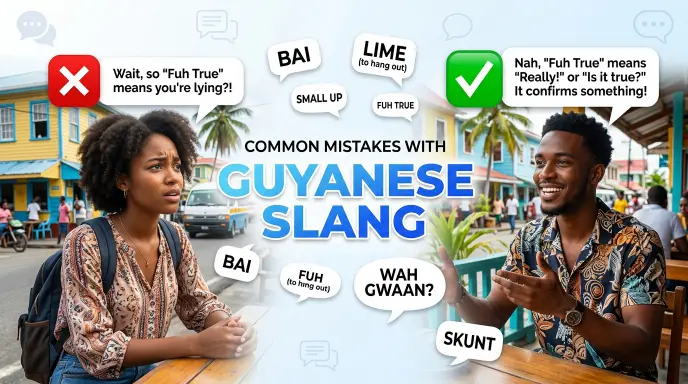
Thinking Every Guyanese Speaks the Same Way
Although Guyanese slang is popular throughout the country, not everyone uses the exact same expressions. Age, region, family background, and personal preference can all influence vocabulary.
Therefore, don’t expect every speaker to use identical slang words.
Assuming Caribbean Slang Is Identical
Many people think Caribbean countries share one type of slang. However, each country has developed its own unique expressions.
For example:
- Guyana: Lime
- Jamaica: Mi Deh Yah
- Trinidad and Tobago: Doh Study
- Barbados: Fuh True
Although some phrases sound similar, they often have different meanings or pronunciations.
Using Strong Expressions Too Quickly
Some Guyanese slang words express frustration or anger. Because locals understand when these words are appropriate, visitors should avoid using them until they understand the context.
For example, words such as skunt and rass may offend some listeners. Therefore, it’s safer to use friendly expressions like bai, lime, or big up instead.
Translating Slang Word for Word
Guyanese slang doesn’t always translate directly into standard English. Instead, many expressions carry cultural meanings that go beyond their literal words.
That’s why learning the context is much more helpful than memorizing simple translations.
Key Takeaways
- Guyanese slang includes informal words and expressions commonly used across Guyana.
- Many slang terms come from Guyanese Creole and reflect the country’s diverse cultural heritage.
- Popular expressions include lime, bai, wah gwaan, bruk, and big up.
- Most slang is friendly and conversational, although a few words can be offensive depending on the situation.
- Understanding the context helps you use Guyanese slang naturally and respectfully.
Frequently Asked Questions
What Are Some Guyanese Sayings?
Answer: Some popular Guyanese sayings include “No scene” (no problem), “Small up yuhself” (move over and make space), “Wha gwan?” (what’s going on?), and “Tek time” (take your time). These everyday expressions reflect the friendly and relaxed style of Guyanese English Creole.
How Do You Say “Hi” in Guyana?
Answer: In Guyana, people often greet each other with phrases like “Wha gwan?” (What’s going on?), “How yuh stay?” (How are you?), “Morning,” “Afternoon,” or simply “Hi.” The exact greeting depends on the situation and how well the speakers know each other.
What Is a “Buck” in Guyanese Slang?
Answer: In Guyanese slang, “buck” usually means to meet someone by chance or to run into someone unexpectedly. For example, “I buck he at the market” means “I ran into him at the market.”
How Do Guyanese Say “Boy”?
Answer: Guyanese people often say “bai” (sometimes spelled “bye”) instead of “boy.” It’s commonly used to address friends or express surprise, such as “Bai, where yuh been?” meaning “Boy, where have you been?”
What Are Some Common Guyanese Slang Words?
Answer: Popular Guyanese slang words include:
- Bai – Friend or boy
- Buck – Meet by chance
- Lime – Hang out with friends
- No scene – No problem
- Small up – Make room
- Tek time – Take your time
These words are widely used in everyday conversations across Guyana.
What Is Guyanese Slang for a Girl?
Answer: A common Guyanese slang term for a girl is “gyal,” which is also used in many Caribbean countries. Depending on the context, people may also simply say “shorty” or “miss,” especially in casual conversations.
What Are Some Guyanese Slang Insults?
Answer: Guyanese slang includes playful insults such as “hard ears” (someone who doesn’t listen), “skunt” (a strong and offensive insult), and “fool-fool” (someone acting silly or foolish). The meaning and level of offensiveness depend on the context, so some terms should be used with caution.
What Is Guyanese Slang and Its Meaning?
Answer: Guyanese slang is a collection of informal words and expressions from Guyanese English Creole. Common examples include:
- Lime – To hang out
- Buck – To meet unexpectedly
- No scene – No problem
- Small up – Move over
- Bai – Friend or boy
These expressions are commonly used in everyday speech throughout Guyana.
What Is Guyanese Slang in English?
Answer: Guyanese slang in English refers to informal expressions used in Guyanese English Creole. While many words come from standard English, they often have unique meanings or pronunciations. For example, “lime” means to socialize, and “buck” means to meet someone by chance.
What Are Some Funny Guyanese Slang Words?
Answer: Some funny and memorable Guyanese slang words include “small up” (move over), “lime” (hang out), “bai” (friend), “buck” (run into someone), and “hard ears” (someone who refuses to listen). These expressions are often humorous because of their unique meanings and colorful everyday use.
Conclusion
Guyanese slang is much more than a collection of informal words it’s a reflection of Guyana’s history, culture, and everyday life.
From friendly greetings like “Wah Gwaan?” to popular expressions such as “lime” and “big up,” these phrases help people communicate in a warm, relaxed, and authentic way.
Because many expressions come from Guyanese Creole, they also highlight the country’s rich cultural diversity.
If you’re planning to visit Guyana, making Guyanese friends, exploring Caribbean culture, or simply expanding your knowledge of world slang, learning these expressions can make conversations easier to understand.
Start with the most common phrases, pay attention to the context, and keep listening to how native speakers use them.
Over time, you’ll become more confident and appreciate the unique character that Guyanese slang brings to everyday communication.
Discover More Articles!
Outfit Slang Meaning: Definition, Uses, Examples & Origin
Link Up Slang Meaning: Definition, Texting & TikTok Explained

Hi, I’m Sophia Bennett, a novelist passionate about creating heartfelt stories filled with romance, emotion, and unforgettable characters. Through my books, I hope to inspire readers and take them on journeys they’ll always remember.