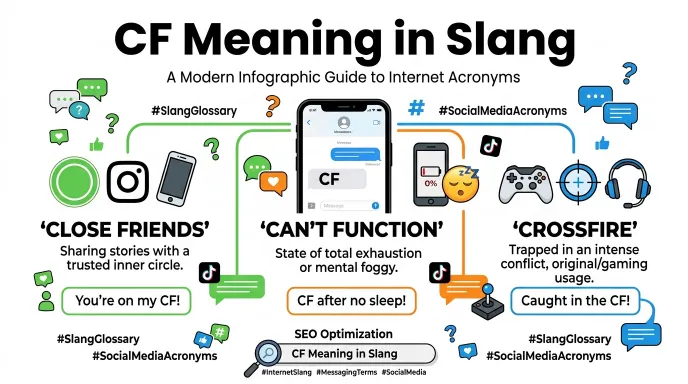
CF in slang most commonly means “Close Friends,” especially on Instagram and Snapchat, where users share private content with selected people.
Many people come across CF in texts, social media posts, or online conversations and wonder what it means. While “Close Friends” is the most popular definition today, CF can have other meanings depending on the platform and context.
You may see it used on TikTok, Discord, or messaging apps, where abbreviations help people communicate quickly.
Because internet slang evolves rapidly, understanding the situation in which CF appears is the best way to interpret it correctly.
In this guide, you’ll learn the meaning of CF in slang, its origins, common uses, and real-life examples.
What Does CF Stand For?
CF is most often slang for “Close Friends,” used on Instagram and Snapchat to describe a private list of trusted followers.
Depending on the platform, CF can also mean “compare,” “crossed fingers,” or “crossfire” in gaming chats.
Quick Answer Table
| Question | Answer |
| Meaning | Usually “Close Friends”; also “compare,” “crossed fingers,” or “crossfire” |
| Tone | Friendly, casual, sometimes hopeful |
| Used By | Teens, young adults, gamers, Gen Z |
| Platforms | Instagram, Snapchat, TikTok, Discord, group texts |
| Offensive? | No it’s neutral slang |
| Formal Use? | Yes, in academic writing as “confer” |
| Still Popular? | Yes, especially the Close Friends meaning |
Context is the deciding factor here. The same two letters can mean something completely different depending on if you’re reading an Instagram story caption or a message in a gaming lobby, so it helps to look at what’s around the word before deciding which meaning fits.
A caption under a selfie is unlikely to reference a shooter game, and a line in a research paper is unlikely to reference a private Instagram list, so most of the guesswork disappears once you factor in where the message actually appeared.
Where CF Comes From
CF has roots that go back further than social media. It started as a shorthand for the Latin word “confer,” used in academic writing to tell readers to compare or check another source.
That formal usage still shows up in essays, footnotes, and research papers today, usually written in lowercase as “cf.” followed by a page reference or citation. Students and academics have used it this way for decades, long before texting existed.
The slang version most people search for now grew separately, once Instagram introduced its “Close Friends” story feature around 2018. The feature let users share stories with a smaller, hand picked group instead of every follower.
People shortened “Close Friends” to “CF” in captions and everyday conversation, and the abbreviation spread to Snapchat, which added a similar private story option, and eventually into TikTok comments and group chats as a general reference to someone’s inner circle.
CF really has two separate histories running in parallel: one formal and academic, one casual and rooted in social media privacy settings.
The Main Slang Meaning: Close Friends
On Instagram, CF almost always refers to the Close Friends list a smaller, private group you can choose to share stories with instead of posting to everyone.
If someone tells you “I added you to my CF,” they mean you’re now part of that private circle and can see content they don’t share publicly.
The feature shows up as a green ring around a person’s profile picture instead of the usual rainbow ring, a quick visual cue that a story went out to that select group only.
Being added to someone’s Close Friends list can feel like a sign of trust, since it usually means they’re comfortable sharing more personal moments with you unfiltered selfies, vent posts, or updates they wouldn’t want a wider audience to see.
Finding out you were left off a friend’s CF list can sting a little, though it’s rarely meant as a snub.
Most people keep that list small on purpose, often limiting it to a handful of close friends or family rather than dozens of followers, since the feature exists for privacy, not popularity.
CF lists shift over time. People add and remove others from their Close Friends group fairly often, sometimes without mentioning it, so being on or off the list at any given moment doesn’t reflect a permanent judgment about the friendship.
Is CF Formal or Informal?
The answer depends entirely on which version of CF is being used. The social media meaning Close Friends is strictly informal.
It belongs in captions, texts, and casual conversation, and using it in a professional email would come across as confusing or out of place. The academic meaning, on the other hand, is formal by design.
Writers use lowercase “cf.” in essays, footnotes, and citations specifically because it reads as scholarly shorthand, not casual slang.
This split matters because using the wrong register in the wrong setting can create real confusion.
A student who writes “cf. Smith, 2019” in a paper is following academic convention, while a coworker who texts “added you to my CF” is talking about social media privacy settings.
The two meanings rarely collide in practice, since the settings they show up in are so different, but it helps to know both exist so neither one catches you off guard.
Where CF Is Used
CF shows up across several platforms, and its meaning shifts depending on where you spot it. Instead of repeating the same explanation platform by platform, here’s a quick side by side view:
| Platform | How It’s Used | Example |
| Refers to the Close Friends story list | “Added you to my CF, don’t share lol” | |
| Snapchat | Same idea a private friends group for select posts | “This is only going to my CF” |
| TikTok | Comments referencing Close Friends, or “compare/check for” another video | “cf the original before the edit changed it” |
| Discord / gaming chats | Shorthand for “compare” or “check for,” pointing to another message | “cf the pinned message for the rules” |
| Group texts | Can mean “crossed fingers” when wishing someone luck | “CF 🤞 you get the job” |
| Email / documents | Formal “confer,” pointing to another section or source | “See page 4 (cf. footnote 12)” |
That speed over precision habit is why the meaning sticks even in servers with no gaming context at all study groups and hobby communities on Discord borrow the same shorthand simply because quick redirects are useful in any fast moving chat.
Is CF Still Popular in 2026?

The Close Friends meaning remains one of the more recognized pieces of Instagram related slang, since the feature itself is still widely used across age groups.
Teens and young adults use CF the most, both as a noun (“my CF”) and as shorthand in captions. Older users tend to recognize the term but use it less in casual speech.
Usage varies somewhat by region. English speaking users in the US, UK, Canada, and Australia lean toward the Close Friends meaning most consistently, while the “compare” sense shows up more in academic and gaming spaces internationally, since that meaning isn’t tied to one social media app.
Popularity can shift as platforms roll out new features, but CF currently reads as a stable, widely recognized abbreviation rather than a fading trend.
Other Meanings of CF
Outside of casual slang, CF has a few other common uses depending on the setting:
- Compare / Confer the original Latin based meaning, still used in academic and formal writing to point readers to another source.
- Crossed Fingers used to wish someone luck, often paired with the 🤞 emoji.
- Crossfire a term used in some gaming communities and the name of a popular shooter game.
- Cash Flow a finance term, unrelated to social slang.
- Cystic Fibrosis a medical abbreviation, common in health related contexts.
- Call Forwarding used in phone and tech support settings.
None of these overlap much with the social media meaning, so context usually makes it obvious which one applies. A finance report using “CF” is not talking about Instagram stories, and a teenager’s caption isn’t referencing cash flow.
If you’re ever unsure, it helps to ask yourself who sent the message and what they were talking about right before a coworker discussing a budget almost certainly means cash flow, while a friend texting after a story post almost certainly means Close Friends.
Real Life Examples
Instagram Caption: Priya posts a story and captions it, “CF only, you know why 👀” letting her private circle know this story is just for them.
Text Message: Marcus texts his friend Devon before an interview: “Good luck today!” Devon replies, “Thanks, CF 🤞 I need it.”
Discord Chat: In a study server, a student named Alina asks a question, and another member replies, “cf the pinned message, it’s answered there already.”
Gaming Lobby: During a match, a player named Jordan types, “cf my last message” to point a teammate back to strategy notes shared earlier in the round.
Workplace Message: A colleague named Farah writes in an email, “See the attached report (cf. page 4 for details),” using the formal, academic sense of the term.
Snapchat Story: Tasha posts a story from a small get together and adds the caption, “cf vibes only tonight,” signaling the post went to her private list instead of all her followers.
Group Chat Before a Big Event: Before a friend’s exam, someone writes, “You’ve studied so much, CF 🤞 it goes well,” pairing the abbreviation with a supportive message rather than a private list reference.
Each of these examples shows why context does most of the heavy lifting. Nothing about the letters “CF” changes from one message to the next, but the platform, the relationship between the people talking, and the situation around the message all point toward a specific meaning.
Once you get used to reading for those clues, guessing the right meaning becomes almost automatic.
Common Mistakes
- Assuming CF always means “Close Friends.” In gaming or academic settings, it often doesn’t, and reading it that way can make a message confusing.
- Using it in professional writing without checking the audience. The Latin “confer” sense fits formal writing; the slang sense doesn’t, and mixing them up can look unpolished in a work document.
- Reading too much into being left off someone’s CF list. It’s usually about keeping the group small, not about excluding anyone on purpose.
- Mixing it up with similar abbreviations like BF (Best Friend) or GF, which mean something different.
- Assuming CF is always the same across every platform. Its meaning on Instagram doesn’t automatically carry over to Discord or a gaming lobby, so it helps to double check before replying.
- Overreacting to a casual “CF 🤞.” In supportive texts, it’s simply short for “crossed fingers” and carries no deeper meaning beyond good wishes.
CF vs. Similar Terms
| Term | Meaning | Used For |
| CF | Close Friends (or compare, depending on context) | Private story sharing, referencing another source |
| BF | Best Friend | Describing a close, singular friendship |
| CC | Carbon Copy / “close crew” in some slang use | Copying someone on a message, or a friend group |
| FR | For Real | Emphasizing that something is genuinely true |
| GG | Good Game | Wrapping up a match politely, win or lose |
Terms like FR and GG don’t overlap in meaning with CF, but they often show up in the same conversations, especially in gaming chats and group texts where short abbreviations pile up quickly.
Key Takeaways
- Check the platform first Instagram and Snapchat almost always point to Close Friends, while Discord and gaming chats usually mean “compare.”
- If the message reads like a citation or footnote, you’re looking at the academic “confer” sense, not slang.
- Don’t read a missed Close Friends invite as a personal slight lists change often and rarely reflect a fixed judgment.
- When in doubt, look at who sent the message and what they were just talking about; that context resolves most of the ambiguity.
FAQs
1. What’s the visual cue that a story went to someone’s Close Friends list? A green ring appears around the profile picture instead of the standard rainbow ring, signaling the post went to a private list rather than all followers.
2. Is CF the same as BFF? Not exactly. BFF means “Best Friends Forever” and describes a close personal bond, while CF usually refers to a private sharing feature or list on social media.
3. Why do gaming chats use CF differently than Instagram? Fast paced chats need short redirects more than they need friend list references, so “compare” or “check for” fits the pace of a match better than a social media meaning would.
4. Can being left off someone’s CF list mean something bad? Rarely. Most people keep the list small for privacy reasons, not to exclude anyone, and lists change often enough that a missed invite today doesn’t mean much long term.
5. Where did the slang meaning of CF come from? It grew out of Instagram’s Close Friends story feature, introduced around 2018, which users shortened to “CF” in everyday conversation.
6. Can CF mean “crossed fingers”? Yes, in casual texting, people use CF along with the 🤞 emoji to wish someone good luck, unrelated to the Close Friends meaning.
7. Does CF ever appear in professional writing? Yes as “cf.” in essays, footnotes, and citations, following its original Latin meaning of “compare” or “refer to.”
8. Can adults use CF the same way teens do? Yes. Usage isn’t age restricted, though teens and young adults use it more often in day to day conversation than older users do.
Conclusion
The next time CF shows up in your notifications, you won’t need to guess. Look at where it landed a caption, a game lobby, a footnote and the right meaning tends to fall into place on its own.
That same habit of reading the platform before the letters carries over to almost every other short slang term you’ll come across, from FR to GG to whatever Gen Z coins next. Context does the work; you just have to know to look for it.
Discover More Articles!
ABF Slang Meaning: Definition, Origin, Uses & Examples
GC Slang Meaning: Definition, Origin, Uses & Examples
WTW Slang Meaning: Definition, Origin, Uses & Examples